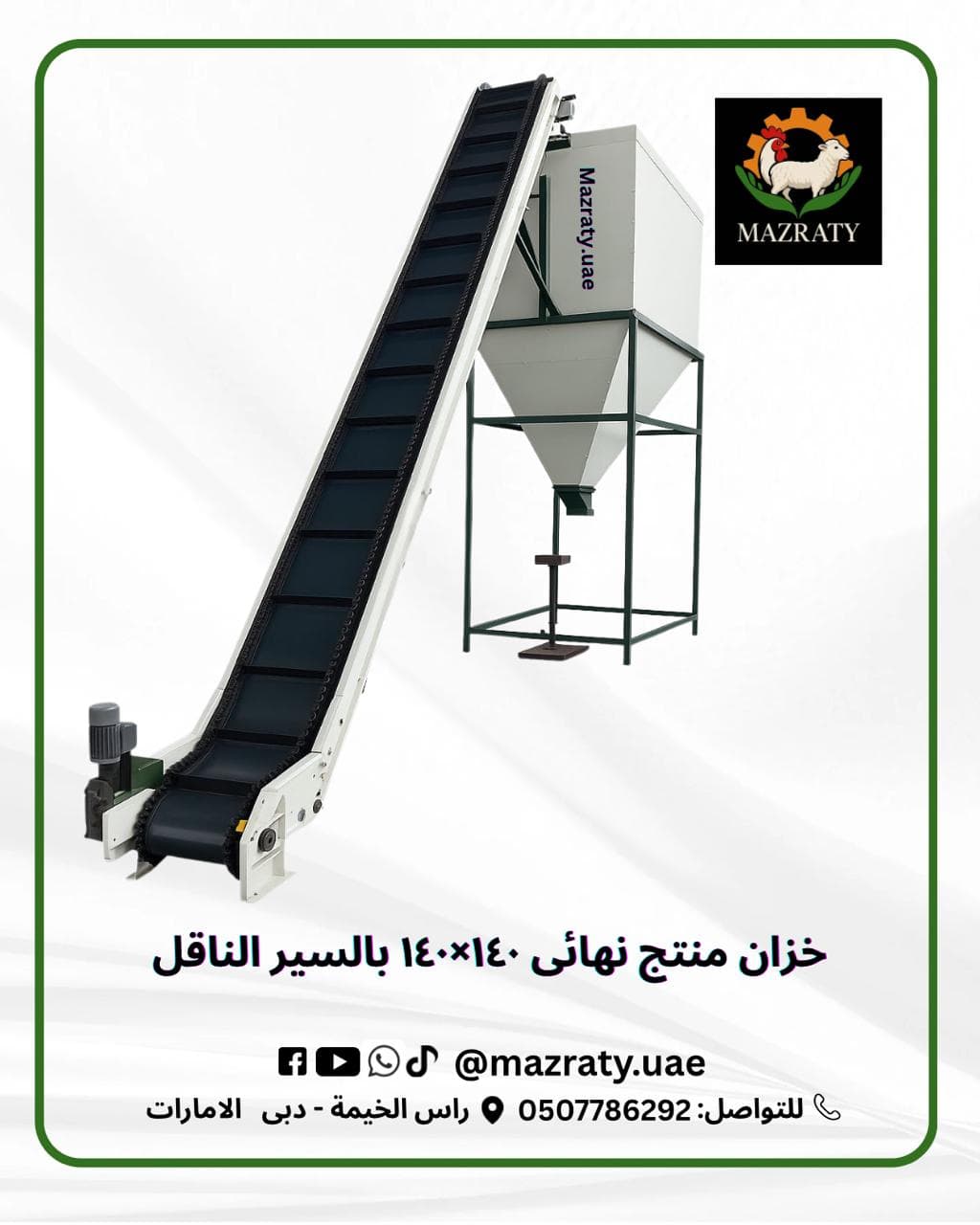
How to select a feed mill bucket elevator and coordinate capacity, layout, maintenance access and protection with the full production line.
A feed mill bucket elevator must handle peak material flow without becoming the line bottleneck. Check bulk density, lift height, inlet and discharge layout, plus belt and bucket access.
Why Feed Handling Equipment Is the Backbone of Any UAE Feed Mill
A feed mill's visible machinery — hammer mills, mixers, pellet presses — earns all the attention, but the handling system is what keeps those machines fed. Every tonne of raw grain that enters your plant must be lifted, conveyed, screened, and redistributed at least four to six times before it leaves as a finished bag of pellets. In the UAE, where ambient temperatures regularly exceed 45 °C in summer and fine limestone dust from desert winds adds to the abrasive load, handling equipment that is merely adequate on paper can become a bottleneck in practice. Mazraty designs and installs complete handling systems — from the receiving pit intake auger to the bagging station weigh hopper — sized to match the throughput of your process machines and hardened for Gulf operating conditions.
Bucket Elevators: Vertical Lifting from Receiving Pit to Top Bin
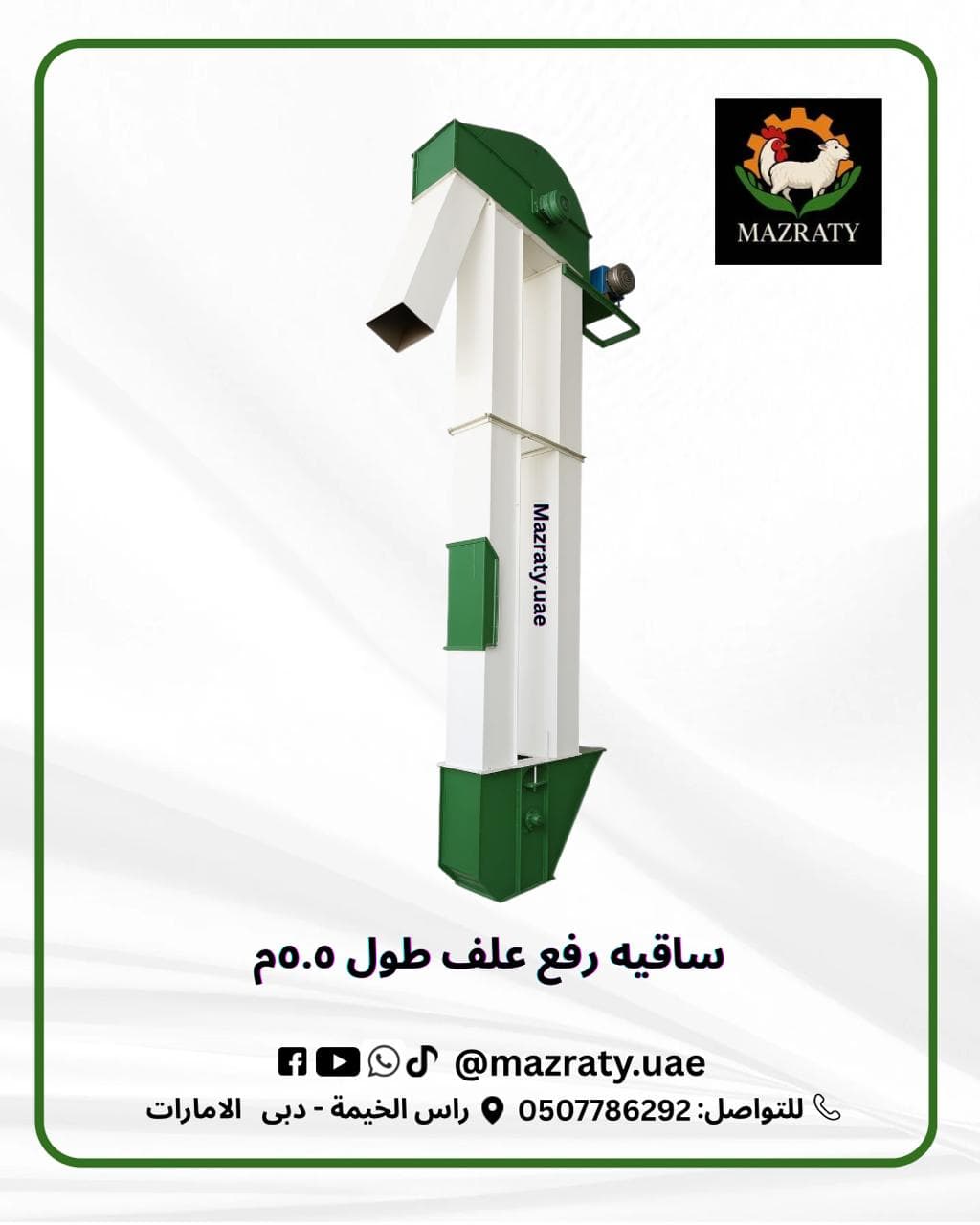
The bucket elevator is the tallest and most critical element in any feed mill layout. It takes material from floor level and delivers it to the head house at heights of 10 to 40 metres, feeding the gravity distribution network that supplies every machine below. Selecting the wrong type or sizing it incorrectly creates a permanent bottleneck that no downstream upgrade can fix.
Centrifugal Bucket Elevators
Centrifugal discharge elevators are the standard choice for free-flowing granular materials: whole grains (maize, barley, sorghum, wheat), coarse meals, and finished pellets above 3 mm. Buckets are spaced far apart on a continuous belt or chain and travel at 1.2 to 2.0 m/s. At the head pulley, centrifugal force flings material out of each bucket and into the discharge spout. Capacities range from 5 to 50 tonnes per hour for standard models, with bucket widths from 200 mm to 600 mm. The key advantage is high speed and low cost per tonne lifted. The key limitation is that fragile products — crumble, small pellets, or fish feed — suffer breakage in the throw.
Continuous (Slow-Speed) Bucket Elevators
Continuous elevators carry buckets with no spacing gap; adjacent buckets form a continuous trough. Head speed is reduced to 0.4 to 0.8 m/s, and material discharges gently by gravity over the back of each bucket rather than by centrifugal throw. This design is mandatory for fragile crumble, fine powders, and materials above 80 °C leaving a dryer or cooler. Continuous elevators cost 30–40 % more than centrifugal models of equal capacity but protect product integrity and reduce fines generation. For UAE poultry crumble or aquafeed, the investment pays back in reduced reprocessing.
Head and Boot Section Design
The head section houses the drive pulley or sprocket, the discharge spout, and the inspection hatch. A properly designed head has a back plate that prevents material recirculation (dribble-back), a sealed bearing housing rated IP65 or higher for dusty environments, and an access door large enough for bucket replacement without removing the belt. The boot section at the bottom contains the take-up pulley, the inlet throat, and the self-cleaning sump. A common failure point in UAE mills is boot flooding — when the intake rate exceeds the elevator capacity, grain piles up in the boot and the belt slips off the pulley. Properly sized boot inlets with a controlled feed gate prevent this. Boot bearings should be plummer block type with labyrinth seals and a grease purge path to expel abrasive dust.
Belt versus Chain Drive
Rubber-impregnated textile belts dominate installations up to 25 metres and 30 tonnes per hour. They are lighter, quieter, and easier to splice in the field. Chain (steel or engineering plastic) is specified for heights above 25 m, heavy abrasive materials (mineral premix, bone meal), and ambient temperatures above 50 °C where rubber degrades. UAE coastal mills should specify SS304 bucket bolts regardless of belt or chain choice — standard carbon steel bolts corrode through in less than two years in the salt-laden air of Ras Al Khaimah and the northern coast.
Horizontal Conveyors: Choosing the Right Type for Each Duty
Once material reaches the head house, gravity spouts and horizontal conveyors distribute it to bins and process machines. Three technologies dominate feed milling: screw (auger) conveyors, chain drag conveyors, and belt conveyors. Each has a distinct profile of dust generation, product attrition, capacity ceiling, and maintenance burden.
Screw (Auger) Conveyors
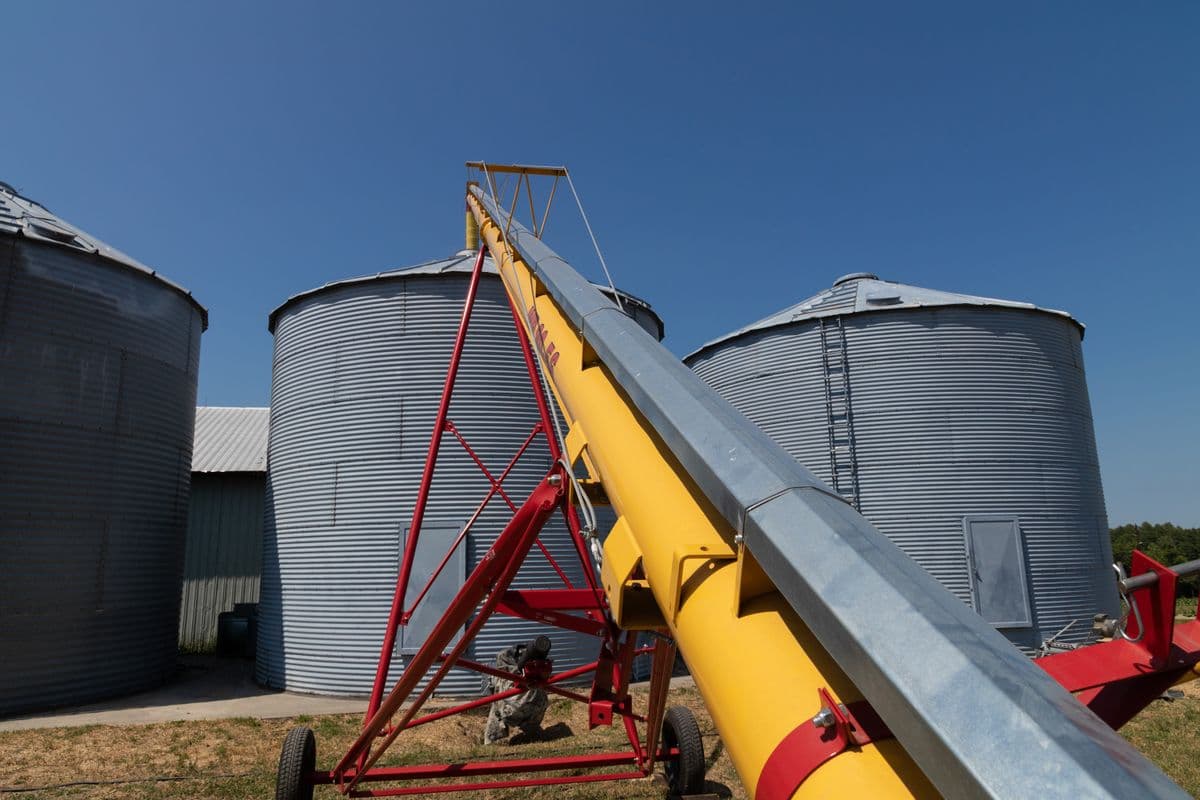
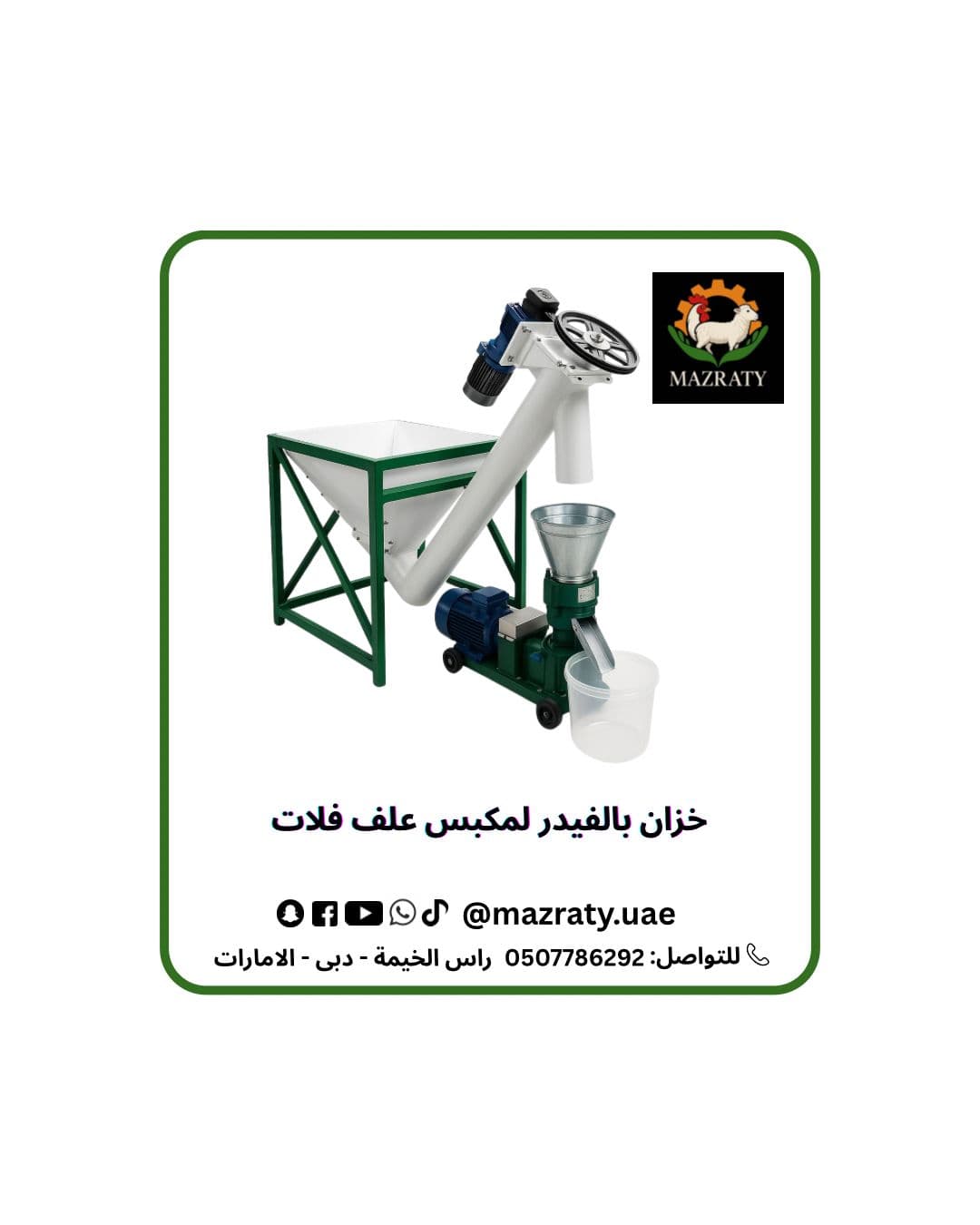
A screw conveyor is a helical flight rotating inside a U-trough or sealed tube. Capacities run from 1 to 30 tonnes per hour for standard diameters (150 mm to 400 mm). Screws are compact, self-enclosed (no open top), and capable of conveying at angles up to 20 degrees
Chain Drag (En-Masse) Conveyors
An en-masse drag conveyor moves a mass of product on a flat-link chain inside a sealed rectangular casing. The chain travels at low speed (0.1 to 0.3 m/s), and the product mass moves with it by internal friction rather than mechanical pushing. This low-shear action produces minimal breakage, making drag conveyors ideal for pelleted and crumbled feeds. They are also fully enclosed, which matters for dusty environments. Capacities reach 50 tonnes per hour in large casings. The maintenance cost is the chain itself — UAE mills running 20 hours per day should budget chain replacement every 18 to 24 months and keep one full chain set on the shelf.
Belt Conveyors
Flat or troughed rubber belt conveyors are the workhorse for outdoor raw material handling — moving grain from a truck discharge pit to a covered intake bin, or shifting finished bags on a picking line. They are gentle on product, energy-efficient at high tonnages, and easy to inspect visually. Their vulnerability in UAE conditions is the open belt surface: desert wind carries fine sand that embeds in the belt surface and accelerates pulley lagging wear. Enclosing outdoor belt conveyors with a steel hood and fitting a belt scraper at the head pulley extends lagging life from 6 months to 2–3 years. Internal plant belt conveyors should be fitted with dust skirts at transfer points to contain spillage.
Pneumatic Conveying for Long Distances and Tight Layouts
When horizontal distances exceed 50 metres, or when the plant layout requires conveying material through walls, over equipment, or around obstacles where mechanical conveyors would require multiple transfers, pneumatic conveying becomes practical. A dilute-phase pneumatic system uses a positive-displacement blower to push air at 0.5 to 1.0 bar through a pipeline of 100–200 mm diameter, entraining material and carrying it to a cyclone or filter receiver at the destination bin.
Capacities of 2 to 15 tonnes per hour are achievable in dilute phase. The main costs are electrical energy (a 15 kW blower moving 5 t/h consumes roughly 3 kWh per tonne, versus 0.4 kWh per tonne for a belt conveyor) and filter maintenance. Dense-phase systems operate at higher pressure (2 to 4 bar) with lower air velocity, dramatically reducing product breakage — essential for fragile fish pellets or mineral premix. Mazraty's engineering team calculates the optimal conveying velocity and pipe diameter for each material, ensuring the system avoids the two failure modes: saltation (material drops out of suspension in low-velocity zones) and excessive wear (pipeline bends eroded by high-velocity abrasives).
Complete Material Flow Sequence in a UAE Feed Mill
Understanding the full flow sequence lets you size every handling component correctly and avoid mismatch penalties — the hidden cost when a bottleneck in one stage starves the next machine.
| Stage |
Typical Equipment |
Key Sizing Parameter |
| 1. Receiving |
Pit intake screw or drag chain, intake elevator |
Truck offload rate: 30–60 t/h |
| 2. Pre-cleaning |
Rotary or vibrating scalper screen |
Match intake elevator capacity |
| 3. Raw material storage |
Flat-bottom or hopper-bottom steel silos |
7–14 days of daily throughput |
| 4. Grinding |
Hammer mill, proportioning screw feeders |
Mill output: 2–15 t/h per unit |
| 5. Micro-ingredient dosing |
Loss-in-weight feeders, ribbon blender |
Dosing accuracy ±0.1 % |
| 6. Mixing |
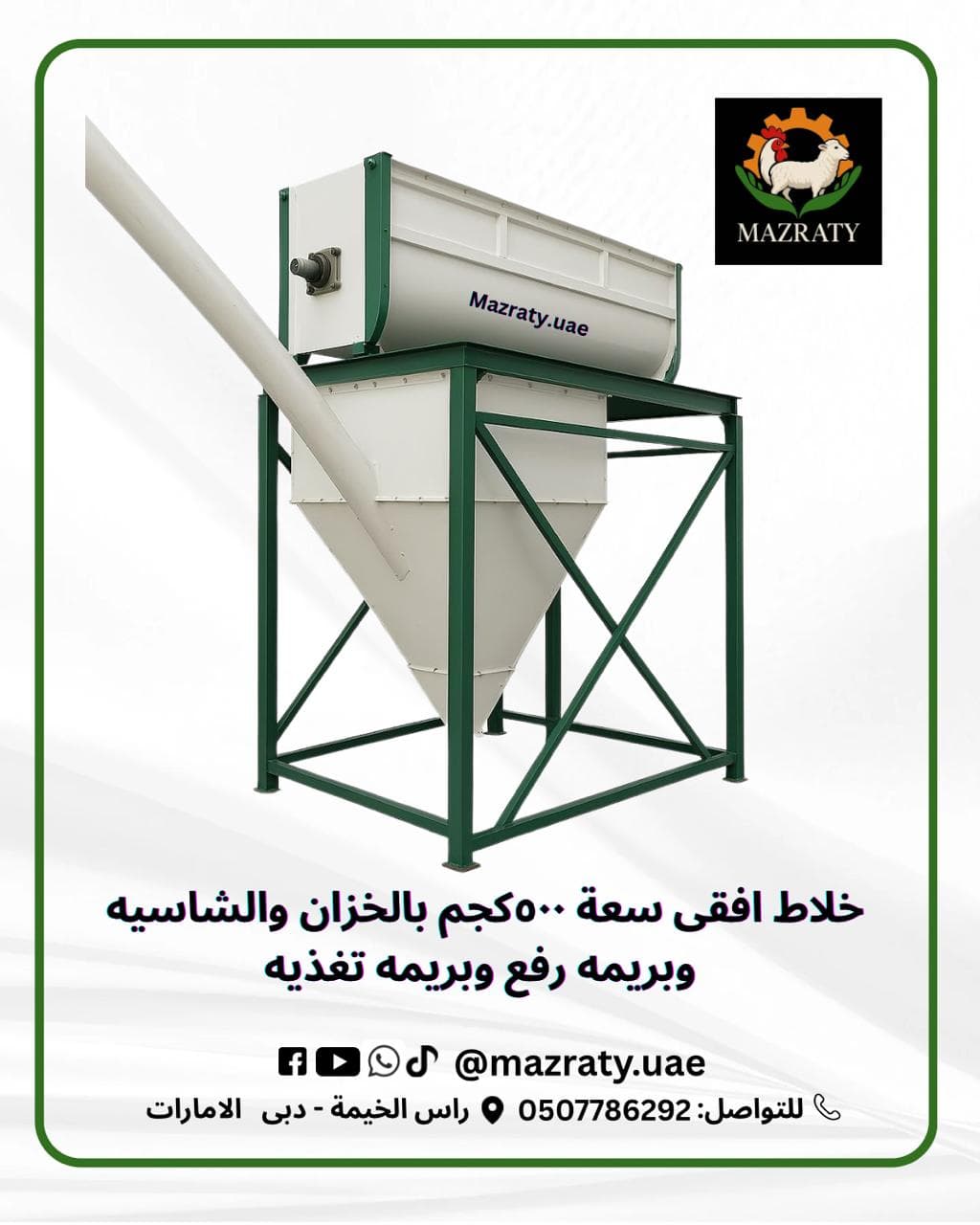
Horizontal paddle or twin-shaft mixer |
Batch time 3–4 min, CV ≤5 % |
| 7. Pelleting |
Conditioner + ring-die pellet press |
Press output: 1–10 t/h |
| 8. Cooling |
Counter-flow cooler |
Pellet temp ≤ ambient +5 °C |
| 9. Sieving / Crumbling |
Pellet sieve + crumbler rolls |
Fines return to conditioner |
| 10. Finished product storage |
Finished-product silos or bins |
1–3 days of daily production |
| 11. Bagging / Bulk loading |
Weigh-fill bagger or bulk spout |
Bag rate: 200–600 bags/h |
Every transition between stages requires a handling component — elevator, conveyor, or pneumatic line. The receiving elevator must outpace the truck offload rate; the intake conveyor to the hammer mill must match the mill's nominal capacity; the pellet cooler outlet elevator must keep pace with the press output. Mazraty performs a capacity cascade calculation for each project, starting from the desired daily production target (in tonnes per day) and working backwards to size every component with a 20 % design margin above the rated throughput of the process machine it serves.
Dust Collection and Aspiration Systems
Feed dust in the UAE context carries a double risk: explosion hazard (grain dust above 50 g/m³ is explosive) and respiratory health for workers. Every elevator head, every conveyor transfer point, and every sifter must be connected to an aspiration network. A central pulse-jet bag filter collects the dust-laden air from all pick-up points. Filter sizing is based on air volume — typically 1,200 to 1,800 m³/h per pick-up point — and cloth area is calculated to keep face velocity below 1.2 m/min on the fabric surface.
In the UAE's high humidity coastal zones (Ras Al Khaimah humidity can exceed 85 % RH in August), standard woven polyester filter bags can blind with damp dust within days. Mazraty specifies PTFE membrane overlay bags for coastal installations — they surface-filter rather than depth-filter, making cleaning more effective and extending bag life from 12 months to 3–4 years. The recovered dust from the filter hopper is returned to the product stream via a rotary airlock, maintaining zero waste.
UAE-Specific Bearing and Seal Selection
Standard open-frame bearings used in European or North American feed mills fail rapidly in UAE conditions for two reasons: abrasive desert dust and salt-laden coastal air. Mazraty specifies the following standards for all UAE handling equipment installations:
- Bearing housing material: Cast iron for inland plants; SG iron or stainless for coastal (within 5 km of sea)
- Sealing: Triple-lip labyrinth seal with grease purge fitting; replace standard felt seals
- Grease specification: High-temperature lithium complex, NLGI Grade 2, rated to 180 °C for elevator head bearings near steam conditioners
- Re-lubrication interval: Every 250 operating hours in dusty conditions (versus 1,000 hours in clean environments)
- Corrosion protection: All external fasteners in A2-70 stainless; painted surfaces with 2-coat epoxy (primer + topcoat, 180 µm DFT)
Safety Devices: Non-Negotiable on Every Elevator
UAE labour regulations and international feed mill safety standards require specific protective devices on all bucket elevators:
- Anti-runback (backstop) device: A mechanical ratchet on the head shaft prevents the loaded belt from reversing under gravity when power is cut — preventing a boot-flooding cascade
- Belt slip / speed monitor: A proximity sensor on the boot shaft triggers a shutdown if belt speed falls below 80 % of set speed — the first sign of belt slip or overload
- Belt alignment switches: Mounted at head and boot; shut down the drive if the belt tracks more than 25 mm off-centre
- Inspection hatches: At minimum, one per 6 metres of casing height; hinged and tool-free openable for bucket and belt inspection without full disassembly
- Belt tensioner: Gravity take-up (preferred) or spring take-up maintains constant belt tension across the temperature range — important in UAE where the temperature swing from 20 °C midnight to 48 °C afternoon changes belt length by up to 8 mm per 10 metres
- Explosion venting panels: On elevator casing for grain dust; area calculation per ATEX or NFPA 61
Matching Capacity Between Hammer Mill, Mixer, and Pellet Press
The most common handling system mistake in UAE feed mills is installing an undersized elevator between the hammer mill and the meal bin, or between the mixer and the pellet press surge hopper. The calculation is straightforward but must account for peaks, not averages.
Example: A 5 t/h pellet press running 20 hours per day produces 100 tonnes of finished product. The mixer feeding it typically operates on a 4-minute batch cycle with a 2-tonne batch — that is 30 tonnes per hour of instantaneous meal discharge into the surge hopper elevator, even though the press only absorbs 5 t/h on average. The elevator between mixer and press must be rated for at least 35 t/h (30 t/h + 20 % margin) to absorb the batch discharge peak. Undersizing this elevator to 6 t/h — matching the press — causes the mixer to wait for the elevator to clear, destroying batch cycle efficiency and reducing daily output by 20–30 %.
Mazraty's engineering team uses a batch timing simulation for every new plant to identify peak flow points before ordering equipment. This service is included at no additional charge for customers purchasing handling systems through Mazraty.
Mazraty: Complete Feed Handling Systems for UAE and Gulf Markets
Mazraty is Ras Al Khaimah's specialist supplier for farm and feed production equipment, with hands-on installation experience across poultry, dairy, and aquafeed operations throughout the UAE. Our handling system offering covers centrifugal and continuous bucket elevators, screw and drag chain conveyors, pneumatic conveying lines, pulse-jet bag filters, and the associated structural steelwork and electrical controls. Every system is sized to your production target and your site conditions — ambient temperature, humidity, available headroom, and power supply — not to a generic catalogue specification.
Whether you are building a new feed mill from the ground up, replacing a bottleneck conveyor in an existing plant, or adding a pellet sieving and aspiration circuit, Mazraty's team will survey your site, prepare a layout drawing and equipment schedule, and manage the installation to commissioning. Contact us today on WhatsApp +971 50 535 3412 to arrange a site visit or to request a capacity calculation for your next handling project.
Reviewed planning sources
These references support operating and welfare principles. Final design and health programs remain site-, strain-, authority- and veterinarian-specific.
Frequently Asked Questions
How can an elevator avoid bottlenecking the line?
Size it for peak flow and bulk density, and coordinate inlet and outlet capacity with the mill, mixer and pellet press.
What maintenance points matter most?
Monitor belt tension, bucket alignment, bearings, sensors and cleanliness, with energy isolated before access.