Complete engineering guide for poultry house cooling system design in UAE — tunnel ventilation, airspeed targets, negative pressure, fan staging, emergency power. Contact Mazraty: +971 50 535 3412
Poultry House Cooling System Design in the UAE: A Complete Engineering Approach
The United Arab Emirates presents one of the world's most demanding environments for poultry production. Summer temperatures in Ras Al Khaimah and across the UAE regularly exceed 48 degrees Celsius, while coastal humidity climbs above 90% during July and August. In this extreme climate, relying on evaporative cooling pads alone or fans in isolation is simply not enough. What poultry farms in the UAE genuinely need is an integrated engineering system that combines tunnel ventilation principles, negative pressure management, staged fan control protocols, and non-negotiable emergency power provisions.
At Mazraty, with over 20 years serving UAE poultry farms, we see the greatest losses stem not from missing equipment but from poorly engineered systems. This article provides a thorough engineering walkthrough so you can design a house that withstands the UAE summer.
Part One: Tunnel Ventilation — The Scientific Foundation
Tunnel ventilation is the gold standard for poultry houses in hot climates. The core concept creates a unidirectional airflow along the long axis of the house, from the wet wall (cooling pads) at the inlet end to the exhaust fans at the far end. This airflow works through two complementary mechanisms:
- Evaporative Cooling: Hot, dry incoming air passes through water-saturated cellulose pads and drops 8 to 12 degrees Celsius before entering the bird zone.
- Wind Chill Effect: Even when the temperature drop is limited on humid days, accelerating airflow over the bird's body significantly improves its ability to shed metabolic heat through convection.
The real difference lies in the precise numbers. Airflow that is too slow does not cool. Airflow that is too fast stresses birds. The correct engineering equation starts here.
Part Two: Airspeed Targets by Bird Type
Optimal airspeed is not universal. Each species has its own physiological requirements:
Broiler Chickens
- Weeks 1-2: No tunnel ventilation — minimum ventilation only with house temperature 32-33 degrees Celsius.
- Weeks 3-4: Target airspeed 1.0 to 1.5 meters per second.
- Weeks 5-6: Target airspeed 2.0 to 2.5 meters per second.
- Week 6 and beyond (especially July-August): Target airspeed of 2.5 meters per second or above during peak heat hours.
Layer Hens
- Adult birds: 1.5 to 2.0 meters per second.
- Chicks: Maximum 0.3 to 0.5 meters per second.
Turkeys
- Due to larger body mass and higher metabolic heat production: 2.0 to 3.0 meters per second.
Critical engineering note: the speeds listed refer to airspeed at bird level (approximately 0.3 meters above litter), not at fan discharge. Velocity losses along the length of a long house require careful calculation when selecting fan diameter and placement.
Part Three: Airflow Rate — CFM Per Kilogram of Bodyweight
The most accurate metric for fan system design is calculating airflow in CFM (Cubic Feet per Minute) relative to the total live weight inside the house. This standard is more objective than bird count alone because it accounts for actual metabolic heat production.
Core Formula:
- Broilers (2.5 kg average): 5.5 to 7.0 CFM per kilogram of bodyweight.
- Layers (1.8 kg average): 4.5 to 6.0 CFM per kilogram.
- Turkeys (10-15 kg): 4.0 to 5.5 CFM per kilogram.
Practical Example for a UAE House:
A broiler house with 20,000 birds at an average market weight of 2.3 kg:
- Total live weight: 20,000 x 2.3 = 46,000 kg
- Required airflow at upper limit: 46,000 x 7 = 322,000 CFM
- Converted to cubic meters per second: 322,000 divided by 2,119 = approximately 152 cubic meters per second
This figure is the design reference for selecting fan count and diameter. Fifty-inch (127 cm) fans rated at 24,000 CFM each would require approximately 14 units to reach this target airflow.
Part Four: Negative Pressure — The 20-50 Pascal Standard
Negative pressure inside the house is the key to successful tunnel ventilation. It means the interior pressure is lower than outside, forcing all incoming air exclusively through the cooling pad inlet openings rather than through any gaps or cracks.
Target Pressure Levels:
- 20-25 Pascals: Basic ventilation on moderate days — fan stages 1-2 running.
- 30-40 Pascals: Full cooling during peak heat — all primary fans running.
- 40-50 Pascals: Emergency mode — additional or backup fans activated.
Above 50 Pascals indicates that inlet openings are too small — inlet velocity increases but total air volume decreases. Below 20 Pascals indicates structural air leaks that compromise the directional airflow pattern.
Measuring Negative Pressure in Practice:
A differential pressure manometer (magnehelic gauge) mounted on a side wall provides the reading. Proper operation produces a steady reading within the target range, not a fluctuating one. Fluctuation indicates air leaks in the building envelope.
Sizing Cooling Pad Inlet Area:
The formula is: inlet area (square meters) = airflow rate (cubic meters per second) divided by target inlet velocity (1.5 meters per second). Increasing inlet area lowers negative pressure; reducing it raises pressure.
Part Five: Fan Staging Controls — A UAE Protocol
Fans should never all turn on simultaneously. Staged operation ensures precise temperature control, prevents thermal shock to birds, and reduces energy costs during the months when UAE electricity bills are highest.
A Four-Stage Model for July Operations in the UAE:
- Stage 1 — Minimum Ventilation: Activates at 26 degrees Celsius. Two to three fans run at the exhaust end only, ensuring minimum oxygen levels and removing carbon dioxide and ammonia. Airflow is 15-20% of maximum capacity.
- Stage 2 — Early Cooling: Activates at 29-30 degrees. Forty to fifty percent of fans running, plus cooling pad pumps start.
- Stage 3 — Full Cooling: Activates at 32-33 degrees. Seventy-five to 85% of fans running at full capacity with all pad pumps at maximum.
- Stage 4 — Emergency Mode: Activates at 35 degrees or above — all primary fans plus backup fans running at full capacity.
This staged control is managed electronically through a control unit linked to multiple temperature and humidity sensors distributed along the house length — not a single sensor that produces a biased average reading.
Part Six: Cooling Pad Design for UAE Climate
Cooling pads are the air inlet of the tunnel ventilation system. Errors in pad design undermine the entire system.
Local Design Standards:
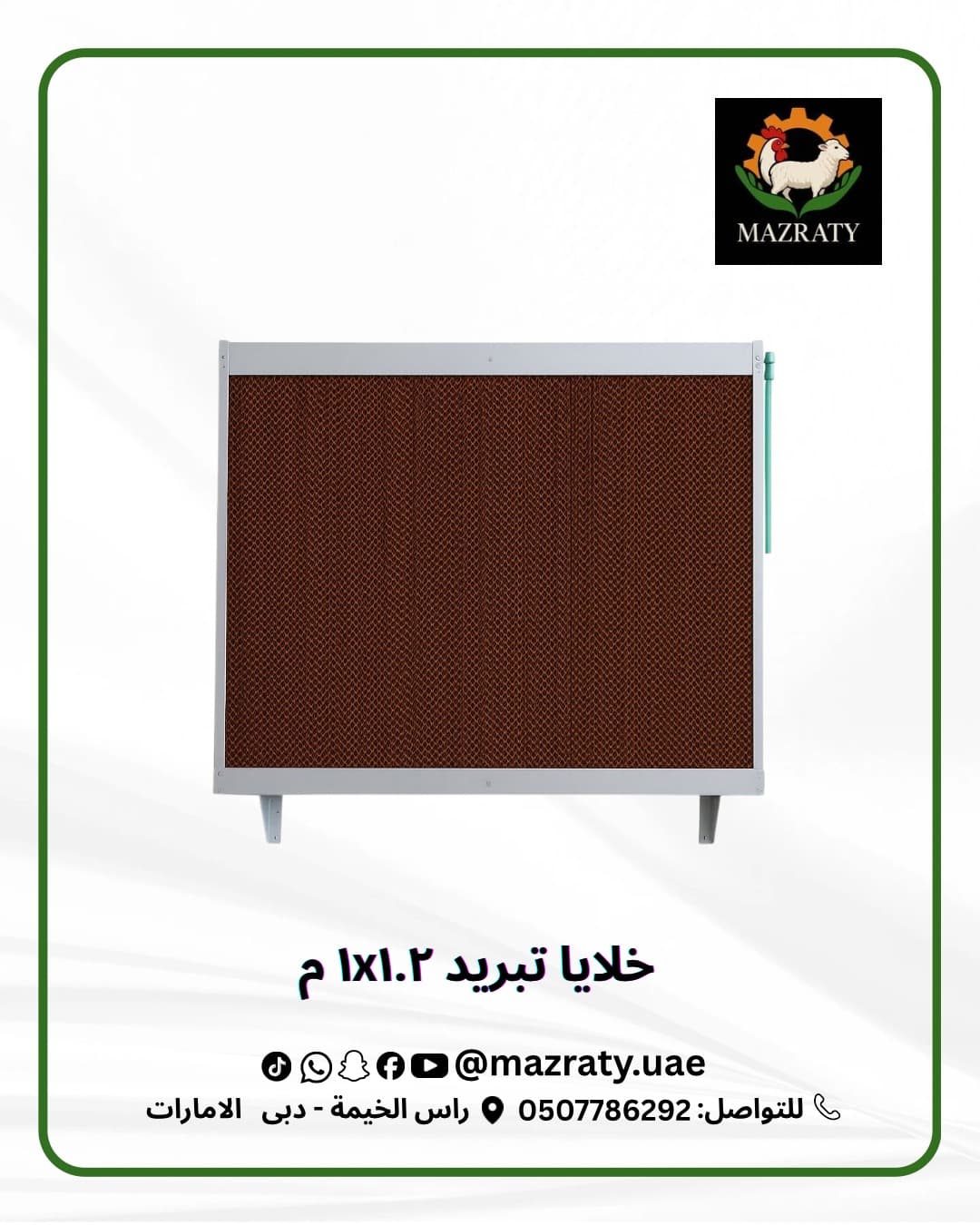
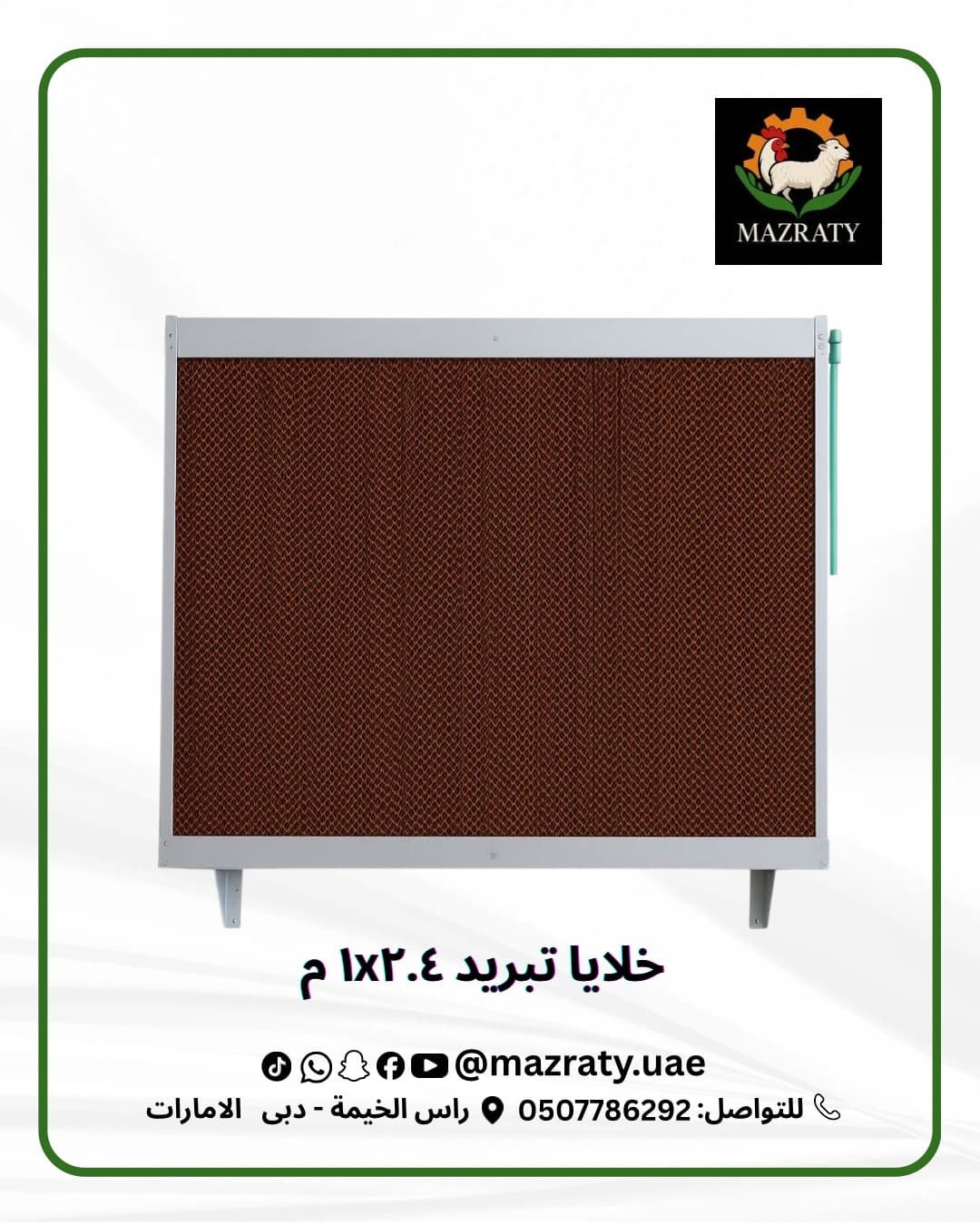
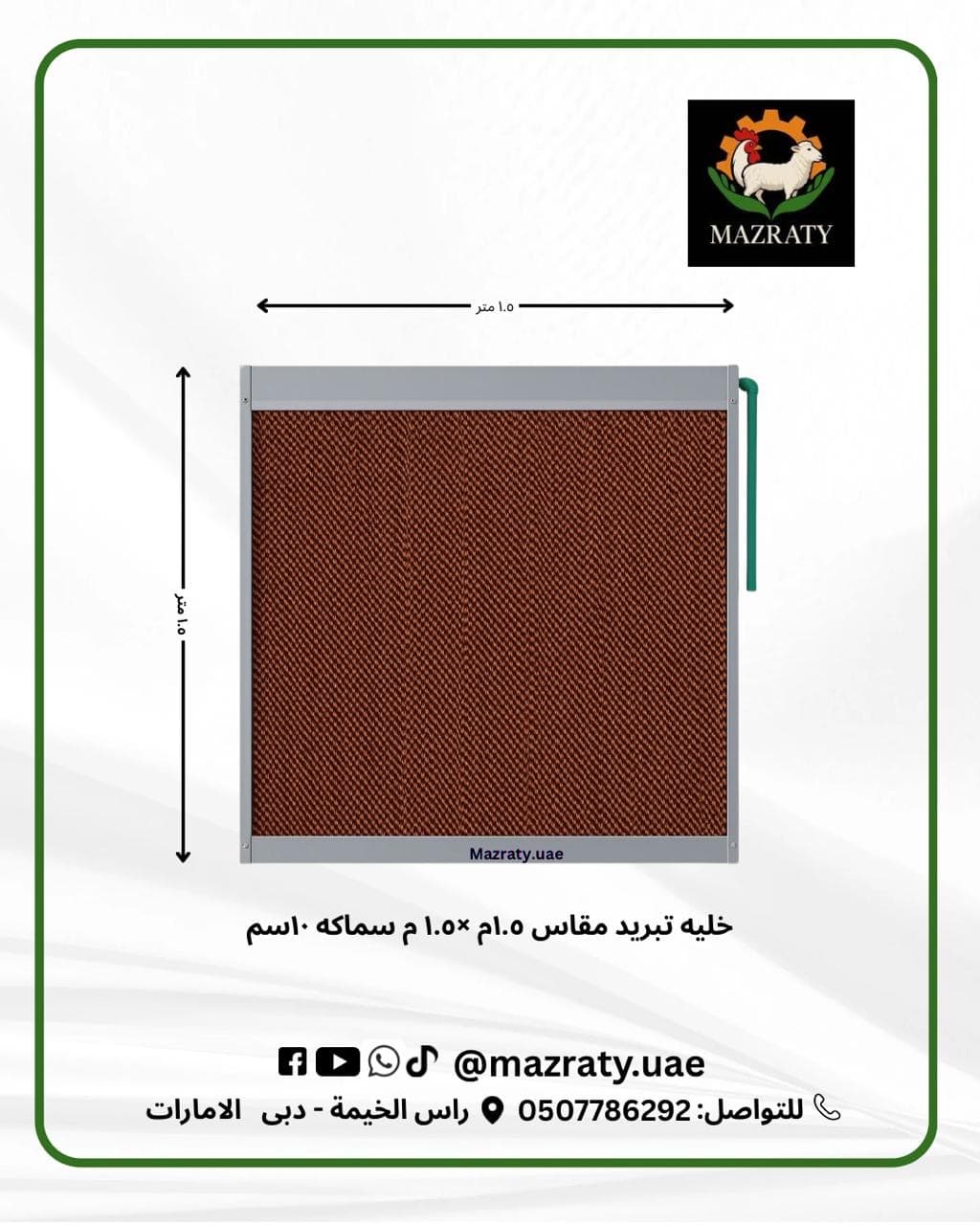
- Pad thickness: 15 cm (6 inches) is the minimum for UAE conditions. Thinner 10 cm pads do not provide sufficient cooling on high-humidity August days.
- Face velocity: 1.0 to 1.25 meters per second through the pad face. Higher velocities overload the pad and reduce cooling efficiency.
- Water distribution system: Must deliver uniform flow across the full pad width. Uneven pressure along the header pipe leaves dry patches that allow uncooled air to enter.
- Water quality: UAE desalinated and municipal water contains elevated mineral content. Install sediment filters and a bleed-off system to prevent calcium carbonate scaling that can clog pad media within three months during UAE summers.
Contact Mazraty on WhatsApp +971 50 535 3412 for cooling pad specifications and installation in UAE conditions.
Part Seven: Emergency Power — Non-Negotiable for UAE Summer
Power outages can last minutes or hours. In July and August, birds operating at full metabolic capacity in 40-degree heat cannot tolerate a loss of cooling for more than 15 to 20 minutes without severe losses.
Emergency Power System Standards for UAE Farms:
- Primary backup generator: Must start and transfer load within 10-15 seconds via an Automatic Transfer Switch (ATS). Capacity must cover at least fan stages 3 and 4 for all houses on the farm.
- Fuel storage: Diesel tank sized for a minimum of 24 hours of full-load operation. Calculate accurately: a 100 kW generator consumes approximately 25-28 liters per hour under full load.
- Load priority: If backup capacity is limited, exhaust fans take priority over pad pumps, followed by water supply pumps.
- Alert system: Temperature sensors linked to SMS or WhatsApp alerts notify the farm manager immediately when house temperature rises more than 2 degrees above target setpoint.
Mazraty provides complete backup power solutions integrated with automatic control systems. Contact us on WhatsApp +971 50 535 3412 to assess your farm's emergency power requirements.
Part Eight: House Engineering — Dimensions and Orientation
Even the best equipment will underperform in a poorly designed structure.
Optimal Orientation in the UAE:
Orient the long axis of the house (the tunnel ventilation axis) east-west. This means the two long side walls face north and south, minimizing direct solar radiation on the building envelope and reducing the radiant heat load that fans and pads must overcome.
Length-to-Width Ratio:
Long, narrow houses are far more efficient in tunnel ventilation than wide, short ones. The ideal ratio is 10:1 to 12:1 (length to width). A house 12 meters wide should be 120-144 meters long to achieve target airspeed throughout.
Roof Insulation:
In the UAE, roof insulation is not optional. Sandwich panels 10 cm thick (U-value 0.35 W/m squared K or lower) reduce the radiant heat load by up to half compared to bare steel cladding. This directly translates to a reduction in the number of fans required to maintain target temperatures.
Part Nine: Managing High Humidity Days — UAE-Specific Protocol
On days with high relative humidity above 75%, evaporative pads lose significant efficiency because the incoming air is already moisture-laden and cannot absorb much additional evaporation. On these days:
- Shift focus from evaporative cooling to maximizing wind chill effect.
- Run all fans at full speed to maximize airspeed over birds.
- Reduce pad wetting rate to avoid adding further humidity to already saturated air.
- Accept that effective temperature reduction will be lower than on dry days — compensate with maximum airspeed.
A smart control system handles this automatically through integrated humidity sensors — an additional reason why automatic control is not a luxury in UAE poultry operations.
Part Ten: Common Design Errors in UAE Poultry Houses
- Placing cooling pads on side walls instead of the end wall: This creates cross-ventilation rather than tunnel ventilation and eliminates the directional negative pressure effect.
- Inadequate building sealing: Unsealed lighting slots, poorly fitting doors, or gaps in wall panels allow hot air infiltration from the sides, destroying the directional airflow pattern.
- Single temperature sensor: One sensor in the house center provides a misleading average. Sensors must be distributed every 15-20 meters along the tunnel axis.
- Neglecting pad maintenance: In UAE conditions, calcium scaling clogs pad media within a single season without regular cleaning.
Installation Cost Estimates in the UAE (AED)
The following figures are indicative for a broiler house 100 meters long by 12 meters wide, capacity 20,000 birds:
- Tunnel ventilation fans 14 x 50-inch units: AED 45,000 to 60,000.
- Cellulose cooling pads 15 cm thick, 90 square meter area: AED 18,000 to 25,000.
- Automatic control system with sensors: AED 8,000 to 15,000.
- ATS unit and 80 kW diesel generator: AED 35,000 to 55,000.
- Installation, wiring, and pipework: AED 15,000 to 25,000.
- Estimated total: AED 121,000 to 180,000.
To put this in perspective: a 20,000-bird broiler house has a market value exceeding one million AED at harvest. Investing in an integrated cooling system protects that asset and improves feed conversion ratio by 5-8% over the summer months — a return that pays for the system within a single production cycle.
Contact the Mazraty team on WhatsApp +971 50 535 3412 for a detailed quotation tailored to your farm. Free delivery across all UAE.
Reviewed planning sources
These references support operating and welfare principles. Final design and health programs remain site-, strain-, authority- and veterinarian-specific.
Frequently Asked Questions — Poultry House Cooling Systems in the UAE
What is the difference between cross-ventilation and tunnel ventilation?
Cross-ventilation places fans and cooling pads on the two long side walls — air travels across the width of the house. Tunnel ventilation places them at opposite ends — air travels the full length. Tunnel ventilation achieves higher and more uniform airspeed, provides controlled negative pressure throughout, and is the accepted standard for hot-climate poultry production in the UAE and worldwide.
How many fans do I need per square meter of floor space?
The correct calculation is based on live bird weight, not floor area. A practical rule of thumb: one 50-inch fan rated at 24,000 CFM per 1,400 to 1,600 broilers at a market weight of 2.5 kg. Contact Mazraty on WhatsApp +971 50 535 3412 for a precise calculation for your house dimensions and bird type.
Can I rely on cooling pads alone without tunnel ventilation fans in the UAE?
No. Cooling pads without negative-pressure tunnel fans are essentially just wet panels. The pad cools air at the entry point only — without fans creating negative pressure to pull that cooled air through the house, hot air infiltrates from all directions and the cooled air never reaches birds in the middle or far end of the house.
How often should cooling pads be serviced in UAE conditions?
Monthly air-pressure cleaning is recommended during summer operation. A deep cleaning with a mild acid solution (1-2% citric acid) every three months dissolves calcium carbonate scale. Pads operating on UAE municipal or desalinated water without regular maintenance lose 30-40% of their rated efficiency within a single summer season.
What size backup generator do I need for a 20,000-bird house?
A 20,000-bird broiler house with 14 exhaust fans, 14 pad pumps, water supply pumps, and lighting draws 75-90 kW at peak load. A 100 kW generator provides adequate reserve capacity. Contact Mazraty on WhatsApp +971 50 535 3412 for a precise load calculation based on your specific equipment list. We supply and install complete backup power systems with delivery across all UAE.
Does negative pressure affect bird health or welfare?
Negative pressure in the 20-50 Pascal range is completely safe and imperceptible to birds. Pressures above 50 Pascals may reduce respiratory comfort for very young chicks. Proper control through sensors and an automatic control unit prevents exceeding the safe range under all operating conditions.