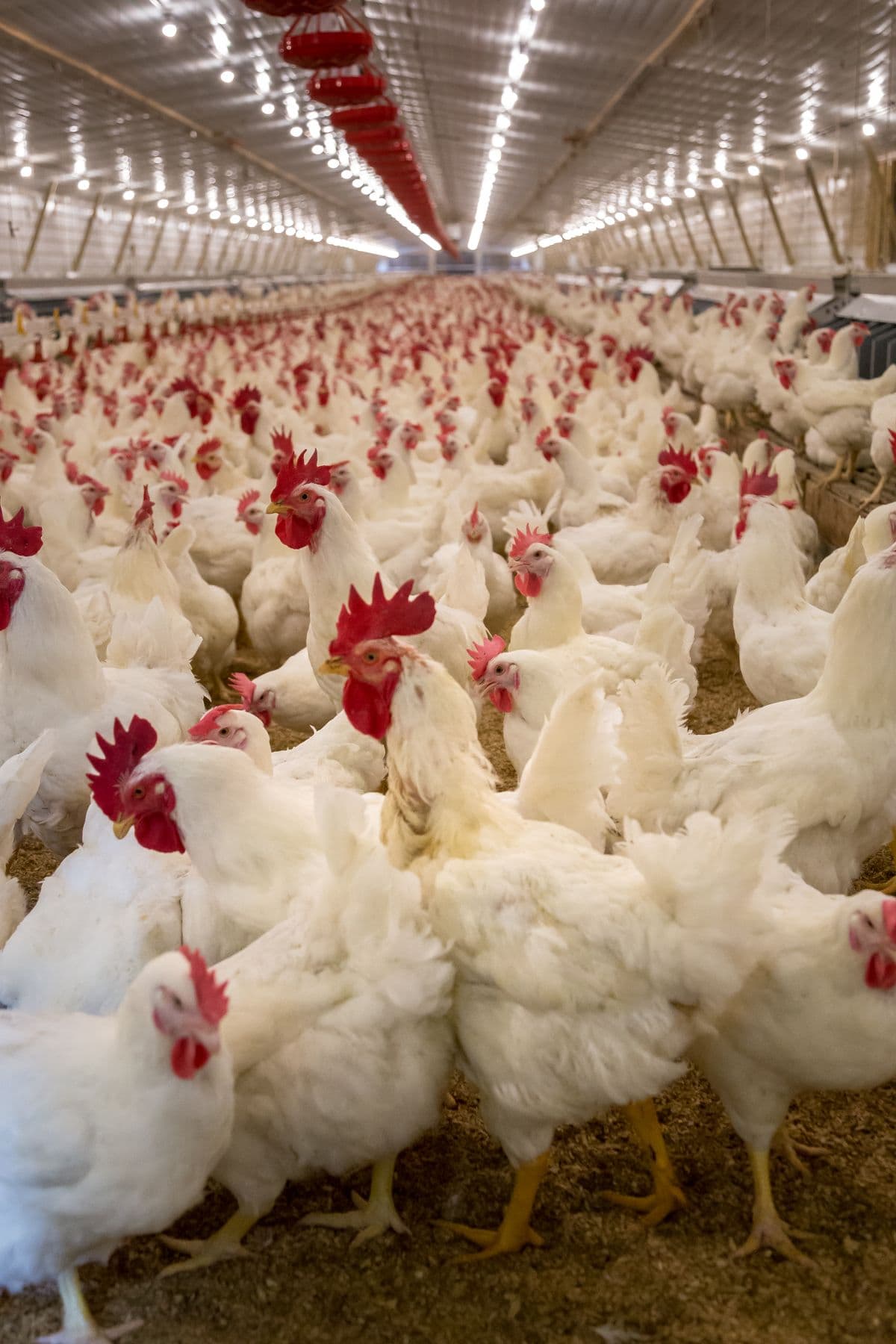
UAE summers are not a seasonal inconvenience for poultry farmers — they are a survival test. When ambient temperatures in Ras Al Khaimah, Sharjah, and the inland Emirates regularly breach 45°C between June and August, a single equipment failure inside a broiler or layer house can kill thousands of birds within two hours. The financial exposure is real: a 10,000-bird broiler house losing its cooling system at 3PM on a July afternoon represents upward of AED 90,000 in live inventory alone, before accounting for disposal costs, downtime, and loss of the production cycle. This operational checklist walks UAE poultry farmers through a month-by-month, week-by-week preparation program starting in April — two full months before peak heat arrives. It covers every system that must be inspected, serviced, calibrated, or replaced: exhaust fans, evaporative cooling pads, water lines, thermostats, generators, shade structures, and emergency response protocols. Follow this guide and you enter summer with confidence, not anxiety.
Why Pre-Summer Preparation Is Non-Negotiable in the UAE
The UAE's climate imposes a unique and severe stress on poultry production infrastructure. Unlike temperate-climate markets where summer means mild temperature rises, UAE poultry farmers face ambient temperatures that regularly exceed 45°C in July and August, with relative humidity in coastal areas sometimes reaching 85%. Inside a poorly managed broiler house, effective temperature — the temperature birds actually experience — can climb 3°C to 5°C higher than ambient due to metabolic heat from the flock itself.
The arithmetic of heat stress mortality is brutal. Broiler chickens begin experiencing heat stress above 32°C. At 38°C with poor ventilation, mortality can reach 2% to 5% of flock in a single afternoon. In a 12,000-bird house carrying birds at AED 8 per live kg and an average weight of 2.2 kg, even a 2% mortality event costs AED 4,224 in a single incident — before accounting for the value of birds that survive but fail to reach target weight due to heat-induced feed suppression.
The good news is that most summer mortality events are preventable with disciplined pre-season preparation. The checklist below is structured by timeline: April work sets the foundation, May work confirms readiness, and the June-to-August protocols keep you managing rather than reacting.
April Checklist: Two Months Before Peak Heat
April is when preparation earns its keep. Temperatures are still tolerable — typically 28°C to 35°C in Ras Al Khaimah — and parts are available from suppliers before Ramadan-period supply disruptions compress delivery timelines. Everything done in April reduces the emergency workload in May and June.
Exhaust Fan Inspection and Servicing
Your exhaust fans are the single most critical component in tunnel-ventilated poultry houses. A fan that delivers 10% below rated airflow due to a worn belt or dirty blade costs you far more in bird performance than the AED 35 replacement belt would have.
- Fan blade inspection: Remove the belt from each fan and spin the blade by hand. It should rotate freely with no grinding, wobbling, or scraping. Inspect blade tips for cracking, delamination, or impact damage. Replace any blade showing structural compromise — a blade failure at full speed can destroy the shutter assembly and adjacent housing.
- V-belt tension test: Reinstall the belt and apply finger pressure at the midpoint of the longest span. Correct deflection is 12 mm under moderate finger pressure — roughly 2 kg of force. A belt that deflects more than 16 mm is too loose and will slip under load, reducing airflow by up to 20%. A belt that deflects less than 8 mm is overtight and will destroy motor bearings within weeks. Replace any belt showing cracking, glazing on the contact surface, or fraying at the edges.
- Shutter inspection: Each shutter blade should open fully when the fan runs and seal completely when it stops. Test by running each fan individually with remaining fans off — watch the shutters open against the back pressure of the tunnel. Lubricate shutter pivot pins with a silicone-based spray; never use petroleum grease as it attracts dust and causes shutters to stick.
- Motor bearing check: With the fan running at full speed, place the back of your hand on the motor housing near the drive end bearing. A bearing running at correct temperature should feel warm but not hot — ideally below 70°C. If the housing is uncomfortable to touch, the bearing is failing. Infrared thermometer readings above 90°C on the bearing housing indicate imminent failure.
- Fan blade cleaning: Dust accumulation on fan blades shifts the balance and reduces aerodynamic efficiency. Wash blades with low-pressure water and a soft brush. Allow to dry before reinstalling belts.
Water Pump Motor Servicing
Evaporative cooling pads consume water continuously during summer operation. In a 1,200 m² broiler house with 20 metres of cooling pads, the recirculation pump runs eight to twelve hours daily in July. Pump failure at peak heat is a critical emergency.
- Impeller inspection: Drain the pump housing and inspect the impeller for mineral scale buildup — common in UAE hard water, typically 400–600 ppm TDS. Scale reduces pump flow rate significantly. Descale with a 10% citric acid solution applied for two hours, then flush with clean water.
- Mechanical seal check: The mechanical seal prevents water from reaching the motor. Signs of seal failure include water staining on the motor housing below the shaft, rust trails, or actual dripping. A mechanical seal replacement costs AED 80–180 depending on pump size and is far cheaper than a burnt motor.
- Bearing temperature: Run the pump for 30 minutes and check bearing housing temperature with an infrared thermometer. Normal operating temperature is 40°C to 65°C above ambient. If the pump is running at 45°C ambient and the bearing reads above 115°C, replace the bearing before summer.
- Distribution header inspection: Check that water is flowing evenly across all pad sections. Blocked distribution holes create dry zones in the pad — hot, uncooled air entering the house. Clear blocked holes with a wire and ensure the header slope maintains a minimum 2 mm per metre fall toward the drain.
Cooling Pad Ordering — Before Ramadan Disruption
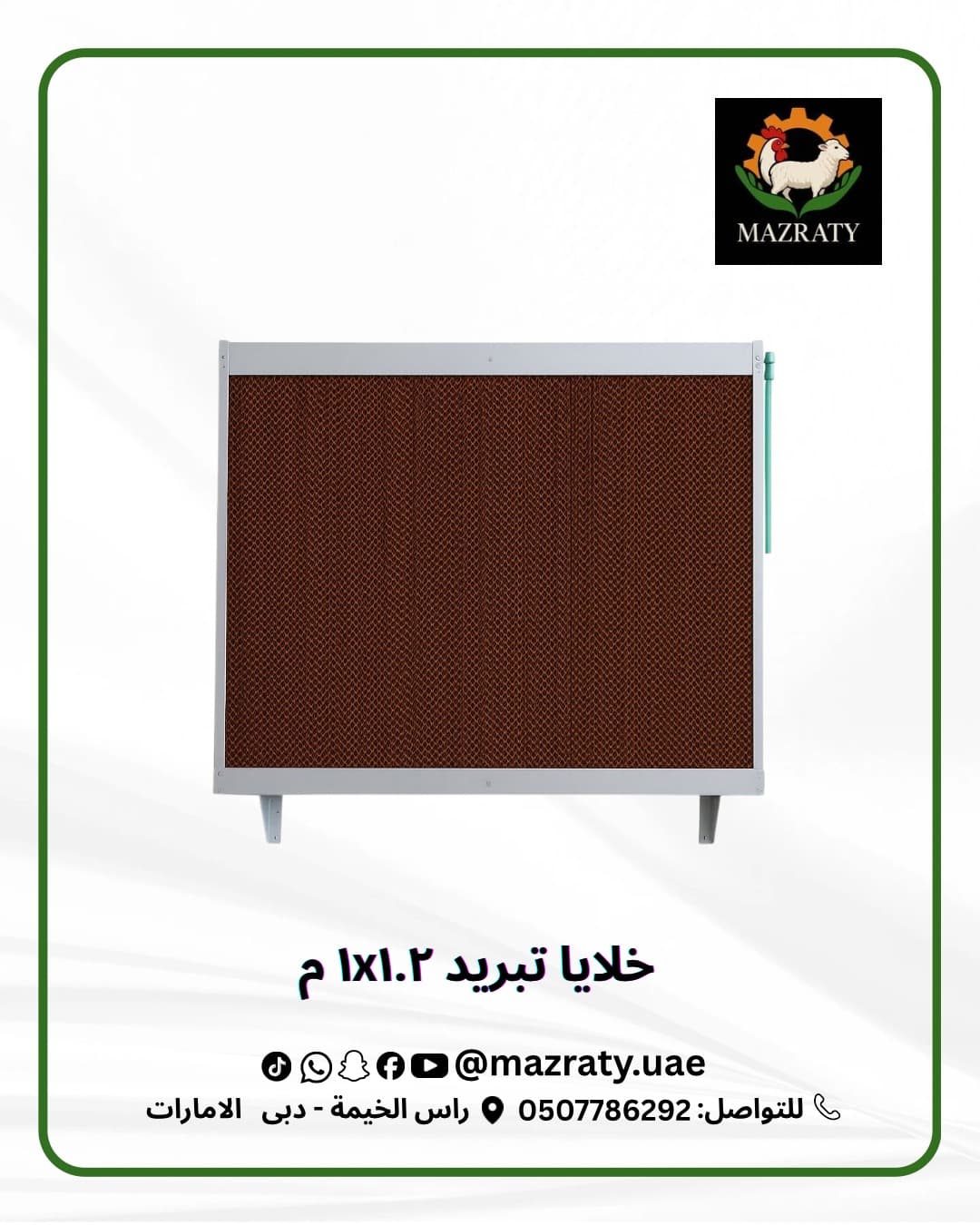
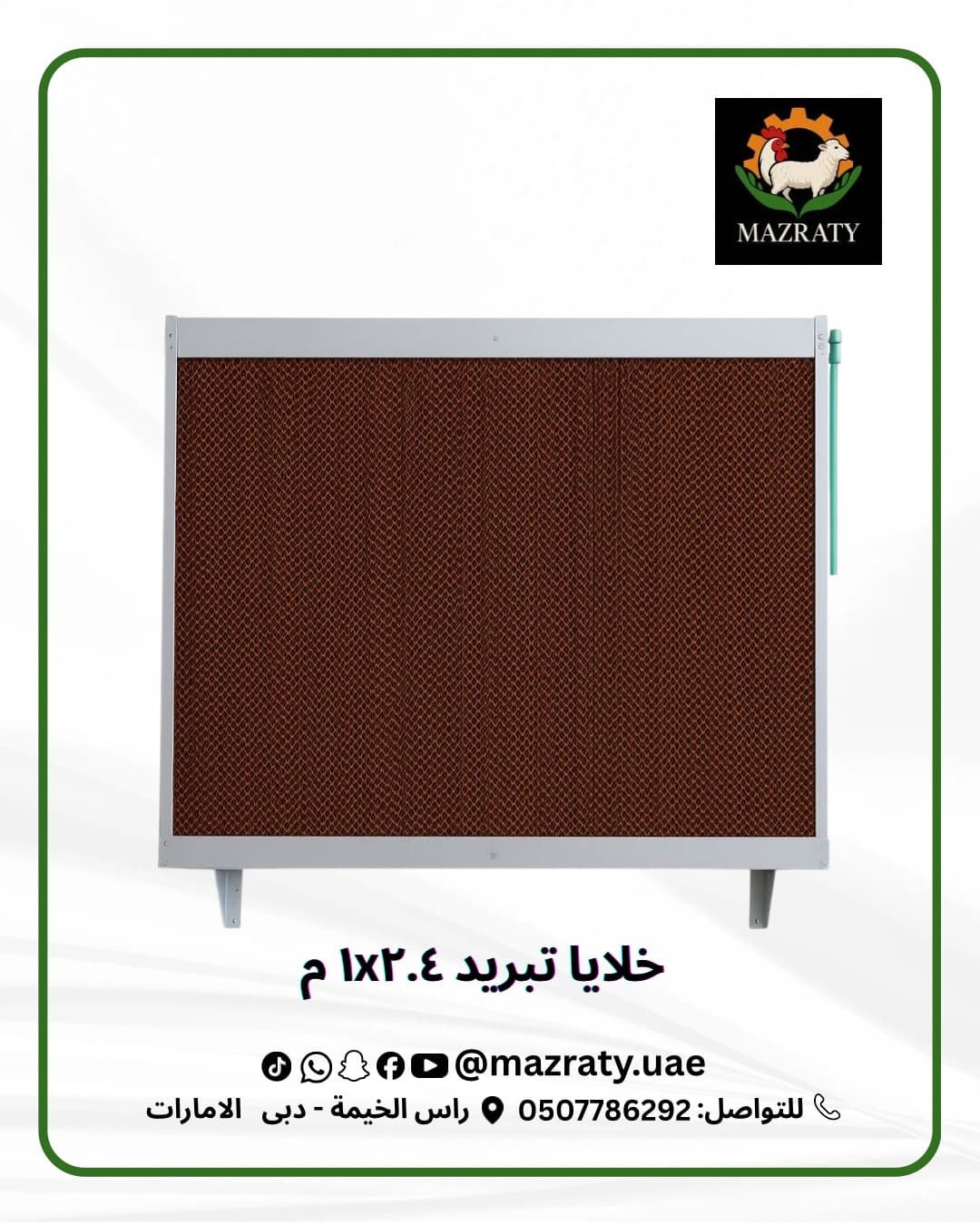
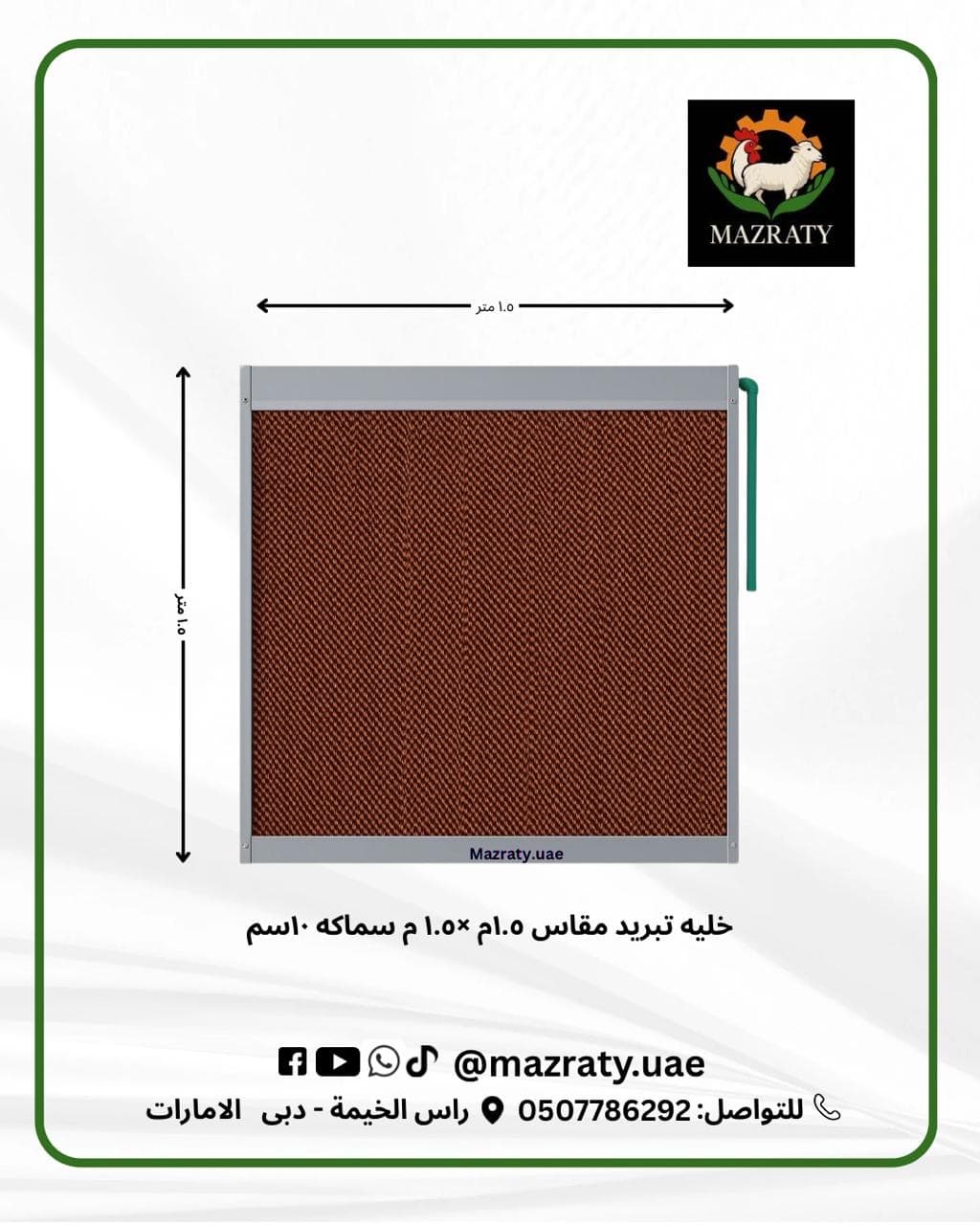
Evaporative cooling pads used in UAE poultry farms are typically imported from China, India, or Turkey. During Ramadan and in the weeks immediately following Eid Al Fitr, supply chains slow significantly as import and logistics staff operate at reduced capacity. Lead times that are normally two to three weeks can extend to six to eight weeks during this period.
Order replacement pads in April, before Ramadan begins. A standard 150 mm thick cellulose pad set for a 1,200 m² house typically costs AED 2,800 to AED 4,200 depending on pad area. This is a fraction of the cost of one mortality event from pad failure in July.
When ordering, specify the correct pad dimensions, thickness (100 mm or 150 mm — do not substitute), and flute angle. A 45° flute angle optimises the balance between cooling efficiency and airflow resistance. Incorrect pads can increase static pressure and reduce fan airflow below the threshold needed for effective tunnel ventilation.
Pad Frame and Housing Inspection
- Inspect galvanized or powder-coated steel frames that hold the cooling pads. Corrosion at weld points and frame corners is common in humid UAE coastal environments. Light surface rust can be treated with a zinc-rich primer; frames showing structural corrosion should be replaced.
- Check that the inlet face of the pad frame sits flush against the building wall opening with no air gaps around the perimeter. Even a 20 mm gap between the pad frame and wall allows hot, uncooled bypass air to enter the house and raises effective temperature at bird level.
- Inspect the sump tank below the pads. Drain, scrub, and disinfect. Algae growth in the sump causes blockage of the distribution header, reduces pad wetting efficiency, and introduces pathogens into water that is continuously recycling across the pads.
Thermostat and Sensor Calibration
Inaccurate temperature sensors kill birds. A sensor reading 2°C below actual temperature means your controller activates the next ventilation stage 2°C too late — at 37°C instead of 35°C. In the time it takes the house to cool from 37°C back to 35°C at full fan capacity, heat stress damage has already occurred.
- Ice bath test (0°C reference): Prepare a container of crushed ice and water in equilibrium — this reads exactly 0°C. Insert the sensor probe. A calibrated sensor should read 0.0°C ± 0.5°C. If reading is outside this range, adjust the calibration offset in the controller or replace the sensor.
- Boiling water test (100°C reference): At sea level in the UAE, water boils at 100°C. Bring water to a rolling boil and insert the sensor probe. Reading should be 100°C ± 0.5°C.
- Sensor placement audit: Temperature sensors should be positioned at bird level (300 mm above the litter for broilers), in the middle third of the house length, and shielded from direct radiation from fans or sunlit walls. A sensor positioned near the cooling pad inlet reads 2°C to 4°C lower than actual bird-level temperature and will systematically underventilate the house.
- Controller programming: Verify that stage setpoints are correctly programmed. A typical UAE summer profile: Stage 1 fans at 28°C, Stage 2 at 30°C, Stage 3 at 32°C, Stage 4 at 34°C, full capacity (100% fans + cooling pads) at 35°C. Ensure hysteresis is set to 1°C to prevent rapid cycling.
Emergency Generator Load Test
In UAE poultry production, the generator is not optional equipment — it is life-safety infrastructure for your flock. DEWA, FEWA, and ADDC supply interruptions do occur, and a grid failure at 2PM in August without a functioning generator is a flock-killing event within 90 minutes in large tunnel-ventilated houses.
- Load test procedure: Run the generator under full load for a minimum of two hours. Do not test at idle — this does not reveal issues with cooling, fuel consumption under load, or voltage regulation under high current draw. Connect all house equipment simultaneously: all fans, all water pumps, all lighting, the control panel. Monitor generator exhaust temperature, coolant temperature, oil pressure, and output voltage throughout the test.
- Oil and filter change: If the generator has not had an oil change within the last 250 hours of operation or 12 months, change it before summer. Use the viscosity grade specified by the manufacturer — typically SAE 15W-40 for UAE ambient temperatures. Change the fuel filter, air filter, and oil filter simultaneously.
- Fuel tank inspection: Drain the bottom 50 litres of fuel and inspect for water contamination (visible water layer at the bottom) or microbial growth (black sludge). Add a biocide treatment if contamination is found. Ensure the tank holds enough fuel for a minimum of 48 hours of continuous full-load operation.
- Automatic transfer switch test: Simulate a grid failure by shutting off the main breaker. The ATS should detect voltage loss and start the generator within 10 to 15 seconds. A transfer time greater than 30 seconds means birds are in zero-airflow conditions for that duration — acceptable for moderate conditions, potentially fatal at 45°C ambient.
May Checklist: One Month Before Peak Heat
May in the UAE brings the first serious heat previews — temperatures regularly reaching 38°C to 42°C, humidity rising in coastal areas, and wind patterns shifting. May work confirms that everything repaired or ordered in April is in place and functioning. This is also the last practical window for installation work before conditions make outdoor work dangerous for technicians.
Cooling Pad Replacement Assessment
Inspect every cooling pad section systematically. Cooling pads degrade through mineral scale accumulation, algae colonisation, physical compression, and fibre breakdown. A pad showing more than 30% surface blockage should be replaced.
- 30% blockage test: Stand at the inlet face of the pad and look through toward the interior. In a healthy pad, you should see light relatively clearly through the cross-section. If more than one-third of the pad face shows brown mineral deposits or green algae blocking the flute channels, replacement is justified.
- Water distribution test: Run the pump and observe wetting of the pad face within 60 seconds of pump start. Any dry vertical strip on the pad face indicates a blocked distribution hole or collapsed pad section. Dry areas allow uncooled air to bypass the pad and enter the house.
- Pad compression check: Press the pad face with your hand. New pads feel firm and springy. Old pads that feel soft, collapsed, or have permanent deformation have lost structural integrity and will collapse further under summer airflow velocities, increasing static pressure and reducing cooling efficiency.
Water Line Cleaning and Disinfection
Biofilm accumulation in poultry drinking water lines during winter and spring creates a pathogen reservoir that summer heat accelerates. A thorough line sanitisation before summer is standard biosecurity practice.
- Hydrogen peroxide shock treatment: Prepare a 500 ppm hydrogen peroxide solution (35% food-grade H₂O₂ diluted at approximately 1.4 ml per litre of water). Fill the entire water system — header tank, trunk lines, drinker lines — with this solution. Maintain 30-minute contact time throughout the system. Flush completely with clean water until residual reads below 1 ppm with a test strip.
- Nipple drinker inspection: After flushing, manually actuate each nipple drinker in a 10% sample across the house. Each nipple should flow freely and seal without dripping. Replace any nipple that drips continuously — in summer, a dripping nipple creates wet litter directly below it, leading to footpad dermatitis and coccidiosis pressure.
- Pressure regulator check: Drinker line pressure regulators should maintain 15 to 25 cm water column pressure at bird level. Regulators maintaining more than 30 cm pressure will cause nipples to flow continuously; less than 10 cm means inadequate water access, which becomes lethal in summer heat when birds are drinking at twice their normal rate.
Shade Cloth Installation
Evaporative cooling pads function best when inlet air temperature is minimised. Direct solar radiation on the cooling pad inlet wall raises the entering air temperature by 3°C to 6°C compared to shaded inlet walls, directly reducing pad cooling efficiency.
- Install 75% shade cloth (knitted polyethylene, UV-stabilised) over all cooling pad inlet areas, extending 1.5 metres beyond the pad face to shade both the pad and the approach air. Maintain a minimum 600 mm clearance between shade cloth and pad face to avoid restricting airflow.
- For houses with east-west orientation, the west wall receives afternoon sun when heat load is already highest. Prioritise shade cloth installation on the west wall inlet if your house design permits inlet cooling from that direction.
- Inspect existing shade cloth from previous seasons. UV degradation reduces shade factor over two to three years. Cloth that has become brittle or has tears exceeding 300 mm should be replaced. The cost — typically AED 4 to AED 7 per m² — is minor relative to its cooling benefit.
Negative Pressure Test
Tunnel ventilation depends on a sealed house creating negative static pressure relative to outside. Air must flow in through the cooling pad inlets and out through the exhaust fans — any infiltration bypass through cracks or gaps reduces effective cooling velocity at bird level and wastes fan capacity.
- Tissue paper test: With all exhaust fans running at full speed and all inlet pads covered, hold a sheet of tissue paper at the edge of any access door or wall penetration. The paper should be strongly pulled toward the building. If the paper is neutral or moves outward, you have significant infiltration at that location.
- Manometer measurement: Use a U-tube or digital manometer to measure static pressure differential between inside and outside the house with all fans at full speed and pad inlets open. For tunnel ventilation in UAE poultry houses, the target is -25 Pa to -40 Pa. Below -20 Pa, airflow velocity at bird level is insufficient. Above -50 Pa, the house is too tight and pad inlet airflow is being restricted.
- Seal any gaps: Use closed-cell foam strip, silicone sealant, or EPDM rubber strips to seal gaps around doors, ventilation panel frames, electrical conduit penetrations, and wall expansion joints. Pay particular attention to the ridge line of the roof — hot air infiltration through ridge gaps is a common source of high house temperature in UAE conditions.
Emergency Supply Stocking
Stock these items before June and confirm their location with all farm staff:
- Electrolytes: Minimum 10 kg of water-soluble poultry electrolyte supplement. During peak heat events, dose at 1 g per litre of drinking water. Electrolytes replace sodium, potassium, and bicarbonate lost through panting.
- Vitamin C: Ascorbic acid powder, minimum 5 kg stock. Supplement at 200–300 mg per litre of drinking water during heat stress periods. Vitamin C is depleted by heat stress and supports adrenal function and immune competence under thermal load.
- Shade cloth rolls: Keep 200 m² of spare 75% shade cloth on site for emergency cover of damaged sections or temporary shading of stressed birds.
- Portable fans: A minimum of four portable high-velocity fans (minimum 0.5 m³/s each) for emergency spot cooling during equipment failure.
- Ice supply arrangement: Establish a standing order with a local ice supplier for emergency delivery within two hours. Adding 50 kg of block ice to the sump tank drops water temperature by 3°C to 5°C and meaningfully reduces pad inlet air temperature.
Electricity Supplier Notification
UAE electricity distributors — DEWA in Dubai and parts of the Northern Emirates, FEWA in Ras Al Khaimah, Fujairah, Ajman, and Umm Al Quwain, ADDC in Abu Dhabi — require advance notice when commercial customers expect significantly increased maximum demand. Poultry farms transitioning from winter to full summer cooling load can see electricity demand double or triple.
Contact your electricity supplier in May to notify them of your expected maximum demand during June through August. Provide your farm's connection reference number, your current contracted demand in kVA, and your anticipated peak demand. This notification protects you against supply interruptions due to unexpected load spikes.
June to August: Active Summer Management Protocols
Daily Temperature Monitoring Schedule
During peak summer months, passive temperature monitoring is insufficient. Implement a four-times-daily reading schedule and maintain a written log in the control room:
| Time |
Reading Purpose |
Action Trigger |
| 6:00 AM |
Night minimum — confirms overnight ventilation was adequate |
If above 30°C at 6AM, pre-cool before sunrise |
| 12:00 PM |
Mid-morning check — temperature rising phase |
If above 35°C by noon, afternoon will exceed 40°C |
| 3:00 PM |
Peak heat — typically hottest part of the day in UAE |
Emergency protocols if above 38°C inside house |
| 6:00 PM |
Temperature declining — assess evening recovery |
If still above 35°C at 6PM, extend full cooling through night |
Ventilation Rate Management
- Above 33°C: Step fan controllers to 80% capacity minimum. If outdoor humidity is high (above 70%), evaporative cooling efficiency drops and fans must compensate by increasing air velocity.
- Above 35°C: All fans at 100% capacity. Cooling pads operating. Water distribution across pads continuous — do not allow pump cycling at peak heat.
- Above 38°C: Implement heat emergency protocol. Verify generator is on standby. Walk the outside of the house and confirm exhaust is vigorous at every fan opening. Contact Mazraty emergency parts line if any fan is not performing.
Feed Management in Extreme Heat
Birds that consume feed in peak afternoon heat produce metabolic heat during digestion that compounds their heat stress. The heat increment of feeding — body heat generated by metabolic processing of feed — is approximately 10% of the feed's energy content. Suspending feed access during the hottest part of the day reduces the bird's internal heat load significantly.
- Suspend feed access from 11:00 AM to 4:00 PM on days when ambient temperature exceeds 38°C. Ensure feeders are empty before the suspension window — residual feed in open pan feeders heats in the house atmosphere and becomes unpalatable.
- Compensate by increasing feeding frequency in the morning (5:00 AM to 10:00 AM) and evening (4:00 PM to 9:00 PM). Birds will adjust their feeding pattern within one to two days and will achieve similar feed intake across a longer eating window.
- Monitor feed intake daily. A drop of more than 15% from the flock's normal daily intake indicates significant heat stress.
Water Management in Summer
Bird water intake in summer doubles compared to thermoneutral conditions. A broiler at 32°C drinks approximately 250 ml per kg of body weight per day — twice the 125 ml per kg typical of optimal temperature conditions. Water lines that adequately supplied birds in spring will be borderline insufficient in summer.
- Increase header tank refill frequency or increase float valve flow rate to ensure the tank is never more than half empty during peak hours.
- Add water-soluble vitamin C and electrolytes to drinking water during heat events at the manufacturer's recommended rate.
- Flush drinker lines at 5:00 AM daily to remove water that has been standing in lines overnight and has warmed. Cool, fresh water intake is significantly more effective at reducing bird core temperature than warm standing water.
Weekly Generator Test
Run the generator under full cooling load for one hour every week during June, July, and August. Log the date, duration, operating temperatures, oil pressure, and output voltage of every test run. If the generator fails to start or shows abnormal readings during a test, the corrective action cost is far less than losing a flock.
Emergency Response Card — Laminate and Post in Every Poultry House
This card should be printed, laminated, and fixed to the wall inside the control room of every house. Every farm worker should know its contents.
Power Failure Protocol
- Automatic transfer switch should start generator within 90 seconds. If generator does not auto-start, go to generator room immediately and start manually.
- Confirm all exhaust fans restart. Walk the outside of the building and physically verify airflow at every fan opening.
- If generator also fails: open all manual ventilation panels, all access doors, and use portable fans immediately. Call Mazraty emergency line: WhatsApp +971 50 535 3412.
- If outside temperature exceeds 40°C and power cannot be restored within 30 minutes: begin emergency thinning of stocking density where possible.
Cooling Pad Failure Protocol
- If water pump fails, open all manual ventilation louvers immediately to maximise air exchange rate even without evaporative cooling.
- Add ice to the sump tank while waiting for pump repair — this provides partial cooling of inlet air.
- If a pad section collapses or blocks, cover the opening with shade cloth temporarily and call Mazraty for emergency pad supply.
Mass Panting Emergency Protocol
- If 20% or more of birds are panting with open beaks, the flock is in active heat stress.
- Add ice to the drinker header tank immediately. Flush all drinker lines with cool water.
- Open all possible ventilation — do not prioritise biosecurity during a heat emergency. Cool birds first.
- Mortality alarm threshold: if mortality exceeds 0.1% of flock within any two-hour period, treat as a mass casualty event and escalate immediately.
Cost Summary: Pre-Summer Investment vs. Emergency Cost
| Preparation Item |
Typical Cost (AED) |
Risk if Skipped |
| V-belt replacement set (6 fans) |
200–350 |
Slipping belts reduce airflow 20%; heat stress mortality |
| Full cooling pad set (1,200 m² house) |
2,800–4,200 |
6–8 week lead time in season = potential total flock loss |
| Generator service (oil, filters) |
400–700 |
Generator failure = flock loss AED 90,000+ |
| Sensor calibration and replacement |
150–300 |
2°C sensor error = chronic underperformance entire season |
| Shade cloth installation |
800–1,400 |
3°C higher inlet air = 5–8% lower pad efficiency all summer |
| Emergency supply stock |
500–800 |
Sourcing during heat event at premium cost and delay |
| Total preparation cost |
4,850–7,750 |
vs. AED 90,000+ in one flock loss event |
Work With Mazraty to Be Ready Before June
Mazraty is Ras Al Khaimah's leading supplier of poultry farm cooling and ventilation equipment, spare parts, and technical support. We stock evaporative cooling pads, V-belts, fan motors, shutter assemblies, water pump spare parts, shade cloth, portable fans, and emergency electrolyte and vitamin C supplements — all items on this checklist.
Our team understands UAE poultry farm conditions and can advise on the right pad specifications, fan sizing, and static pressure targets for your specific house dimensions and stocking density. We carry stock through the summer season and can arrange emergency delivery to farms in Ras Al Khaimah, Fujairah, Umm Al Quwain, and Sharjah.
Do not wait until June to discover that your cooling pads are blocked, your belts are cracked, or your generator oil has not been changed in 18 months. Contact Mazraty today to schedule a pre-summer inspection and parts order.
WhatsApp: +971 50 535 3412
Save this number to your phone now and put it on your emergency card in every poultry house. Your flock's survival this summer may depend on how quickly you can reach us.
Reviewed planning sources
These references support operating and welfare principles. Final design and health programs remain site-, strain-, authority- and veterinarian-specific.
Frequently Asked Questions
When should summer preparation begin?
Start early enough to replace parts and test fans, pumps and backup power under real load before heat events.
What is the most important pre-summer test?
Test ventilation, cooling, water and backup power as one system because one failed link can disable the whole response.