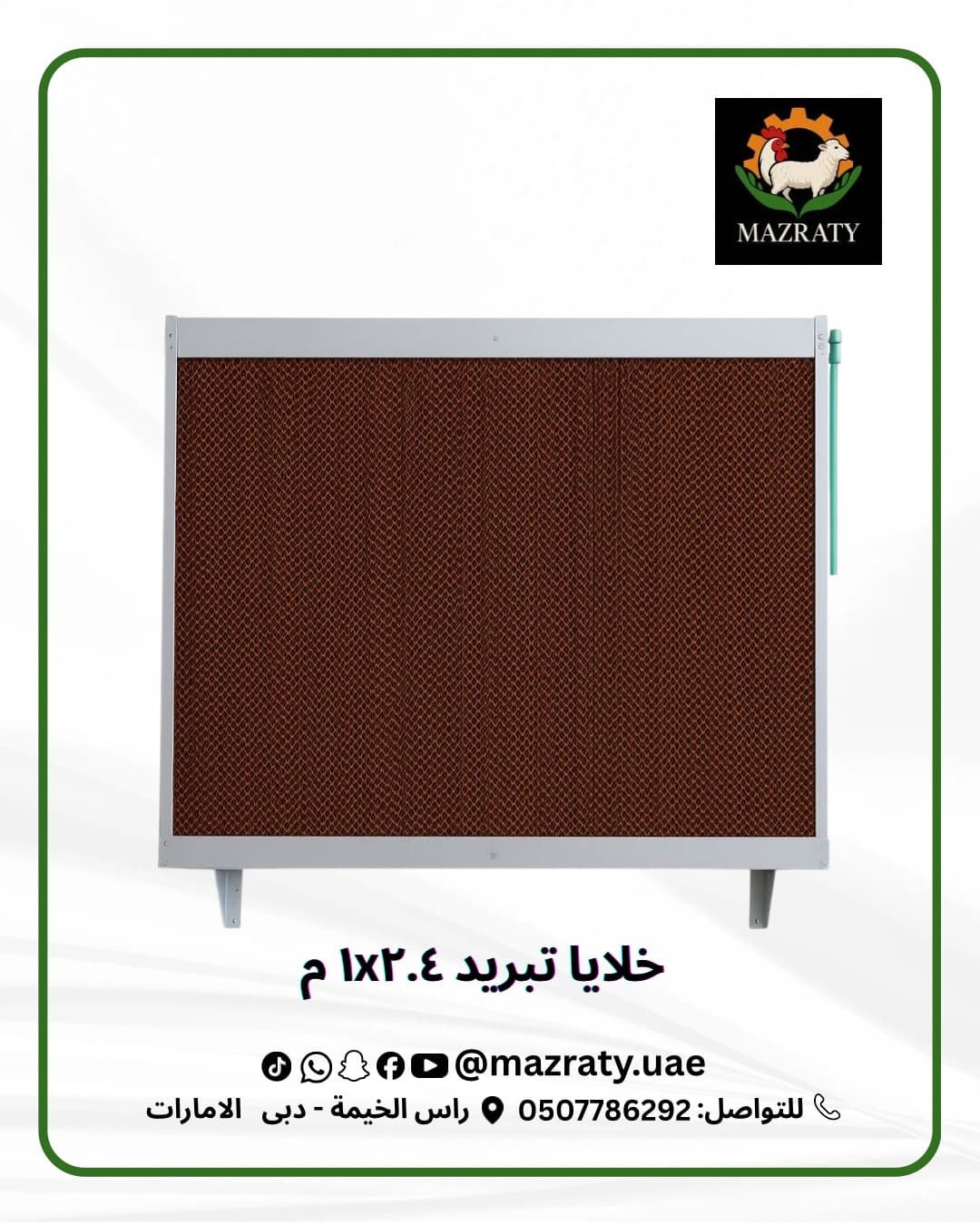
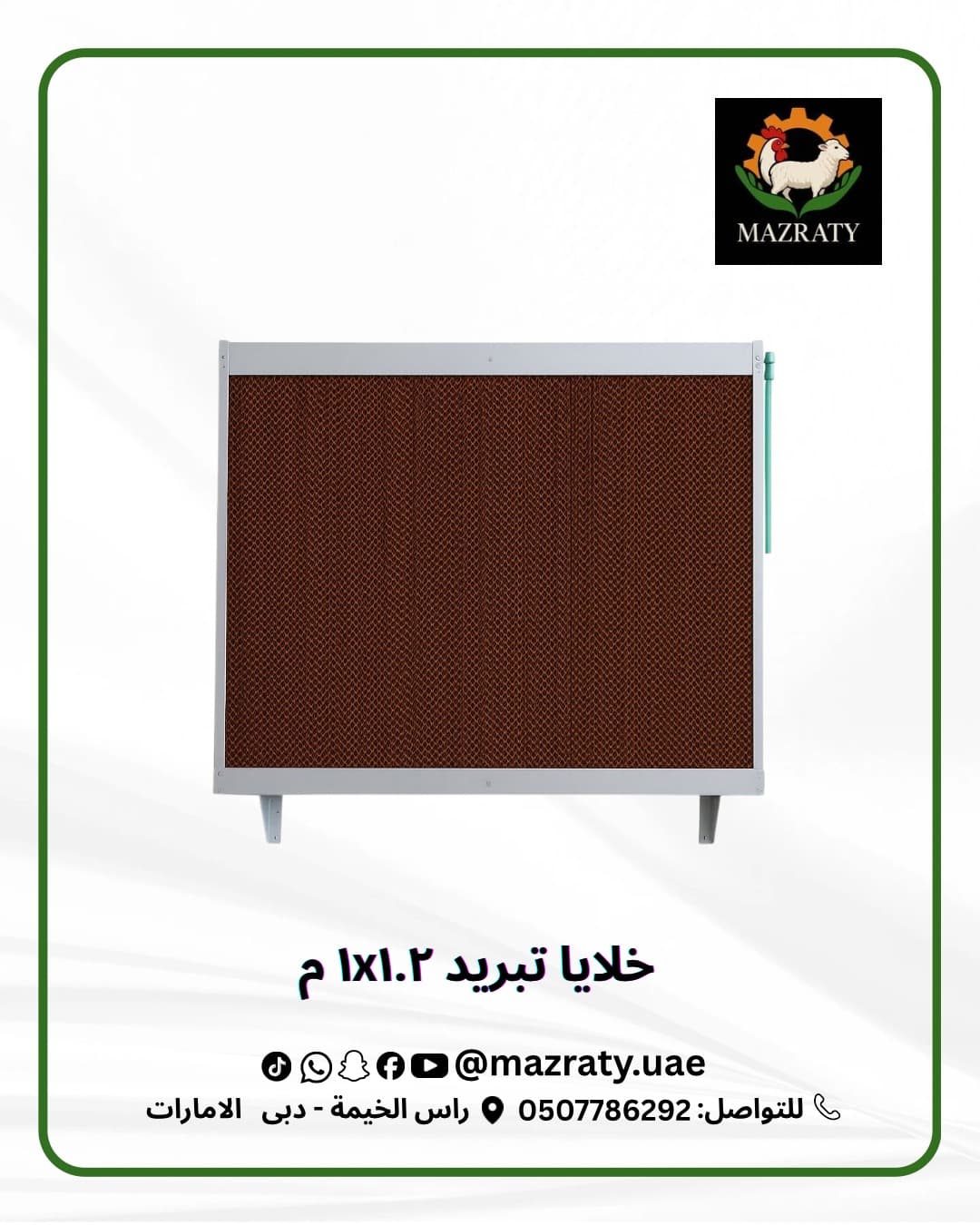
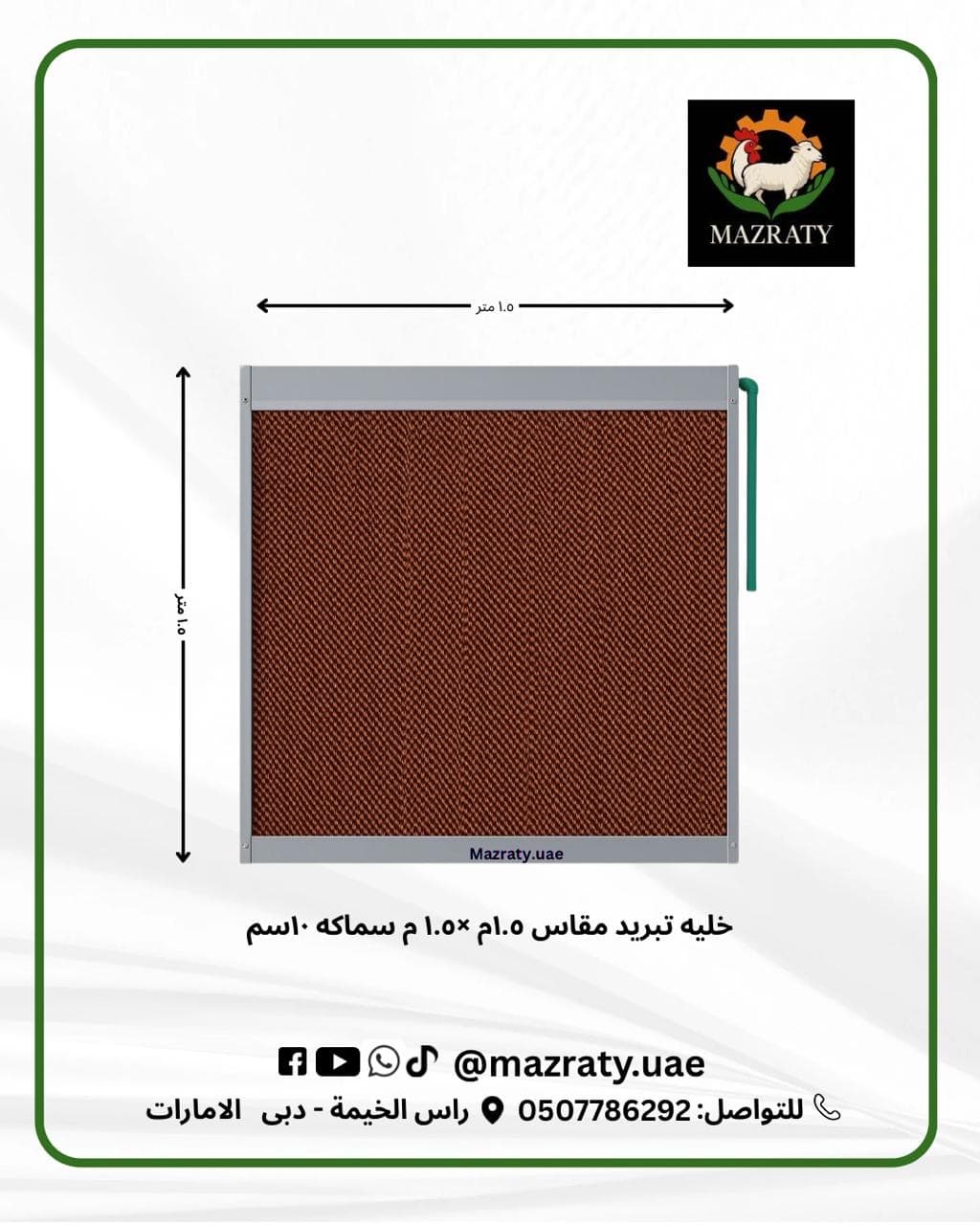
A specialist engineering guide to designing poultry ventilation systems in the UAE — air changes calculations, negative pressure control, staged fan sequences and sensor placement. Contact Mazraty +971 50 535 3412
Why Engineering-Grade Ventilation Is the Foundation of Poultry Success in UAE
The UAE summer is among the most challenging environments on earth for livestock production. Ambient temperatures regularly exceed 45 degrees Celsius, heat index values can push effective temperatures beyond 55 degrees when humidity is factored in, and the diurnal temperature swing from night lows to afternoon peaks adds further physiological stress on broiler flocks. In this context, poultry ventilation is not a convenience feature — it is the primary life-support system for your birds and the single largest determinant of flock performance, feed conversion, and mortality rates.
This guide is not a fan buying checklist. It is a structured engineering framework covering the calculations, design principles, and control logic needed to build or evaluate a mechanical ventilation system purpose-built for UAE conditions. Mazraty has been supplying, installing and maintaining complete ventilation systems across Ras Al Khaimah and the wider UAE for over 20 years. Reach our engineering team any time via WhatsApp: +971 50 535 3412.
Two Fundamental Modes: Minimum vs Maximum Ventilation
Every properly designed mechanical ventilation system must handle two distinct operational demands that sit at opposite ends of the performance envelope. Failing to design for both means the system will underperform in at least one critical scenario.
Minimum Ventilation Mode
Minimum ventilation operates during cooler periods, early chick placement phases, or nighttime hours when outdoor temperatures are manageable. Its primary function is not cooling — it is air quality management: removing excess moisture, carbon dioxide, ammonia, and dust while maintaining thermal comfort. The design target for minimum ventilation in UAE broiler houses is 0.1 cubic metres per minute per kilogram of live weight. For a house holding 20,000 birds averaging 1.5 kg:
- 20,000 × 1.5 kg = 30,000 kg live weight
- 30,000 × 0.1 = 3,000 m³/min required at maximum stocking weight
In practice, minimum ventilation in cold or mild weather is delivered by small dedicated fans running on timer-controlled intermittent cycles — typically 2 minutes on and 8 minutes off — to ensure uniform distribution without causing cold drafts on young chicks.
Maximum Ventilation Mode
Maximum ventilation is the UAE summer survival mode. All tunnel fans operate at full capacity to drive high-velocity air across the birds, generating a wind-chill effect that can reduce the effective temperature birds experience by 6 to 10 degrees Celsius even when outdoor ambient remains at 43 degrees. The engineering target for tunnel ventilation in UAE is a minimum air velocity of 2.5 metres per second at bird level, which is the threshold at which meaningful evaporative cooling begins when cooling pads are operating.
Calculating Air Changes Per Hour
Air changes per hour (ACH) is the fundamental throughput metric that governs how completely and how quickly the air inside a poultry house is replaced with fresh outside air. The formula:
- ACH = (Airflow rate m³/min × 60) ÷ House volume m³
Recommended ACH benchmarks for UAE broiler houses by ventilation mode:
- Minimum ventilation: 2 to 5 ACH
- Transitional ventilation: 20 to 30 ACH
- Maximum tunnel ventilation: 40 to 60 ACH
Full Worked Example
Consider a standard UAE broiler house: 120 m long × 12 m wide × 2.5 m average internal height (accounting for pitched roof geometry).
- House volume = 120 × 12 × 2.5 = 3,600 m³
- Target maximum ventilation at 50 ACH: 50 × 3,600 ÷ 60 = 3,000 m³/min
- Using tunnel fans rated at 500 m³/min each: 3,000 ÷ 500 = 6 fans required
- Target minimum ventilation at 4 ACH: 4 × 3,600 ÷ 60 = 240 m³/min — one small 250 m³/min fan is sufficient
This calculation gives you the fan count backbone. Inlet sizing, pressure targets, and control staging are then layered on top of this foundation.
Negative Pressure Control: The Engineering Backbone
Mechanical ventilation in poultry houses operates on the negative pressure principle: exhaust fans draw air out of the house, creating sub-atmospheric internal pressure. Fresh external air is then pulled in through precisely sized and positioned inlets. This approach is the global industry standard for commercial poultry operations for three critical reasons:
- Full directional control over airflow paths — no dead zones or short-circuiting
- Containment of odour, dust, and pathogens within the house
- Measurable, adjustable pressure differential that can be tuned in real time
Target Static Pressure Values
During minimum ventilation mode the target static pressure differential is between 10 and 25 Pascals. Understanding what deviations mean:
- Below 10 Pa: Inlets are oversized relative to active fan capacity. Air enters slowly and drops to the floor before reaching the centre of the house, creating cold feet and wet litter near inlets.
- Above 25 Pa: Inlets are undersized. Fans work against excessive back-pressure, airflow drops below rated output, and air jets from inlets are too narrow to reach the flock uniformly.
During full tunnel mode, the lateral curtains are closed and all airflow is directed longitudinally from the inlet end through cooling pads to the fan end. Static pressure in full tunnel mode may reach 40 to 50 Pa — this is acceptable because all inlet area is concentrated at the cooling pad wall.
Engineering the Inlets: Sizing Calculation
Inlet sizing is one of the most common engineering errors in poultry house design. The governing formula:
- Required inlet area (m²) = Airflow rate (m³/min) ÷ (Target inlet air velocity (m/s) × 60)
The target inlet air velocity in minimum ventilation mode should be between 2.0 and 3.0 m/s. This speed ensures the incoming air jets travel far enough horizontally to mix with house air before descending to bird level, preventing cold spots directly under the inlets. Working through the numbers for 240 m³/min at 2.5 m/s:
- Required inlet area = 240 ÷ (2.5 × 60) = 1.6 m²
- Achieved with 8 inlets each measuring 40 cm × 50 cm = 0.2 m² each
- Inlets distributed equally along both long sidewalls at spacing no greater than 4 metres apart
In tunnel mode, these sidewall inlets are fully closed and the cooling pad inlet area is designed separately to handle the full maximum airflow volume.
Staged Fan Control: How to Sequence Fans Correctly
Running all fans at full power simultaneously or switching all fans on and off together is one of the costliest operational mistakes in poultry production. Staged fan control sequences individual fans or groups of fans in response to rising or falling house temperature, providing smooth, proportional ventilation response. The engineering rationale:
- Prevents thermal shock to the flock from sudden large changes in airspeed or temperature
- Reduces peak electrical demand charges which are significant in UAE commercial tariffs
- Extends fan motor life by distributing run-hours across the bank of fans
- Achieves finer temperature control resolution — typically 0.5 to 1.0 degree Celsius per stage
Recommended Staging Sequence for UAE Broilers
The following is an example staging plan for a 4-week-old broiler flock with a target house temperature of 25 degrees Celsius in UAE summer conditions:
- Stage 0 — Minimum ventilation timer: One small circulation fan running 2 minutes on / 8 minutes off regardless of temperature. This stage never switches off during flock presence.
- Stage 1 — 26 °C: One large tunnel fan at 100% speed
- Stage 2 — 27 °C: Add a second tunnel fan
- Stage 3 — 28 °C: Add two more tunnel fans + activate cooling pad water pump
- Stage 4 — 29 °C: All remaining tunnel fans at 100% + full cooling pad flow
- Alarm stage — 32 °C: Immediate SMS alert to farm manager + backup fan activation
The recommended step increment between stages is one full degree Celsius. This differential prevents the hunting behaviour where a fan switches on, cools the house to just below the setpoint, switches off, and the temperature immediately climbs back to trigger the same fan again — a cycle that wastes energy and causes rapid motor wear.
Sensor Placement: The Most Underestimated Design Element
The most precisely engineered fan staging sequence is only as accurate as the sensors feeding it temperature and pressure data. Incorrect sensor placement in UAE poultry houses is surprisingly common and is frequently responsible for ventilation systems that read correctly in the controller display yet fail to protect the flock during heat events.
Temperature Sensors
- Height: Mount sensors between 30 and 60 cm above the back level of the birds — not at human head height (1.5 m), which reads 2 to 4 degrees lower than bird-level temperature in tunnel mode
- Longitudinal position: Place sensors at one-third of the house length measured from the inlet end, not from the fan end. Heat accumulates progressively from inlet to fan, so the warmest zone is near the exhaust fans — that is where your high-alarm sensor should be
- Quantity: Minimum one sensor per 500 m² of floor area, with at least two sensors in any house regardless of size. Controllers should be programmed to respond to the average of all sensors or the highest reading, depending on flock age
- Avoid placement within 3 metres of any open inlet where cool incoming air will give a falsely low reading
Static Pressure Sensors
- Mount on a long sidewall at mid-house length
- Maintain minimum 3 metres clearance from any inlet
- Houses longer than 80 metres benefit from two pressure sensors — one at each end — to detect pressure asymmetry caused by partially blocked inlets or fan imbalance
Humidity Sensors
- In coastal UAE locations — Dubai, Sharjah, Ajman, Fujairah — humidity monitoring is critical for cooling pad management
- Target internal relative humidity: 50 to 70%
- When external relative humidity exceeds 80%, cooling pads become counterproductive — they add moisture to already saturated air, increasing the heat stress index. The control system must be programmed to automatically inhibit cooling pad water flow above this outdoor humidity threshold
Tunnel Fan Array Layout: Engineering the Fan End Wall
In tunnel ventilation design, the positioning and spacing of fans in the exhaust wall directly affects airflow uniformity across the entire house cross-section. Engineering guidelines for UAE tunnel fan wall design:
- Maximum recommended tunnel length for a single-stage tunnel system in UAE: 120 to 150 metres. Longer houses require intermediate fans or a split-tunnel design to avoid unacceptable temperature gradients from inlet to exhaust end
- Optimal house aspect ratio for tunnel effectiveness: 8:1 or greater (length to width)
- Fan opening area should not exceed 50% of the total end-wall area — leaving structural framing and clearances around fans
- Maintain a minimum of 30 cm of clearance between adjacent fan frames to prevent aerodynamic interference between fan discharge streams and to allow maintenance access
- Fan shutters must open fully and close completely. Partially stuck-open shutters are a major source of energy waste and cold backdraft during minimum ventilation mode in cooler months
UAE-Specific Engineering Adjustments
Designs validated in temperate climates require deliberate modification for UAE conditions. The following factors are frequently underweighted in standard poultry ventilation designs:
Dust Storm Filtration (Haboob Events)
Spring and autumn dust events in inland UAE — particularly in Abu Dhabi, Al Ain, and Ras Al Khaimah — can dramatically reduce cooling pad airflow efficiency by coating the pad media with fine particulate. Engineering responses include:
- Installing G3-grade pre-filter screens across all inlets, cleaned weekly during dust season
- Designing inlet plenum chambers that allow coarse dust to settle before air reaches the cooling pads
- Programming automatic pressure compensation — if static pressure rises above 35 Pa during a dust event, trigger an alert and increase minimum fan speed to compensate for reduced inlet area
Overnight Coastal Humidity Spikes
In Dubai, Sharjah and northern coastal emirate locations, outdoor relative humidity frequently exceeds 90% between 02:00 and 06:00. During these periods:
- Cooling pads must be switched off — adding moisture to supersaturated air worsens heat stress index
- The control system should reference the outdoor humidity sensor and automatically inhibit pad water pumps when external RH is above 80%
- Minimum ventilation timer cycles may need to be shortened to 2-on / 6-off to compensate for reduced moisture removal efficiency of saturated incoming air
Electricity Cost Engineering in UAE
At typical UAE commercial electricity tariffs of AED 0.20 to 0.40 per kWh, the operating cost of tunnel fan arrays is significant. A house running six 1.1 kW tunnel fans for 18 hours daily consumes approximately 119 kWh/day, costing between AED 24 and AED 48 per day just for ventilation. Engineering levers to reduce this cost:
- Specify IE3 or IE4 efficiency class motors — they deliver 12 to 20% lower energy consumption versus standard IE1 motors over the same airflow
- Design staging gaps of 1.0 degree Celsius minimum to reduce unnecessary fan cycling
- Install variable frequency drives (VFDs) on at least two fans in the bank for proportional control in transitional weather — reducing motor speed by 20% reduces power draw by approximately 49% due to the cubic relationship between speed and power in fans
Mazraty can assess your current system energy profile and recommend upgrades. Contact us: +971 50 535 3412. Free delivery across all UAE on all equipment orders.
Climate Controller Specifications: What to Require
The climate controller is the brain of the entire system. Minimum specification requirements for a UAE commercial poultry house controller:
- Support for at least 6 independently programmable fan stages based on temperature
- Separate minimum ventilation timer control with adjustable on/off cycle times
- Multi-sensor input with configurable response logic: average, maximum, or zone-specific
- Static pressure input with automatic inlet adjustment output for motorised inlets
- Humidity sensor input with cooling pad inhibit logic
- Alarm outputs: high temperature, low temperature, fan failure, power failure
- Remote monitoring and alert via SMS or app — essential for UAE farms where a 15-minute power or fan failure in summer can kill hundreds of birds
- Data logging with at least 30 days of sensor history for performance trend analysis
Commissioning Checklist for UAE Poultry Ventilation Systems
Before placing the first chicks, verify the following with an independent physical check — not just controller display readings:
- Measure static pressure with a calibrated manometer at mid-house with minimum ventilation fans running — confirm reading is within 10 to 25 Pa
- Use a handheld anemometer to verify inlet air velocity is between 2.0 and 3.0 m/s at each inlet
- Walk the full house length while all minimum ventilation fans run — check for cold spots near inlets or dead zones in the centre
- Activate each fan stage manually and verify each fan starts and reaches full speed — check all shutters open fully
- Simulate a sensor failure — confirm the controller alarms correctly and defaults to a safe fan mode
- Test all alarm outputs: buzzer, remote SMS, or app notification
When to Call an Expert: Red Flags in Existing Systems
If your existing UAE poultry house shows any of these symptoms, the ventilation system needs engineering evaluation before the next UAE summer season:
- House temperature more than 3 degrees above outdoor ambient during tunnel mode — indicates insufficient fan capacity or cooling pad blockage
- Wet litter near sidewall inlets in mild weather — indicates excessive minimum ventilation or incorrect inlet positioning
- Uneven bird distribution with birds clustering at one end — indicates airflow asymmetry or temperature gradient exceeding 3 degrees across house length
- Static pressure reading consistently above 30 Pa in minimum mode — inlet area is undersized for current fan configuration
- Mortality spikes during afternoon peak temperature hours despite all fans running — potential sensor placement error or controller programming fault
The Mazraty engineering team performs full ventilation system audits across UAE. Contact us for an assessment: +971 50 535 3412.
Reviewed planning sources
These references support operating and welfare principles. Final design and health programs remain site-, strain-, authority- and veterinarian-specific.
Frequently Asked Questions: Mechanical Ventilation Design for UAE Poultry Farms
How many tunnel fans does a 100 m × 12 m broiler house need in UAE summer conditions?
For this house (volume approximately 3,000 m³ at 2.5 m average height), targeting 50 ACH in maximum mode requires 2,500 m³/min. Using standard 500 m³/min tunnel fans that means 5 fans. You would also add one small 250 m³/min minimum ventilation fan on a separate timer circuit. For a precise calculation matched to your specific birds, stocking density and local conditions contact Mazraty at +971 50 535 3412 — free site assessment available.
What is the correct static pressure range for a UAE poultry house in minimum ventilation mode?
The target range is 10 to 25 Pascals, measured by a wall-mounted differential pressure sensor (transducer) comparing inside and outside pressure. Below 10 Pa indicates oversized or too many open inlets; above 25 Pa indicates insufficient inlet area or inlets that are partially closed. Adjust inlet blade opening angles to achieve the target — do not add fans to compensate for incorrect inlet sizing.
Should I use variable frequency drives (VFDs) on poultry house fans in the UAE?
VFDs deliver the greatest benefit on one or two fans in a staged bank, allowing proportional speed control during transitional weather when binary on/off staging creates temperature swings. In full summer tunnel mode all fans typically run at 100% anyway. The energy saving from VFDs is most significant during the shoulder months of April, October, and November. Payback on VFD investment in UAE conditions is typically 18 to 30 months depending on electricity tariff and operating hours.
How do I prevent cooling pads from increasing humidity inside the house at night in coastal UAE?
Install an outdoor relative humidity sensor and programme the controller to inhibit the cooling pad water pump when outdoor RH exceeds 80%. This is a standard configuration in coastal UAE installations. On humid nights the fans continue running — you still get airspeed cooling — but without adding moisture that would raise the internal humidity above the 70% comfort threshold for broilers.
What maintenance schedule does a UAE poultry ventilation system require?
Given UAE dust and heat conditions, recommended maintenance intervals are: fan belt tension and condition check every 4 weeks; cooling pad inspection and cleaning every 2 weeks during summer operation; inlet screen cleaning every week during dust season; motor bearing lubrication every 6 months; full system pressure and airflow calibration check before each flock placement. Mazraty offers maintenance contracts covering all UAE regions with same-day emergency response. Call or WhatsApp +971 50 535 3412 for a service quote.