Size poultry evaporative coolers from airflow, humidity, outlets and water distribution, with on-site commissioning instead of fixed cooling claims.
The industrial desert cooler — known interchangeably as an evaporative air cooler, swamp cooler, or wet-air cooler — has become the backbone of poultry farm climate management across the UAE because it delivers dramatic cooling at a fraction of the energy cost of conventional split or chiller systems. When correctly sized and positioned, a properly specified industrial evaporative cooler can hold broiler house temperatures between 28 and 32°C even when the outside reads 44°C, giving your flock the productive environment they need to reach target weight efficiently.
This guide covers everything a UAE poultry farmer needs to know to choose, size, install, and maintain the right unit — and to know when the desert cooler alone is not enough.
How a Desert Cooler Works: The Evaporative Principle
The physics behind a desert cooler is straightforward: when liquid water evaporates into dry air, it absorbs heat from the surrounding air — specifically 2,501 joules per gram of water evaporated. This latent heat absorption cools the air passing through the wet medium.
In a practical industrial evaporative cooler, the process works as follows:
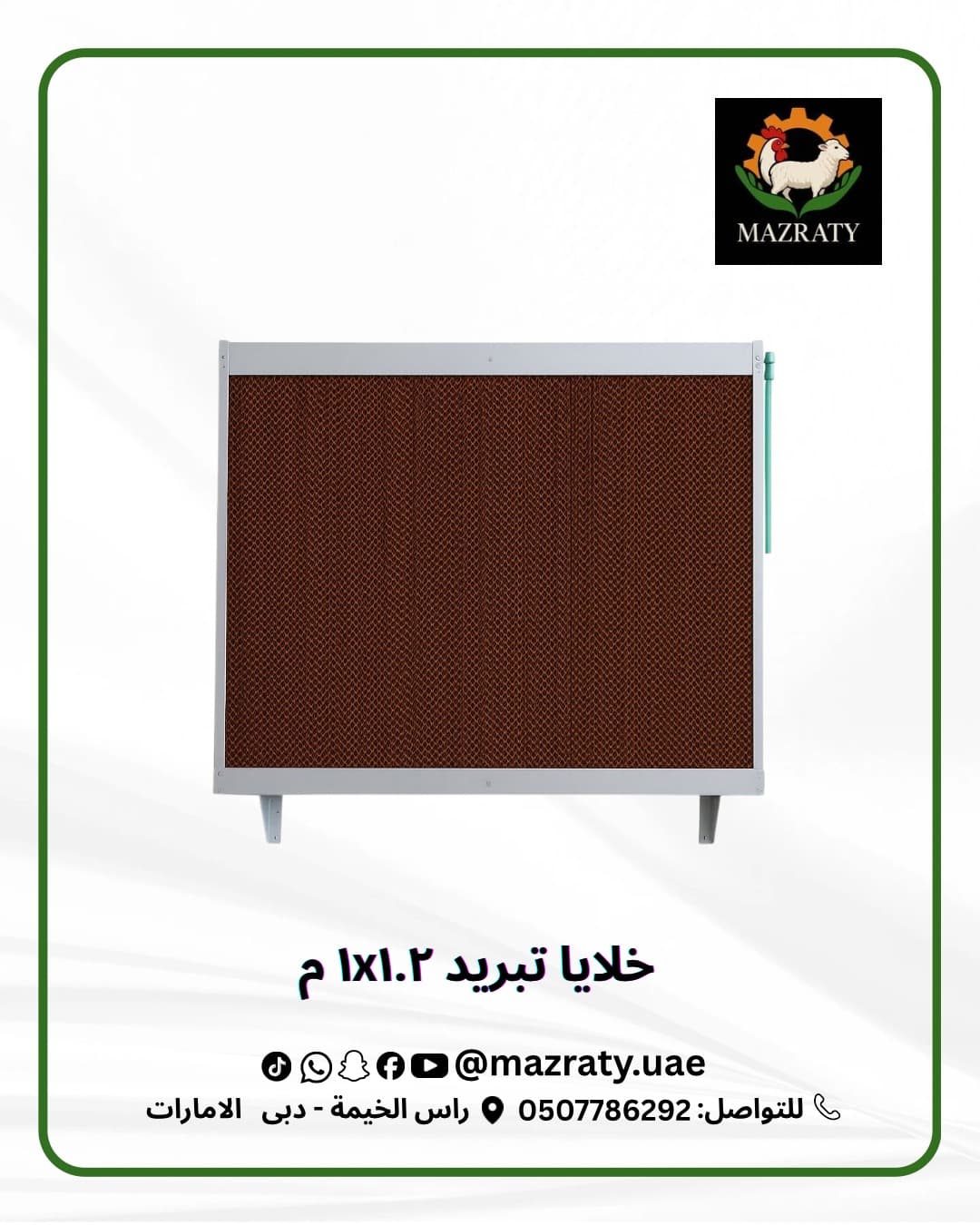
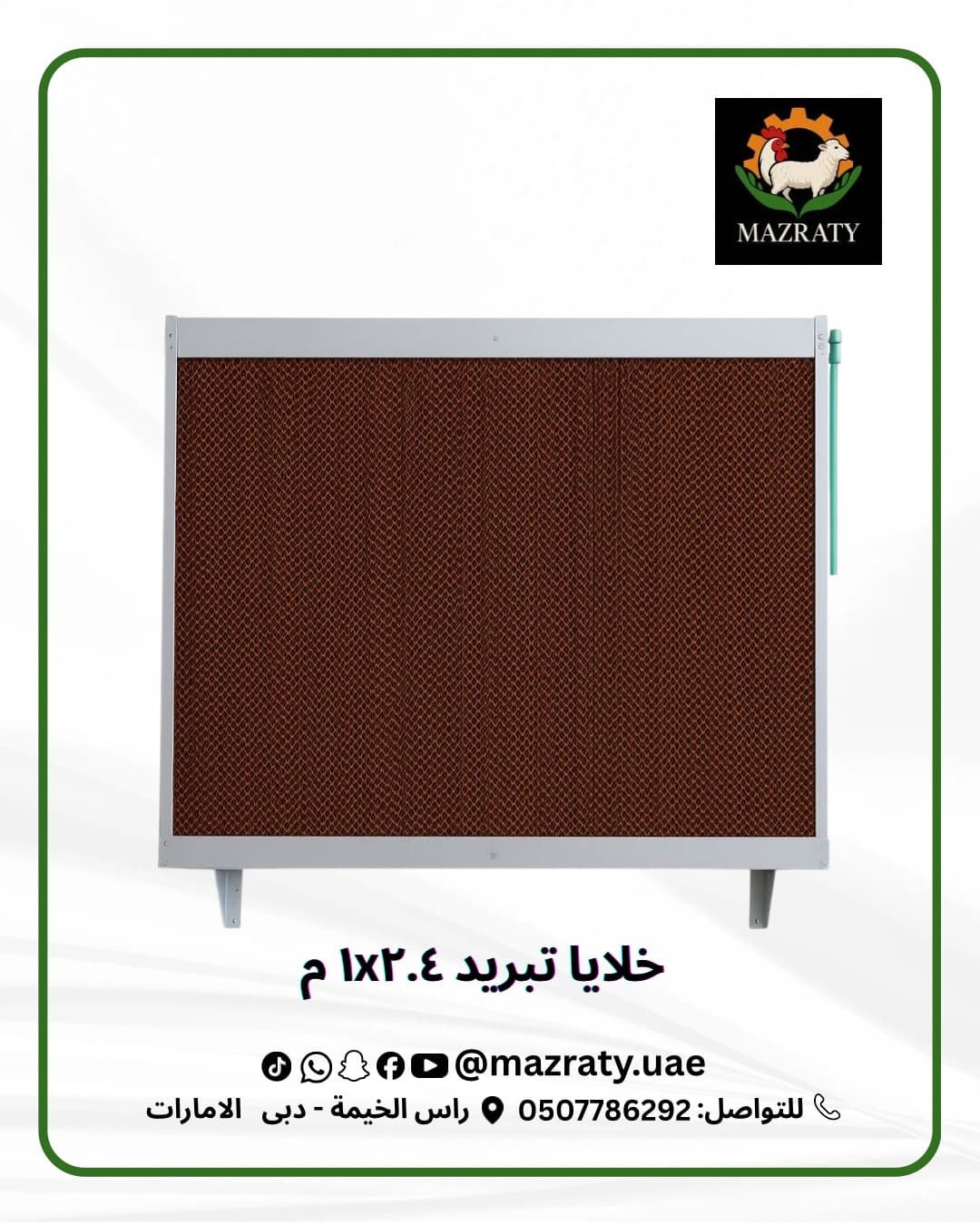
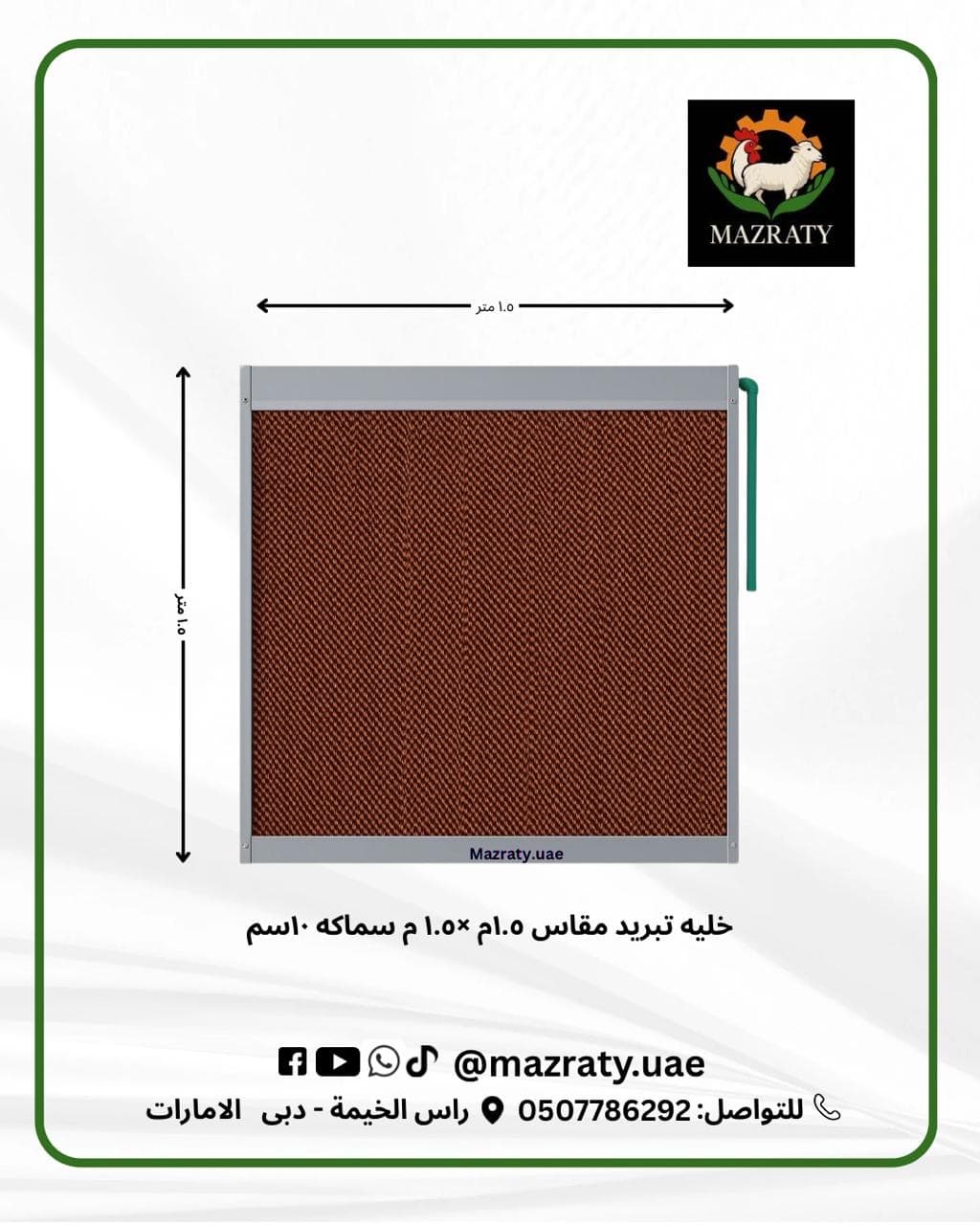
- A recirculating water pump draws water from a sump tank and distributes it evenly across thick cellulose or synthetic cooling pads.
- A powerful motor-driven fan draws hot outside air horizontally or vertically through the saturated pads.
- As the dry hot air contacts the wet pad surface, water molecules evaporate into the airstream, cooling the air by 8 to 15°C before it enters the building.
- The cooled, slightly humidified air then flows through the house, picking up heat and moisture from the birds and the litter, and exits through exhaust fans or ventilation openings on the opposite end.
The wet-bulb depression — the difference between the dry-bulb temperature and the wet-bulb temperature — determines the maximum cooling potential. In the UAE interior, where midday relative humidity can drop to 20 to 30 percent in dry months, a well-designed system can achieve the full 12 to 15°C drop. On humid coastal days when RH reaches 70 to 85 percent, the achievable drop shrinks to 3 to 5°C. Understanding this limitation is critical before making a purchasing decision.
Standalone Desert Cooler Unit vs Built-In Wall Pad System: Which Is Right for Your Farm?
Two fundamentally different configurations exist in the market, and the choice between them (or combining both) significantly affects capital cost, flexibility, and long-term performance.
Standalone Industrial Desert Cooler Unit
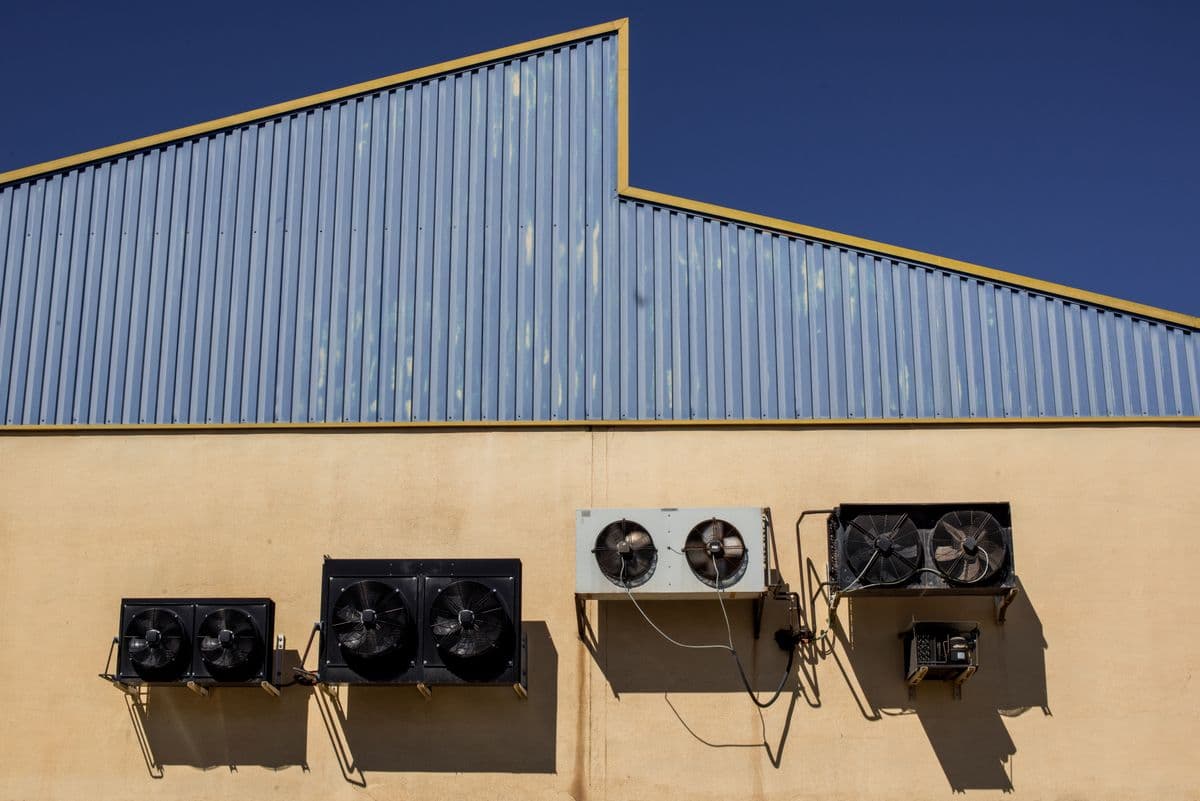
A standalone unit is a self-contained box — motor, fan, pads, pump, and water tank — that can be mounted on the floor, a wall bracket, or the roof. You purchase one or several units and position them at the inlet end of the house. Key advantages:
- Flexibility: units can be repositioned if house layout changes or if you expand your operation.
- Phased investment: you can start with two or three units and add more as your flock size grows.
- Independent water systems: each unit has its own tank, simplifying water management in houses without piped supply.
- Faster installation: no ductwork or continuous pad frames to build; installation typically takes one to two days per unit.
Standalone units available in the UAE market range from compact 5,000 CFM units (ideal for small backyard or starter houses up to 500 m²) up to heavy-duty 50,000 CFM industrial units designed for large commercial houses of 3,000 m² and beyond.
Built-In Wall Pad System (Tunnel Ventilation)
The built-in system — also called a tunnel ventilation pad-and-fan system — integrates cellulose cooling pads into the entire width of the inlet wall of the house, paired with multiple large exhaust fans on the opposite end. Water is distributed from a central header pipe. This is the standard configuration for large integrated broiler operations with house widths of 12 m and above and lengths of 100 m or more.
- Uniform air distribution: the full-width pad delivers consistent airspeed across the entire cross-section of the house, eliminating hot spots.
- Higher total airflow capacity: a 12 m wide house can have 12 linear metres of pad delivering 80,000 to 120,000 CFM.
- Lower maintenance per square metre of pad: a single central pump and header serves the whole system.
When to Combine Both Systems
Many UAE farms use a hybrid approach: a built-in pad system on the primary inlet wall for base-load cooling during tunnel ventilation, combined with standalone desert cooler units at secondary inlets or within the house to boost cooling in high-density sections or for transitional season use when full tunnel ventilation is not activated. Mazraty's technical team can advise on the optimal hybrid configuration for your specific house geometry.
Key Specifications to Compare When Shopping for a Desert Cooler
Do not buy on price alone. The following specifications determine whether a unit will actually cool your house or merely circulate warm air.
Airflow: m³/Hour and CFM
This is the single most important specification. Airflow is stated either in cubic metres per hour (m³/hr) or cubic feet per minute (CFM). Conversion: 1 CFM = 1.699 m³/hr, or approximately 0.0283 m³/min. A unit rated at 18,000 m³/hr delivers approximately 10,600 CFM. Always confirm which standard the manufacturer uses — some Middle East distributors quote m³/hr while UAE buyers often compare in CFM.
Cooling Pad Thickness
Cooling pads are typically 100 mm or 150 mm thick. The thicker 150 mm pad has greater surface area for water-air contact, achieving higher saturation efficiency (up to 92 percent vs 80 percent for 100 mm pads). For UAE summer conditions where every degree counts, 150 mm thick cellulose pads are recommended for all primary poultry cooling applications. Thinner pads suit supplementary or mild-weather use.
Motor Wattage
Industrial desert cooler motors range from 0.75 kW for small 5,000 CFM units up to 15 kW and above for large 50,000 CFM units. Motor efficiency class (IE2 or IE3) matters for operating cost. A 5.5 kW IE3 motor running 16 hours per day for 150 summer days consumes approximately 13,200 kWh — at UAE electricity tariffs for farms, budget accordingly.
Water Pump Flow Rate
The pump must deliver enough water to fully saturate the pad surface at all times. As a rule of thumb, a properly sized pump circulates approximately 1.5 to 2 litres per minute per 0.1 m² of pad face area. Undersized pumps create dry spots on the pads, dramatically reducing cooling efficiency and shortening pad life through uneven mineral deposition.
Water Tank Capacity
Tank capacity determines how long the unit can operate before the float valve must refill it. For continuous operation in UAE summer, you need a reliable mains or well connection; the tank acts as a buffer only. Aim for a minimum tank capacity of 100 litres for units above 15,000 CFM, with a properly adjusted float valve set to maintain the water level automatically.
How to Calculate the Required CFM for Your Poultry House
Undersizing the cooling system is the most common and costly mistake UAE poultry farmers make. The standard sizing formula is:
Required CFM = (Length × Width × Height × Air Changes Per Hour) ÷ 60
Where dimensions are in feet (or convert metres × 3.281 to get feet). Air changes per hour (ACH) for poultry houses in the UAE should be set at a minimum of 60 ACH during peak summer — some integrators specify 80 ACH for high-density broiler houses above 35,000 birds.
Worked Example: 15 m × 80 m Poultry House
- House dimensions: 15 m wide × 80 m long × 3 m average height
- In feet: 49.2 ft × 262.5 ft × 9.8 ft
- House volume: 49.2 × 262.5 × 9.8 = 126,630 cubic feet
- Required air changes: 60 per hour
- Required CFM = (126,630 × 60) ÷ 60 = 126,630 CFM
This 15 m × 80 m house (1,200 m² floor area) needs approximately 126,000 to 130,000 CFM of total cooling and ventilation airflow. If you choose standalone 18,000 CFM units, you need at least 7 units. If you use 25,000 CFM units, you need 5 to 6 units. This calculation only covers airflow; you must also verify that your exhaust fans on the opposite wall have matching or slightly greater total capacity to maintain the pressure differential that drives air through the house.
Important: Mazraty's team at +971 50 535 3412 can perform this calculation for your specific house, factoring in local wind direction, roof insulation, and bird density, so you don't over-invest or under-specify.
Industrial Desert Cooler Models Available in the UAE Market
Three physical configurations are common in the UAE poultry supply market:
Floor-Standing Units (Portable Industrial Coolers)
Capacity range: 5,000 to 25,000 CFM. These units sit on heavy-gauge steel frames with lockable castor wheels. They are ideal for smaller houses under 800 m², for supplementary cooling in specific zones, or for temporary cooling during construction or emergency. Capital cost in the UAE market ranges from approximately AED 800 to AED 4,500 depending on capacity and brand. The lower price point and zero civil works requirement make them attractive for new or small-scale farmers.
Wall-Mount Units
Capacity range: 8,000 to 30,000 CFM. Mounted through or on the inlet wall of the house, wall-mount units save floor space and deliver more concentrated airflow at bird level. They require simple angle-iron framing into the wall opening and are the most common standalone configuration for medium-sized UAE commercial poultry houses (800 to 2,000 m²). Price range: AED 2,500 to AED 8,000.
Roof-Mount Units
Capacity range: 15,000 to 50,000 CFM. Heavy-duty roof-mount evaporative coolers sit on engineered roof frames and discharge cooled air downward through a duct or diffuser into the house. They are used where wall space is limited or where a multi-directional airflow pattern is needed. These units typically require three-phase 380V power and are priced from AED 6,000 to AED 15,000 for units in the 30,000 to 50,000 CFM range.
Positioning Rules: Where to Place Your Desert Coolers
Even the most powerful cooler will underperform if placed incorrectly. These rules are non-negotiable for UAE poultry farms:
- Always position coolers on the windward/inlet side of the house — the side from which the prevailing wind naturally blows. In most Ras Al Khaimah and UAE interior locations, the prevailing summer wind is from the northwest or north. Place cooler inlets on this side.
- Exhaust fans must be on the leeward end — the opposite end from the coolers. This creates a negative pressure tunnel effect that pulls cooled air the full length of the house at consistent velocity.
- Never place two coolers facing each other on opposite walls. This creates turbulence and dead zones rather than directional airflow. All coolers must push air in the same direction toward the exhaust fans.
- Maintain at least 1.5 m of clearance between the cooler discharge face and the nearest structural obstruction (feed lines, nipple drinker pipes) to allow full air expansion before it enters the bird zone.
- Position inlets slightly above bird level (1.8 to 2.2 m from floor) so cool air descends gradually through the litter and bird zone rather than hitting birds directly with high-velocity cold air, which can cause respiratory stress in young chicks.
- Seal all gaps in the building envelope except the designed inlets and exhausts. Air leakage through cracks, open doors, or gaps around pipes reduces the tunnel ventilation velocity by 10 to 30 percent, undermining the cooling effect.
UAE Humidity Limitations: When Evaporative Cooling Is Not Enough
This is the section most suppliers neglect to explain, and it is critical for UAE coastal farms and for all farms during the August and September humid period.
Evaporative cooling efficiency is governed by the difference between dry-bulb and wet-bulb temperatures. In a UAE interior location like Al Ain or Ras Al Khaimah interior in June, midday RH of 25 percent with a dry-bulb of 44°C gives a wet-bulb of approximately 28°C — a potential cooling of 14 to 15°C. Excellent conditions for evaporative cooling.
However, on a typical August or September afternoon in Ras Al Khaimah coastal, you may face a dry-bulb of 42°C with RH of 75 to 85 percent. The wet-bulb rises to 39°C, leaving only 3°C of theoretical cooling. In practice, after accounting for pad inefficiency and heat gain inside the house, you may achieve only a 1 to 3°C drop — insufficient to protect your flock.
Practical Guidelines for UAE Humidity Management
- When RH exceeds 70 percent, evaporative cooling efficiency drops below 5°C. Continue operating coolers for their airflow and ventilation value, but do not expect meaningful temperature reduction.
- For coastal farms or farms in low-lying areas subject to frequent high-humidity events, a hybrid system combining evaporative pre-cooling with a partial refrigerated cooling stage is the recommended long-term solution.
- A practical interim measure during humidity spikes: maximize exhaust fan speed to increase air velocity over the birds (wind chill effect), which reduces perceived heat stress even if air temperature does not drop significantly.
- Monitor both a dry-bulb thermometer and a wet-bulb thermometer (or electronic RH sensor) inside the house continuously during summer. Mazraty supplies both simple analog psychrometers and digital temperature-humidity-data-logging controllers for farm climate monitoring.
Water Quality Requirements: Protecting Your Pads from Scale
Water quality is the most frequently overlooked operational factor in UAE evaporative cooler performance. UAE groundwater and in many areas even municipal water supplies carry high mineral content — total dissolved solids (TDS) commonly ranging from 1,200 to 3,500 ppm. As water evaporates from the pads, the dissolved minerals remain and concentrate. Scale buildup on cellulose pads reduces airflow, cuts cooling efficiency, and shortens pad life from a typical 3 to 5 years down to as little as 6 to 12 months.
Water Quality Targets
- TDS below 1,500 ppm is the maximum recommended for cellulose cooling pads. Below 800 ppm is ideal.
- If your source water exceeds 1,500 ppm TDS, consider installing a simple reverse osmosis blending system on the cooler supply line, or blend with RO-treated water to dilute mineral content.
Float Valve and Bleed-Off System
A bleed-off (or bleed-down) system continuously drains a small fraction of the sump water — typically 5 to 15 percent of pump circulation — to prevent mineral concentration buildup. The float valve simultaneously replaces the drained water with fresh supply. This simple mechanism can triple pad life in high-TDS areas. All Mazraty-supplied industrial coolers come with adjustable bleed-off valves. Set bleed-off rate based on your source water TDS — higher TDS requires a higher bleed-off rate.
Electrical Requirements: Single-Phase vs Three-Phase
Matching the cooler to your available power supply is essential — installing a three-phase unit on a farm with only single-phase supply requires either a phase converter (which adds cost and efficiency loss) or a new supply line from the DEWA/FEWA meter room.
Single-Phase 220V Units
Units up to approximately 18,000 CFM (with motor power up to 1.5 to 2.2 kW) are typically available in single-phase 220V configuration. These are suitable for small to medium UAE poultry houses up to 800 m². Starting current for direct-on-line (DOL) single-phase motors can be 5 to 7 times rated current — ensure your MCB rating and cable sizing account for this inrush.
Three-Phase 380V Units
Units above 18,000 CFM and all units with motors above 2.2 kW should be specified as three-phase 380V. Three-phase motors start more smoothly, run more efficiently, and have longer bearing life than single-phase equivalents at the same power rating. Cable sizing for a 5.5 kW three-phase motor running at full load should be minimum 4 mm² copper — consult a licensed UAE electrician for your specific cable run length.
VFD (Variable Frequency Drive) for Large Motors
For large roof-mount or high-capacity wall-mount units with motors of 5.5 kW and above, fitting a VFD (variable speed drive) allows you to modulate fan speed based on temperature setpoint rather than running at 100 percent constantly. This reduces energy consumption by 40 to 60 percent during transitional periods, extends motor and bearing life, and eliminates the high inrush starting current. Mazraty can supply VFD-ready industrial coolers and source compatible drives for retrofitting existing units.
Maintenance Schedule: Keeping Your Desert Cooler at Peak Performance
A poorly maintained evaporative cooler loses efficiency rapidly in UAE conditions. The following schedule applies to all poultry farm installations:
Weekly
- Inspect pads for scale buildup, algae growth, or physical damage. Green algae on pads indicates insufficient bleed-off rate or poor water quality — increase bleed-off and check TDS.
- Check sump water level and float valve operation.
- Verify water distribution — all pad areas should be evenly wet. Dry streaks indicate blocked distribution pipes or low pump flow.
- Check for unusual motor noise or vibration — early indicator of bearing wear.
Monthly
- Descale pads: dissolve 1 kg of citric acid or white vinegar (10 litres) in the sump tank and run the pump for 2 hours with fans off, then flush with fresh water. This removes calcium carbonate deposits and restores pad airflow.
- Check belt tension on belt-drive models — deflection should be 12 to 15 mm per 300 mm of belt span. A loose belt slips and reduces airflow; a too-tight belt accelerates bearing wear.
- Lubricate motor and fan shaft bearings with appropriate grease (follow manufacturer spec — over-greasing is as damaging as under-greasing).
- Flush sump tank completely to remove sediment accumulation.
- Clean water distribution header holes with a small wire — mineral deposits partially block the small-diameter distribution holes, causing uneven pad wetting.
Seasonal (End of Cooling Season)
At the end of the UAE summer cooling season (typically October), prepare coolers for storage or reduced-use period as described in the winterization section below.
Cost Comparison: Desert Cooler vs Split AC for Poultry Farms
This is where the industrial desert cooler makes its strongest case. The numbers for a UAE poultry operation are compelling:
| Parameter |
Desert Cooler |
Refrigerated Split AC |
| Capital cost per 10,000 CFM of cooling |
AED 2,500 – AED 5,000 |
AED 15,000 – AED 35,000 |
| Power consumption per 10,000 CFM |
1.5 – 3 kW |
8 – 15 kW |
| Daily electricity cost (16 hrs, UAE farm tariff ~0.25 AED/kWh) |
AED 6 – 12 per unit |
AED 32 – 60 per unit |
| Seasonal operating cost (150 summer days) |
AED 900 – 1,800 per unit |
AED 4,800 – 9,000 per unit |
| Maintenance cost (annual) |
AED 200 – 500 per unit |
AED 800 – 2,000 per unit |
| Typical electricity savings |
70 – 80% lower than split AC |
For a 15 m × 80 m house requiring seven 18,000 CFM units, the capital saving over equivalent split AC cooling capacity is approximately AED 80,000 to AED 150,000. The annual operating cost saving is approximately AED 25,000 to AED 50,000. Payback period on the desert cooler investment is typically 6 to 12 months compared to the refrigerated alternative.
Seasonal Storage: How to Winterize Your Desert Cooler
UAE poultry farms typically do not require active evaporative cooling from November through April. Properly winterizing your units each October protects your investment and ensures the coolers start the next summer in peak condition.
- Drain the sump tank completely. Stagnant water left in tanks over winter promotes bacterial and algae growth that will contaminate the water system and clog distribution pipes by the time you restart.
- Run the pump dry briefly to expel water from distribution pipes, then remove and clean the pump impeller housing.
- Inspect and clean cooling pads. If pads have significant scale buildup or visible damage, replace them now rather than discovering the problem in June when suppliers are under peak demand and lead times are extended.
- Cover the unit with a breathable cover or tarp (not airtight plastic — trapped humidity encourages corrosion). Cover both the inlet face and the discharge grille.
- Apply a light coat of corrosion-inhibiting oil to exposed unpainted steel surfaces on the frame and motor housing.
- Store in a location protected from dust storms (shamal) if the unit is portable. UAE winter dust events can pack abrasive particles into motor windings and pad frames if units are left uncovered.
- Reconnect and test-run the unit in April — a full month before cooling season begins — to identify any bearing, pump, or pad issues before you are in emergency mode.
Mazraty: Your Partner for UAE Poultry Farm Cooling Solutions
Mazraty — مزرعتي — is Ras Al Khaimah's leading supplier of farm equipment and agricultural machinery, with a full range of industrial evaporative coolers from 5,000 CFM compact floor-standing units to 50,000 CFM heavy-duty roof-mount systems. Our team has direct experience with UAE poultry farm conditions: the summer heat, the humidity peaks, the water quality challenges, and the electrical infrastructure realities of farms across Ras Al Khaimah, Fujairah, Sharjah inland, and Abu Dhabi.
When you contact Mazraty, you are not just buying equipment — you are getting a farm cooling consultation that covers your house dimensions, bird density, local climate data, water supply TDS, and available electrical supply, so that the units we recommend are correctly sized for your operation from day one.
Contact Mazraty on WhatsApp at +971 50 535 3412 today to book your free poultry farm cooling consultation. Tell us your house size, flock size, and current cooling setup, and we will recommend the right units, calculate your required CFM, and provide a complete supply and installation quotation. Beat the summer before it arrives — contact Mazraty now.
Reviewed planning sources
These references support operating and welfare principles. Final design and health programs remain site-, strain-, authority- and veterinarian-specific.
Frequently Asked Questions
Is CFM enough to size a desert cooler?
No. Match airflow to house volume, humidity, outlet area and water distribution, then verify performance on site.
When is evaporative cooling a poor fit?
Its effect falls as humidity rises or exhaust weakens, so site climate and ventilation must be reviewed first.