Find the right hammer mill and grain crusher for your UAE farm. Mazraty's complete guide covers screen sizes, motor capacity, AED pricing, and dust management for UAE conditions.
Hammer Mill vs. Feed Chopper: Understanding the Difference
Before diving into hammer mill specifics, it is worth clarifying a common source of confusion among farmers:
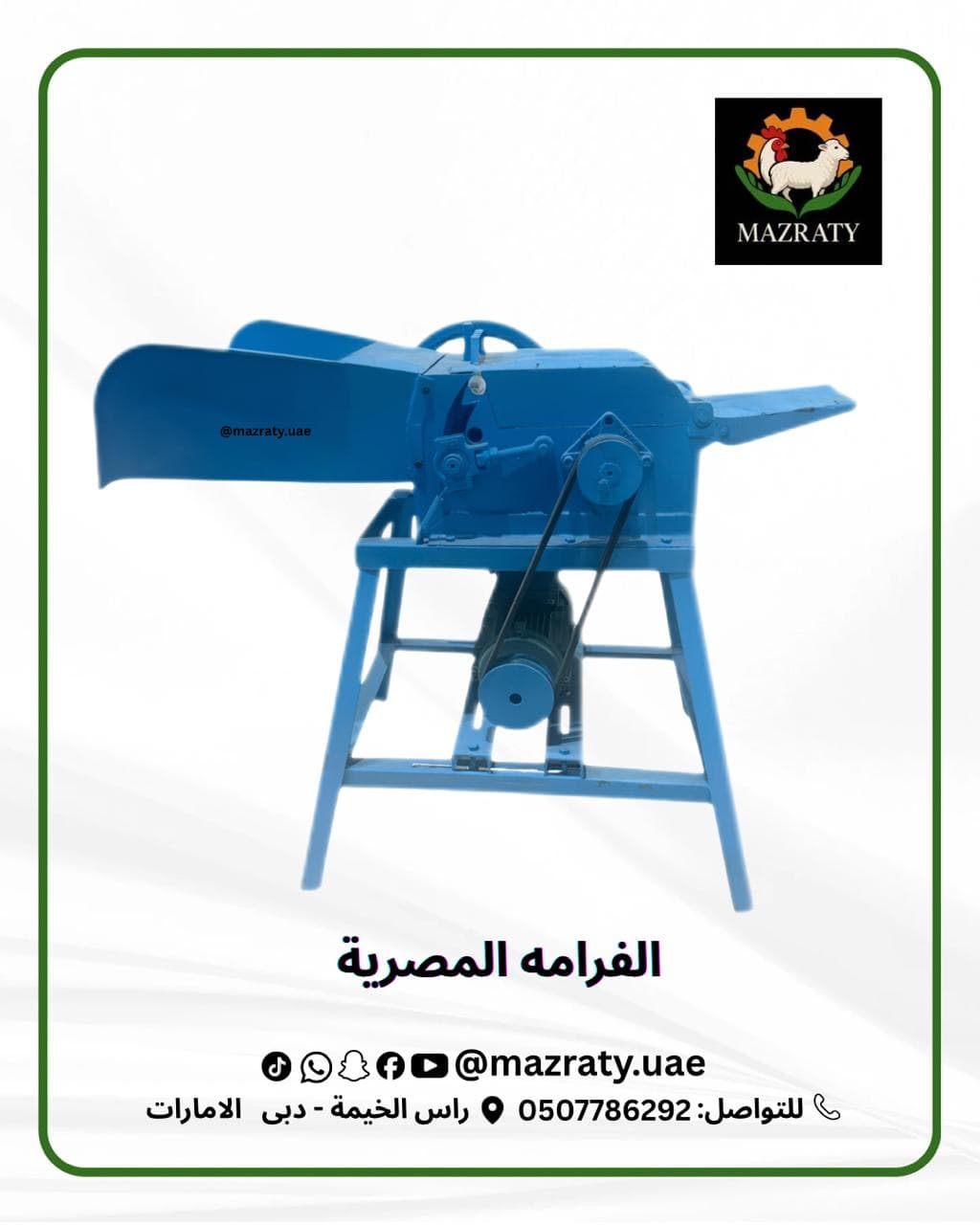
- Feed Choppers / Chaff Cutters: These machines cut long fibrous materials — green fodder, straw, silage — into short pieces. They work by shearing, not grinding.
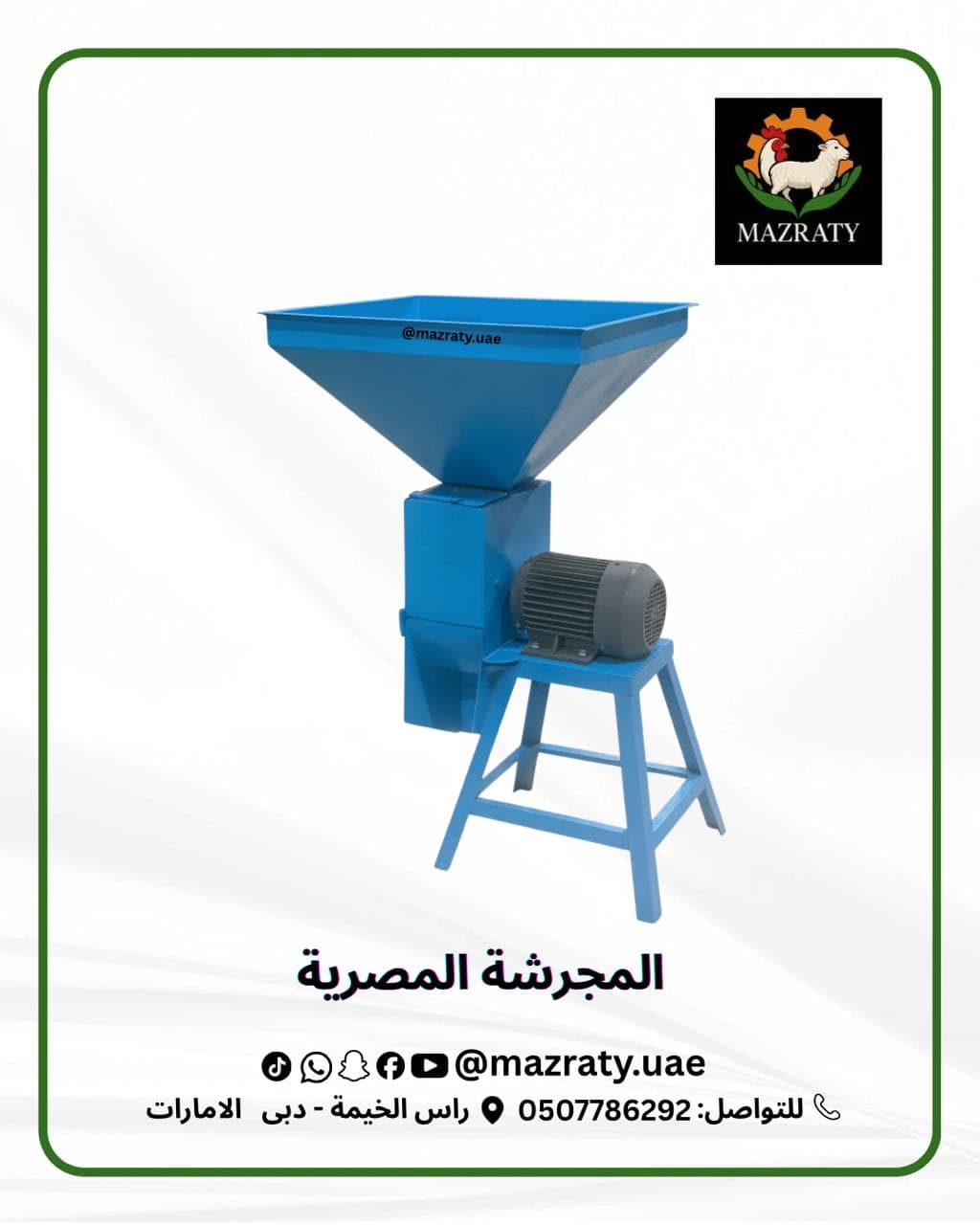
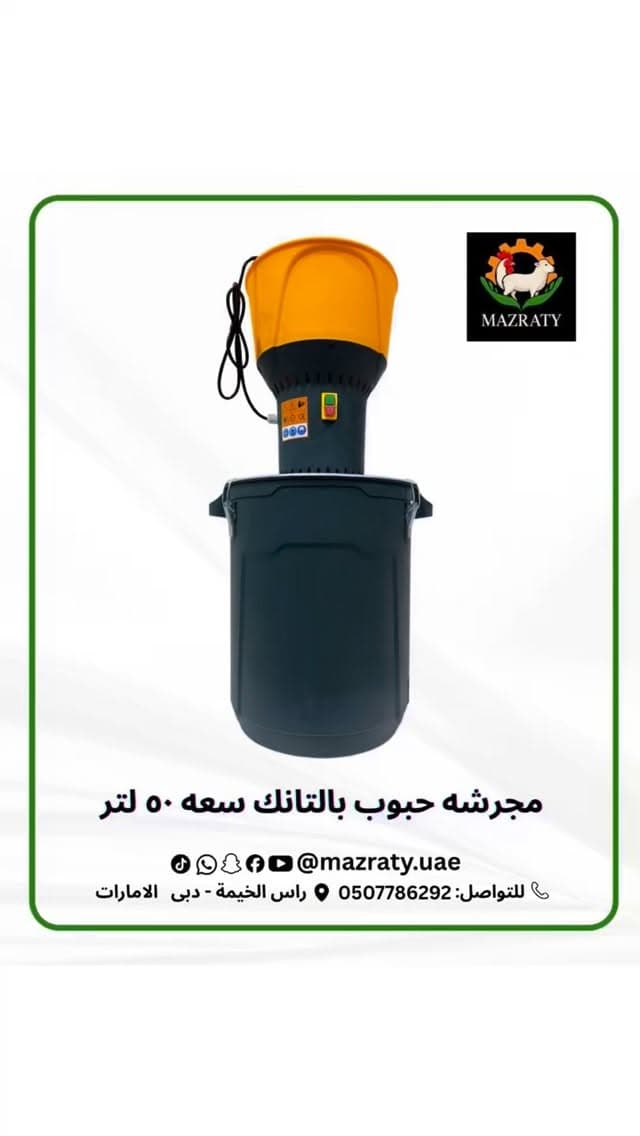
- Hammer Mills / Grain Crushers: These machines reduce hard grain kernels — corn, barley, wheat, soybean — into fine or coarse meal through high-speed impact. They produce a powder or meal, not cut pieces.
This article focuses entirely on hammer mills for grain grinding. The two machines serve very different purposes, and your farm may ultimately need both.
How a Hammer Mill Works
The operating principle of a hammer mill is elegant in its simplicity, yet highly effective across a wide range of materials and particle sizes:
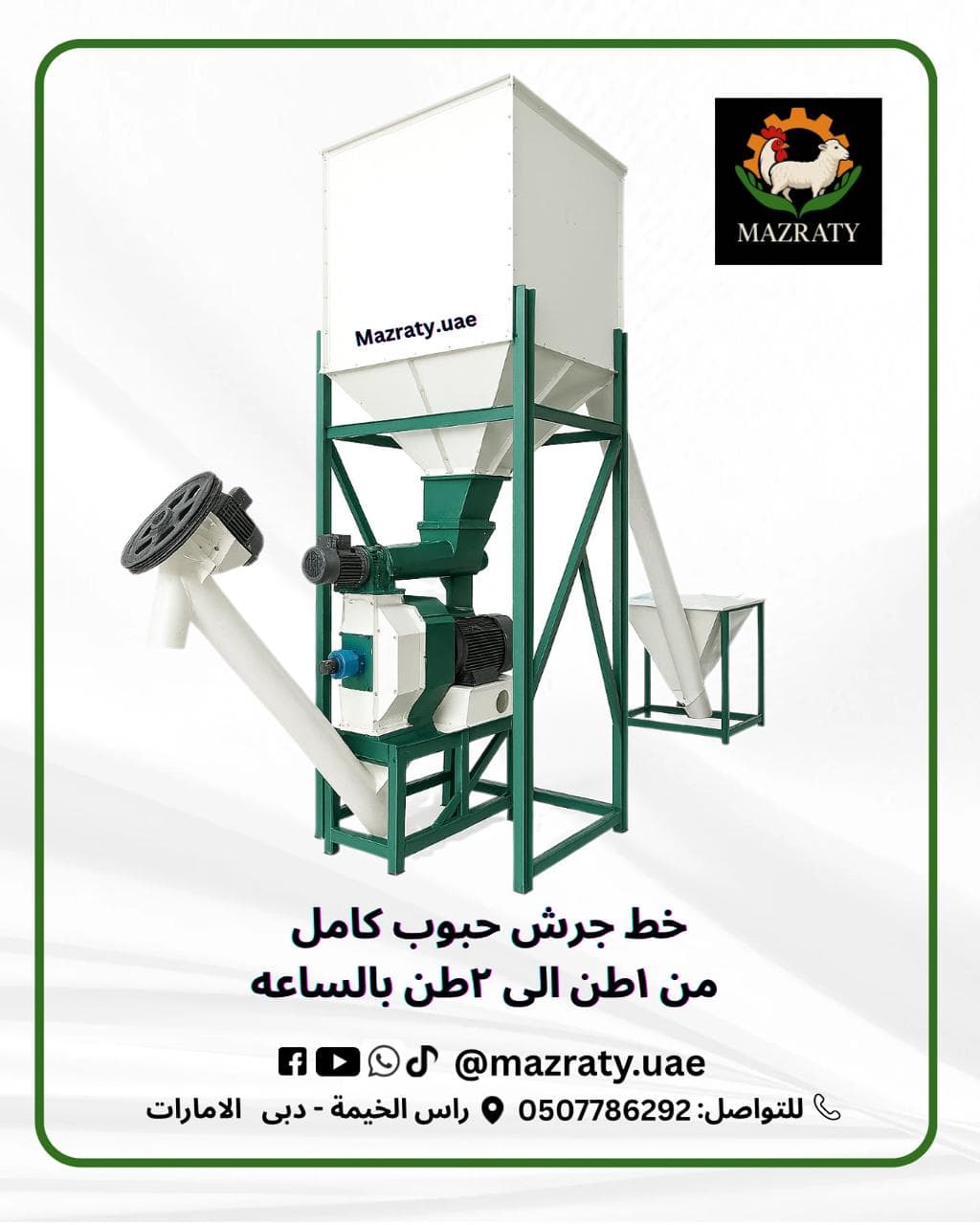
- Grain kernels are fed into a hopper at the top of the machine, either by gravity or with a feeding screw auger for larger units.
- Inside the grinding chamber, a central rotor shaft spins at 2,500 to 3,600 RPM. Attached to this shaft are rows of free-swinging steel hammers.
- As the hammers rotate at high velocity, they strike the grain repeatedly, reducing it by impact and attrition against the interior walls of the chamber.
- Ground material migrates outward to a screen (perforated metal plate) fitted around or below the grinding chamber. Particles small enough to pass through the screen exit as finished meal. Oversized particles remain inside and continue to be ground.
- The finished meal collects in a bin below the machine or is conveyed pneumatically to storage bins or a mixer.
The key variable in this process is the screen — change the screen hole size and you change the particle size of the output. This makes the hammer mill the most versatile grain-reduction machine available to farm operators.
Screen Sizes for Different Animals: The Critical Decision
Particle size directly affects feed digestibility, feed efficiency, and pelleting performance. Using the wrong screen size wastes energy and reduces animal performance. Here is a practical guide:
Poultry (Broilers, Layers, Turkey, Duck)
Poultry have relatively short digestive tracts and require fine to medium particle sizes for efficient nutrient absorption. Finer grinding also produces better pellet quality if you are pelleting your feed:
- Day-old chicks to 3 weeks: 1.0 to 1.5 mm screen
- Broilers (grow-out phase): 2.0 to 3.0 mm screen
- Laying hens: 2.5 to 3.5 mm screen
- Turkey and waterfowl: 3.0 to 4.0 mm screen
Research consistently shows that poultry fed properly ground grain at 600 to 900 microns average particle size show better feed conversion ratios than those fed coarsely ground grain.
Sheep and Goats
Ruminants can handle coarser grinding since their multi-stomach digestive system partially compensates for incomplete mechanical breakdown. However, grinding still significantly improves starch utilization:
- General purpose ruminant grinding: 4.0 to 6.0 mm screen
- Lactating ewes and high-producing does: 3.0 to 4.0 mm for better energy density
Cattle and Buffaloes
Coarse grinding is sufficient and actually preferred for cattle. Over-fine grinding of barley for cattle can cause digestive acidosis. Recommended screen sizes:
- Beef cattle: 6.0 to 8.0 mm screen
- Dairy cows (concentrate portion): 4.0 to 6.0 mm screen
- Calves (under 3 months): 3.0 to 4.0 mm screen
Horses and Donkeys
Horses are sensitive to over-fine grinding of grain as it can cause starch overload in the hindgut. Coarse cracking is preferred:
- Horses and donkeys: 6.0 to 10.0 mm screen (grain cracking rather than fine grinding)
Fish and Shrimp (Aquaculture)
Aquaculture feeds require extremely fine grinding — often below 0.5 mm — to ensure even suspension in water and proper pellet formation. Standard hammer mills need special fine screens and high-speed motors for this application.
Mazraty keeps all common screen sizes in stock. We can supply complete screen sets so your farm can process different grains for different animal groups. Contact us on WhatsApp: +971 50 535 3412.
Flat Screen vs. Round Screen Hammer Mills
This technical distinction significantly affects performance and is worth understanding before you purchase:
Flat Screen (Bottom Discharge) Mills
- The screen sits below the rotor in a flat horizontal position.
- Simpler design, lower cost, easier screen replacement.
- Limited screen area means the grain-to-screen contact time is shorter.
- Can handle medium to coarse grinding efficiently.
- Fine grinding (below 2 mm) produces more heat and reduces throughput.
- Best for: cattle, sheep, general farm use with coarser requirements.
Round Screen (Full Circle / Peripheral Screen) Mills
- The screen wraps fully around the rotor, dramatically increasing screening area — often 3 to 5 times more screen surface area than flat screen models.
- Greater screen area means lower screen velocity, less heat buildup, and more uniform particle size distribution.
- Significantly higher throughput per motor kilowatt compared to flat screen designs.
- Better for fine grinding (poultry feed, pelleted feed).
- Higher initial cost but lower operating cost per tonne of output.
- Best for: poultry operations, high-volume farms, feed pelleting lines.
Mazraty's recommendation for UAE farms: if your operation focuses on poultry with daily grinding volumes above 500 kg, the round screen mill pays for itself within weeks through lower energy costs and higher output. For mixed farms grinding primarily for cattle and sheep, a quality flat screen mill is perfectly adequate.
Motor and Capacity Sizing: Matching the Machine to Your Farm
Choosing the correct capacity is the most important financial decision in this purchase. An undersized machine creates a production bottleneck; an oversized machine wastes capital and electricity.
Step 1: Calculate Your Daily Grain Requirement
Add up the grain component of each animal group's daily ration:
- Laying hen: approximately 90 to 100 grams of grain per day
- Broiler chicken (5 weeks): approximately 120 to 150 grams per day
- Sheep (maintenance): approximately 400 to 600 grams of concentrate grain per day
- Dairy cow (high production): approximately 6 to 10 kg of grain concentrate per day
Step 2: Calculate Required Hourly Throughput
Divide daily requirement by your planned daily operating hours (typically 2 to 4 hours for a farm mill):
Example: 5,000 broilers needing 750 kg of grain daily, to be ground in 3 hours = 250 kg/hour capacity needed.
Step 3: Match to Available Machine Categories
Here are the common capacity tiers available in the UAE market with approximate AED pricing:
- Small (2 to 5 kW motor): 100 to 300 kg/hour — suitable for small family farms up to 500 poultry or 50 sheep. Price range: AED 800 to 2,000.
- Medium (7.5 to 15 kW motor): 500 to 1,200 kg/hour — ideal for mid-scale farms of 2,000 to 10,000 birds or 200 sheep. Price range: AED 3,000 to 8,000.
- Large (22 to 55 kW motor): 1.5 to 5 tonnes/hour — for large commercial farms and small feed mills. Price range: AED 12,000 to 35,000.
- Industrial (75 kW and above): 5 to 20+ tonnes/hour — for full-scale feed manufacturing plants. Price range: AED 50,000 and above.
For a personalized capacity recommendation and pricing, contact Mazraty on WhatsApp: +971 50 535 3412. We will help you calculate exactly what you need at no cost.
Common Grain Types in the UAE and Their Grinding Characteristics
Yellow Corn (Maize)
The backbone of poultry and livestock diets across the UAE. Medium hardness, grinds easily, produces relatively low heat. Widely available in Ras Al Khaimah and Dubai markets. Optimal moisture for grinding: 12 to 14 percent.
Barley
Widely used in sheep, goat, and camel rations in the UAE. Higher fiber content than corn. The outer husk is tough and requires good hammer condition for efficient grinding. Produces more dust than corn.
Wheat
Used as an energy source in poultry diets and some ruminant rations. Produces more fine dust than corn. Screen easily and avoid over-grinding for ruminants.
Roasted Soybean
High oil content causes meal to stick to screens more readily than dry grains. Clean screens more frequently when processing soybeans. Always use heat-treated or roasted soybeans to deactivate anti-nutritional factors.
Sorghum (Milo)
Increasingly used in the Gulf region as a corn substitute. Grinds similarly to corn. Slightly harder kernel may accelerate hammer wear.
Dust Management: A Critical Challenge for UAE Farm Operations
Grain mills generate substantial fine dust, and this presents amplified challenges in the UAE's hot, dry climate. Proper dust management is not optional — it is a safety and operational necessity.
Why Dust Management Matters
- Explosion risk: Grain dust suspended in air at concentrations above 50 g/m3 is explosive. A single electrical spark in a poorly ventilated mill room can cause a catastrophic explosion.
- Worker health: Chronic exposure to grain dust causes respiratory conditions including occupational asthma, hypersensitivity pneumonitis, and chronic bronchitis.
- Equipment damage: Fine dust infiltrates motor windings, bearings, and electrical panels, significantly shortening equipment life.
- Feed contamination: Dust settling in storage areas creates stale, oxidized feed fractions that reduce palatability and nutritional value.
Recommended Dust Control Systems for UAE Conditions
- Cyclone Dust Separator: The first line of defense. Uses centrifugal force to separate coarser particles from the air stream. Cost-effective and low-maintenance. Essential for any mill above 7.5 kW. Mazraty supplies cyclone separators matched to each mill model.
- Bag Filter House: Captures fine particles that pass through the cyclone. Provides very high collection efficiency. Clean bags weekly; replace annually in typical UAE operating conditions.
- Positive Pressure Ventilation: Install exhaust fans to maintain slight negative pressure in the mill room, directing air and dust toward collection systems rather than into the surrounding environment.
- Grain Moisture Management: UAE grain imports often arrive very dry (below 10 percent moisture). Grinding extremely dry grain generates more fine dust and more heat. If grain moisture is below 10 percent, lightly mist the grain with water (add 0.5 to 1 percent by weight) before grinding to reduce dust generation and screen blinding.
- Enclosed Transfer Systems: Use enclosed augers or pneumatic conveyors rather than open belt conveyors when moving freshly ground meal to storage. This eliminates a major secondary dust source.
Mazraty provides complete dust management system packages designed for the UAE climate. Contact us on WhatsApp +971 50 535 3412 for a system design consultation.
Installation Considerations for the UAE Climate
- Mount the mill on a reinforced concrete plinth at least 150 mm thick to absorb vibration and simplify cleaning. Use anti-vibration mounts between machine and concrete.
- Provide shade — direct UAE summer sun raises ambient temperature to 48 degrees Celsius and above. Motor windings rated for 40 degrees Celsius ambient will fail prematurely when exposed to full sun. Build a simple corrugated metal shade structure if a permanent building is not available.
- Install a dedicated ventilation fan drawing at least 20 air changes per hour through the mill room. This single measure can reduce motor operating temperature by 8 to 12 degrees Celsius.
- Fit motor thermal protection (overload relay or thermistor protection) set to the motor's rated temperature class. This prevents burnout during peak summer loads.
- Position the mill as close as possible to grain storage to minimize manual handling or conveyor distances.
- Ensure a minimum 2-meter working space on all sides for hammer replacement, screen changes, and motor maintenance access.
- Install IP54 or higher rated electrical panels to protect against the fine dust generated by the milling operation.
Maintenance Schedule for Grain Mills in UAE Conditions
UAE operating conditions — high ambient temperature, dry dusty air — accelerate wear compared to temperate-climate benchmarks. Follow this schedule to protect your investment:
Daily Checks
- Empty the dust collector and meal collection bin before starting.
- Listen for unusual vibration or bearing noise before and during operation.
- Check motor temperature — should not exceed motor rating plate temperature in ambient conditions.
- Clear any grain residue from the feed hopper after shutdown to prevent moisture absorption overnight.
Weekly Maintenance
- Remove and inspect the screen for holes, cracks, or deformation. A damaged screen passes oversized particles and defeats the purpose of controlled grinding.
- Inspect hammers for wear. Flip worn hammers to expose a fresh striking face — this doubles hammer life.
- Check V-belt tension. A slack belt causes slippage, heat, and power loss. Tension to manufacturer specification.
- Lubricate rotor bearings with the specified grease. In UAE conditions, use high-temperature, water-resistant grease and apply more frequently than the manufacturer's temperate-climate recommendation.
Monthly Maintenance
- Measure rotor shaft vibration with a simple vibration meter or observe for visible wobble. Unbalanced wear across the hammer set causes vibration that damages bearings and the machine frame.
- Inspect all fasteners — nuts, bolts, and screen clamps. Vibration loosens fasteners; a loose hammer bolt is a catastrophic failure risk.
- Check the electric motor's capacitors (if single-phase) and starting relay.
- Inspect the inside of the grinding chamber for worn liners or shell cracks.
Every 6 Months or 500 Operating Hours
- Replace the complete hammer set. Never replace half the hammers — always replace all hammers in matched sets to maintain rotor balance.
- Replace V-belts as a matched set if any single belt shows cracking or glazing.
- Have a qualified electrician inspect motor windings, particularly if the motor has been operating in dusty conditions.
- Replace screen if thickness has reduced by more than 30 percent from new.
Mazraty stocks all wear parts including hammers, screens in all standard sizes, V-belts, and bearings. Free delivery anywhere in the UAE. Call or WhatsApp us at +971 50 535 3412 to order parts.
Economic Analysis: Is Buying a Hammer Mill Worth It?
The economics of on-farm grain grinding are compelling in the UAE market. Here is a realistic calculation:
Current UAE Market Prices (Approximate)
- Ready-ground corn-soy broiler starter feed: AED 280 to 340 per 100 kg
- Whole yellow corn grain: AED 180 to 220 per 100 kg
- Price saving by grinding your own: AED 80 to 120 per 100 kg (30 to 40 percent)
Example Farm: 5,000 Broilers
- Daily grain consumption (corn component): approximately 600 kg/day
- Daily saving by grinding own corn: 600 kg x AED 1.00 per kg = AED 600 per day
- Monthly saving: approximately AED 18,000
- Cost of a suitable 11 kW hammer mill: approximately AED 5,500
- Payback period: under 10 days of operation
Even accounting for electricity costs (approximately AED 30 to 40 per day for an 11 kW motor running 4 hours) and maintenance (approximately AED 300 per month), the net saving remains AED 17,000 to 17,500 per month for a 5,000-bird operation.
Larger operations see proportionally greater savings. A 50,000-bird farm grinding 6 tonnes of grain daily saves approximately AED 180,000 per month on feed costs alone.
Reviewed planning sources
These references support operating and welfare principles. Final design and health programs remain site-, strain-, authority- and veterinarian-specific.
Frequently Asked Questions
Can I grind wet or freshly harvested grain?
It is strongly not recommended. Grain with moisture content above 15 to 16 percent will clog the screen, cause excessive heat buildup, and dramatically accelerate hammer and screen wear. It can also cause mold growth in ground meal within 24 hours. Dry grain to below 14 percent moisture before grinding. In the UAE, grain imported from international markets is usually at acceptable moisture levels, but verify before processing large quantities.
How often do hammers need replacing?
Typical hammer life is 300 to 800 operating hours depending on grain hardness, hammer steel quality, and whether abrasive foreign matter (soil, small stones) enters with the grain. Flip hammers to a fresh face at half their life. Always replace the complete hammer set as a matched unit to maintain rotor balance. Mazraty keeps hammer sets in stock for all machines we supply.
Why has my machine's power consumption suddenly increased?
The most common causes are: worn hammers that require more energy per unit of grinding, a partially blocked screen (especially with oily grains like soybean), a slipping V-belt, or an oversized batch entering the feed hopper too quickly. Diagnose in this order before calling a technician.
Can the hammer mill be powered by a tractor PTO?
Yes. PTO-driven hammer mills are available and are an excellent option for farms in remote areas of the UAE interior without reliable grid power, or for farms that want the flexibility of portable grinding. Mazraty supplies PTO-driven models suitable for tractors of 40 HP and above. Contact us on WhatsApp +971 50 535 3412 for availability and pricing.
What is the difference between Chinese and European hammer mills?
European mills (primarily from Germany, Netherlands, and Denmark) offer higher precision engineering, longer service life, lower energy consumption per tonne processed, and better spare parts availability globally. They cost significantly more — typically 3 to 5 times the price of comparable Chinese units. Modern Chinese mills from established manufacturers have improved considerably and offer excellent value for small and medium UAE farms that do not require 24/7 industrial operation. Mazraty offers both options and will recommend the appropriate choice based on your operating hours, budget, and long-term plans.
Does Mazraty provide installation and after-sales support across all UAE emirates?
Yes. Mazraty provides free delivery, professional installation, operational training, and ongoing after-sales support across all UAE emirates including Ras Al Khaimah, Dubai, Abu Dhabi, Sharjah, Ajman, Fujairah, and Umm Al Quwain. Our team has been supporting UAE farms for over 20 years. Reach us any time on WhatsApp: +971 50 535 3412.
Choose Mazraty for Your Grain Grinding Equipment Needs
With more than two decades of experience supplying, installing, and maintaining farm equipment across the UAE, Mazraty is the partner you need for grain grinding solutions that work in the real conditions of Gulf agriculture — extreme heat, dusty environments, and demanding production schedules.
Our team will assess your farm's actual production requirements, recommend the correct mill size and screen configuration, handle delivery and installation, and be available for ongoing support. We carry a full inventory of wear parts so your operation is never stopped by a worn hammer or broken screen.
Ready to cut your feed costs significantly? Contact Mazraty today on WhatsApp: +971 50 535 3412. Free delivery across all UAE emirates.