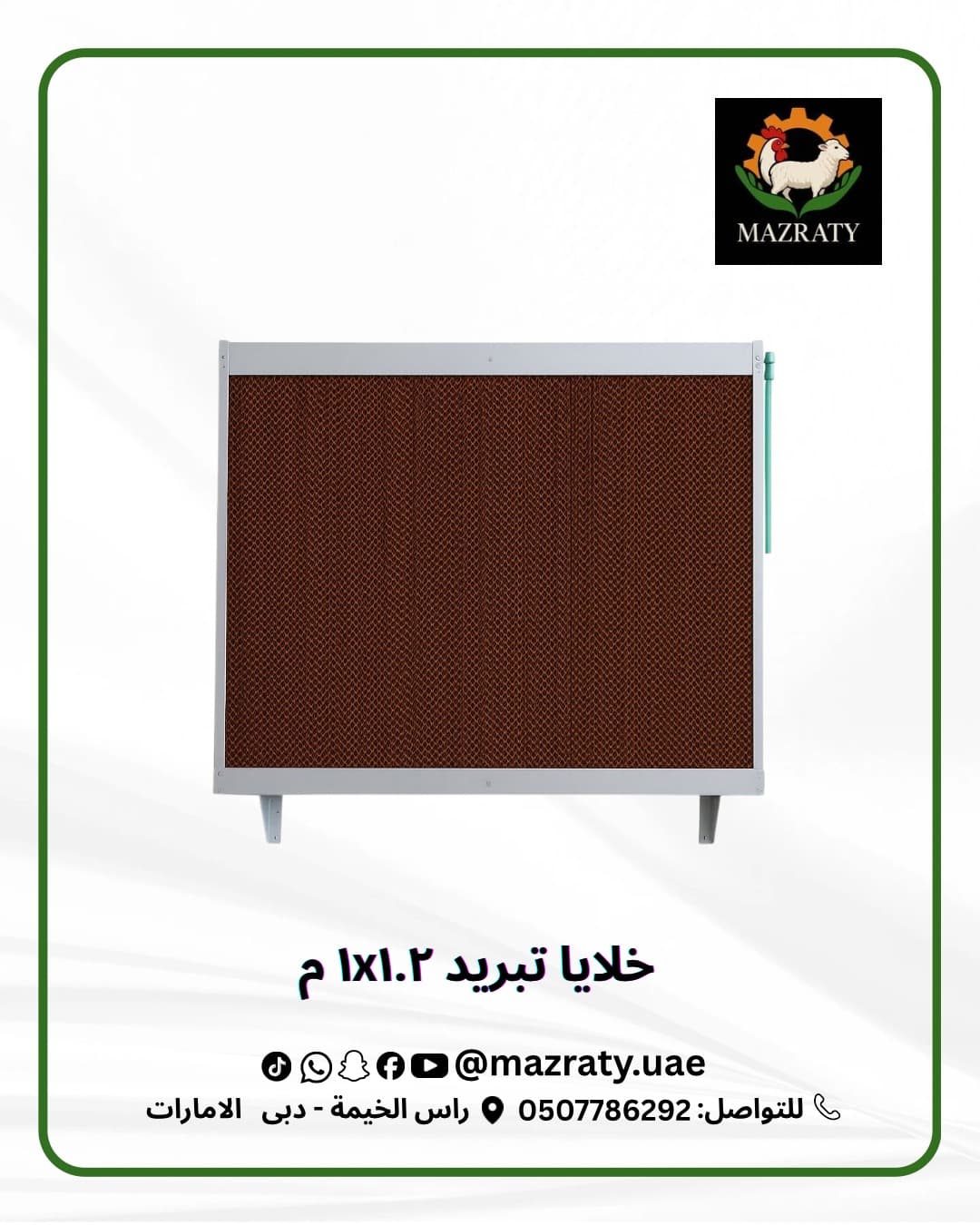
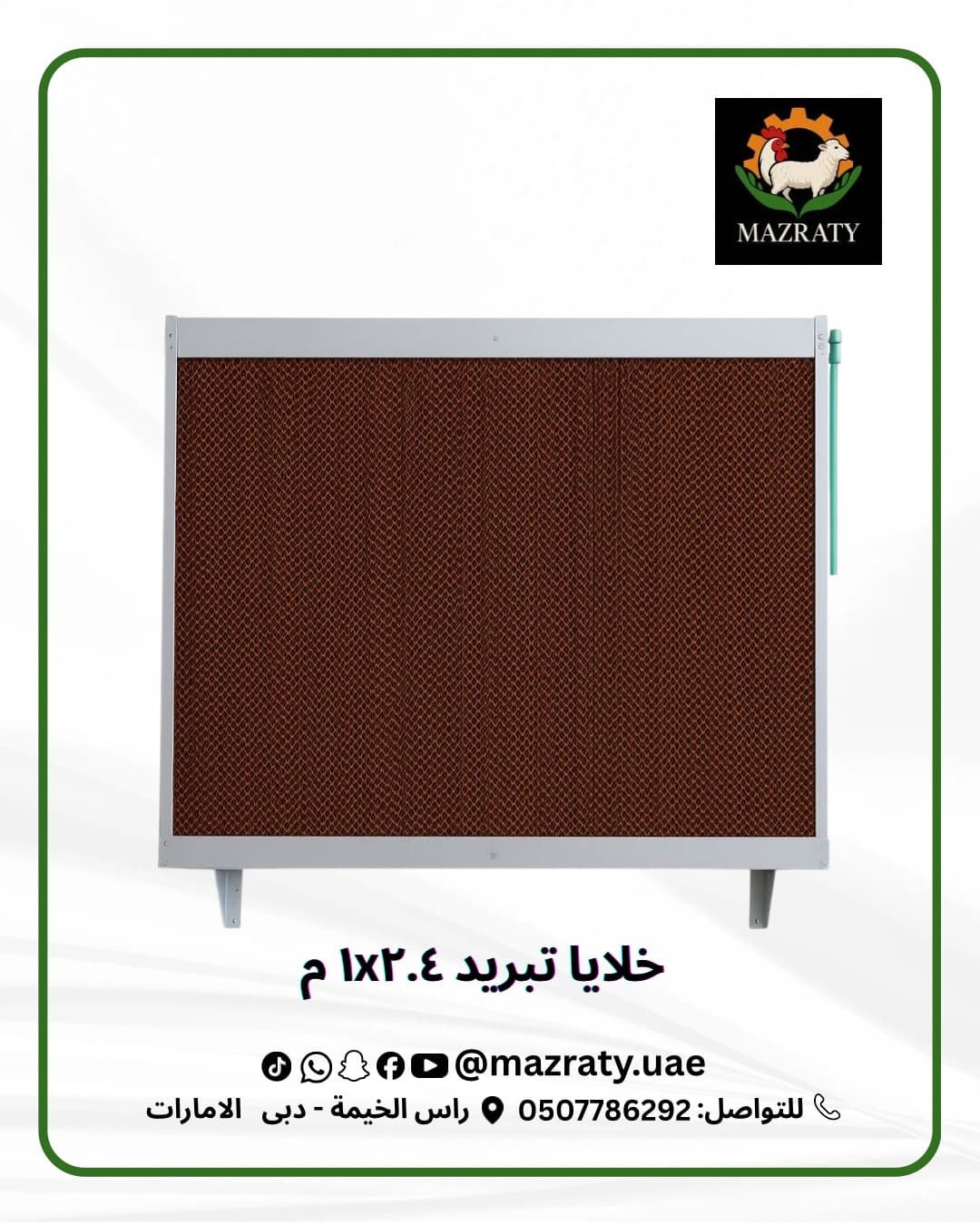
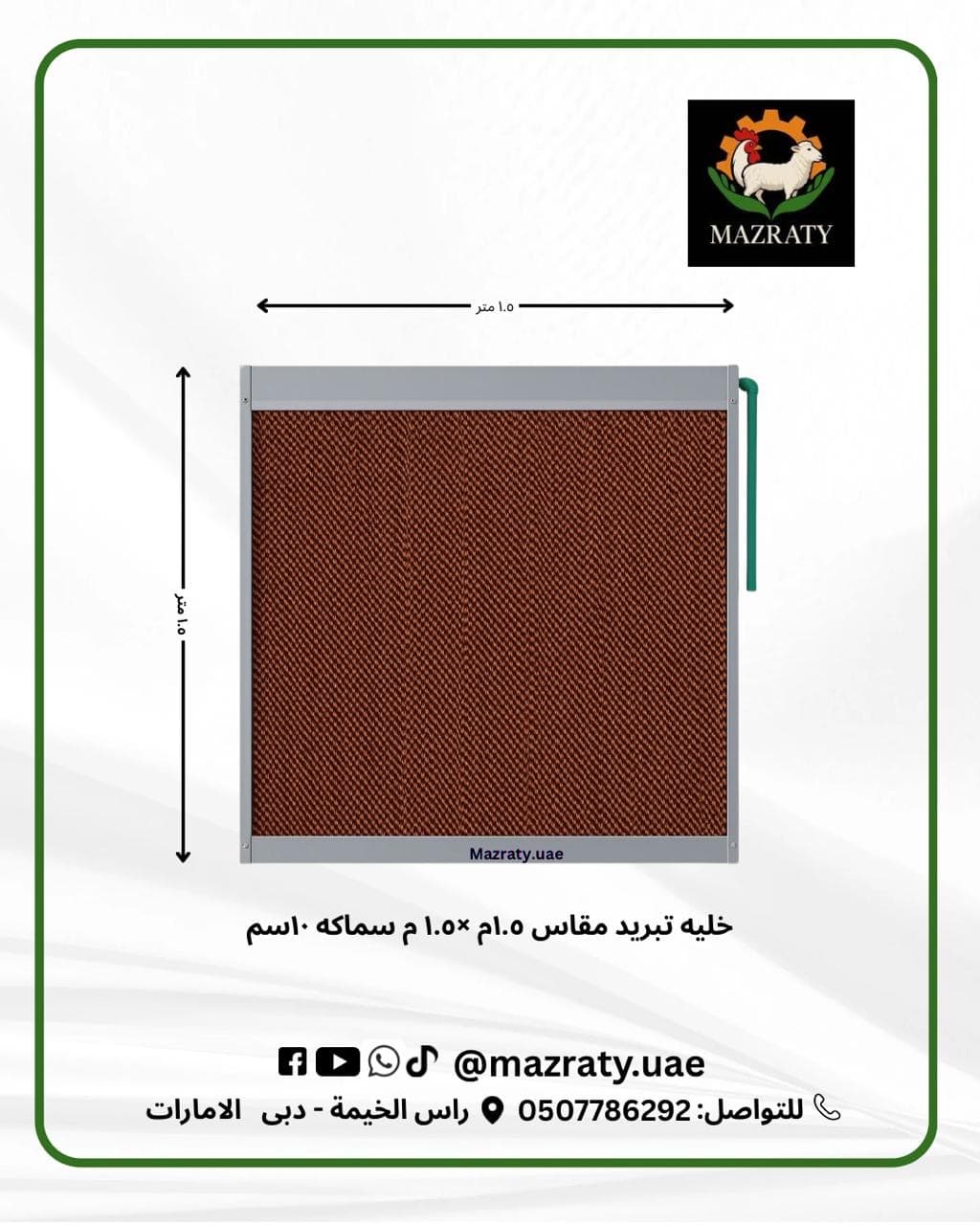
Discover how evaporative air coolers slash temperatures in UAE farms with high efficiency and low running costs. Mazraty supplies and installs the best desert coolers suited for Gulf climate. Contact us on WhatsApp.
Evaporative Air Coolers for UAE Farms: The Smart Cooling Solution
Summer temperatures in the UAE regularly exceed 45 degrees Celsius across inland areas including Ras Al Khaimah's interior, Al Ain, and the regions flanking the Hajar Mountains. For livestock, poultry, and farm operations of any kind, this extreme heat is not merely uncomfortable — it is a direct threat to animal welfare, productivity, and profitability. Heat stress causes sharp drops in egg production and milk yield, suppresses immunity, reduces feed conversion, and in severe cases leads to mass mortality events that can devastate an entire season's returns.
Against this backdrop, the evaporative air cooler — also known as a desert cooler or swamp cooler — has emerged as one of the most practical, cost-effective cooling solutions available to UAE farm operators. It harnesses the natural physics of water evaporation to deliver real, measurable cooling at a fraction of the running cost of conventional air conditioning.
How Evaporative Cooling Physics Work
The operating principle is elegantly simple: when hot, dry air is drawn through water-saturated cooling pads, the water molecules evaporate, absorbing large amounts of thermal energy from the passing air and lowering its temperature by 8 to 15 degrees Celsius. This is the same refreshing effect you feel standing near a waterfall or when a breeze carries moisture across your skin on a hot day.
Unlike conventional air conditioners that rely on refrigerant compression cycles, an evaporative cooler requires only a water pump, a fan, and a set of cooling media pads. The result is energy consumption that is 70 to 80 percent lower than equivalent refrigerant-based cooling systems — a critical advantage given electricity costs and the sheer scale of cooling required on working farms.
Types of Evaporative Coolers Suitable for Farm Use
Direct Evaporative Coolers
The simplest and most affordable category. Warm outside air passes directly through wetted cooling pads before being blown into the space. This type delivers outstanding performance in the dry inland zones of the UAE — Al Ain, interior Ras Al Khaimah, parts of interior Sharjah — where relative humidity regularly falls below 40 percent during the hottest months. A well-sized direct evaporative cooler can bring ambient temperature down from 43 degrees to a manageable 27–30 degrees in these conditions.
- Highest cooling efficiency in dry conditions
- Lowest purchase and installation cost
- Minimal electricity consumption
- Simple maintenance with widely available spare parts
Indirect Evaporative Coolers
In indirect systems, the cooled air never contacts the wet medium directly. Instead, a heat exchanger transfers thermal energy between the wet air stream and the supply air, keeping moisture addition to a minimum. This design suits environments where humidity is a concern, including coastal-adjacent areas or periods of elevated humidity in the transitional seasons.
- Does not add moisture to the cooled space
- More effective on semi-humid days
- Higher unit cost than direct coolers
- Requires periodic heat exchanger cleaning
Two-Stage (Indirect-Direct) Coolers
The two-stage design first pre-cools incoming air indirectly, then passes it through a direct evaporative stage. The result is a deeper temperature drop with minimal humidity gain. These units are the preferred choice for larger operations housing poultry or humidity-sensitive animals in enclosed buildings, and they represent the best performance option when coastal humidity periodically creeps upward.
UAE Humidity Zones: Where Evaporative Cooling Excels
Understanding your farm's humidity profile is the single most important factor before investing in an evaporative cooler. Performance is directly tied to relative humidity in the incoming air.
Excellent Performance — Dry Inland Zones
Interior Ras Al Khaimah, Al Ain, Al Dhahirah, the Hajar mountain foothills: relative humidity drops to 20–40 percent during peak summer months. In these conditions, direct evaporative coolers deliver temperature reductions of 12–16 degrees, easily achieving comfortable livestock environments even during the hottest afternoons.
Good Performance — Semi-Coastal Zones
Interior Sharjah, parts of Ajman and Umm Al Quwain, Abu Dhabi inland areas: humidity ranges 45–65 percent. Evaporative cooling remains effective, particularly during midday hours when heat peaks and humidity naturally dips. Indirect or two-stage units are the recommended choice for these zones.
Limited Performance — Open Coastal Areas
Coastal Dubai, Abu Dhabi island, Fujairah during the monsoon-influenced July–August period: humidity can reach 85–95 percent. In these specific conditions, standalone evaporative cooling delivers limited temperature reduction. Combining evaporative units with strong mechanical ventilation, or supplementing with spot cooling for critical areas, is advisable. Two-stage units still outperform direct coolers in these conditions.
Sizing Your Evaporative Cooler Correctly
Undersizing is the most common and costly mistake farm owners make when purchasing evaporative coolers. An inadequately sized unit will run continuously without achieving meaningful cooling. Correct sizing is straightforward:
- Required airflow (m3/hour) = Space volume (m3) x Air changes per hour
- Poultry and small livestock housing: 40–60 air changes per hour
- General farm buildings and storage: 20–30 air changes per hour
- Semi-open shading structures: 25–35 air changes per hour
Practical example: A poultry house measuring 20m x 10m x 3m has a volume of 600 cubic meters. At 50 air changes per hour, the required total airflow is 30,000 m3/hour. You would need one or multiple units totaling this capacity.
Industrial units available in the UAE market range from 3,000 m3/hour for compact models up to 18,000 m3/hour or more for heavy-duty industrial units. Determining the right combination for your specific building layout requires assessing placement, air distribution, and exhaust openings. Contact Mazraty on WhatsApp +971 50 535 3412 for a free sizing consultation tailored to your farm.
Water Consumption and Hard Water Management in the UAE
Water usage is an important operating consideration. A mid-sized evaporative cooler consumes between 15 and 60 liters per hour depending on its size and ambient conditions. Across a full summer season, this adds measurable water costs — but the electricity savings still yield a strongly positive overall cost balance.
The Hard Water Challenge
UAE water supply is well-known for high calcium and mineral content. This hard water causes calcium scale deposits to build up on cooling pads and the water reservoir tray rapidly. Neglected scale buildup reduces airflow, decreases cooling efficiency, and shortens the life of cooling pads significantly.
- Solution 1: Drain and rinse the reservoir tray daily during peak season (May through September)
- Solution 2: Apply a diluted citric acid or white vinegar solution weekly to dissolve calcium deposits from pads and the tray
- Solution 3: Install a simple inline water filter at the cooler's water inlet — this significantly extends pad life and reduces scale accumulation
- Solution 4: Replace cooling pads (typically cellulose or synthetic fiber media) every one to two seasons depending on local water quality
With a straightforward maintenance routine, a quality evaporative cooler will deliver reliable service across many seasons in the UAE. Contact Mazraty on WhatsApp +971 50 535 3412 for replacement pads, filters, and maintenance guidance.
Evaporative Cooler vs. Split Air Conditioner: UAE Farm Cost Comparison
The financial case for evaporative cooling in farm applications is compelling. Here is a realistic comparison in UAE Dirhams:
Purchase and Installation Cost
- Industrial evaporative cooler (10,000–15,000 m3/h capacity): AED 800 – 2,500
- Equivalent-capacity split air conditioning system: AED 8,000 – 20,000+
Monthly Running Cost (Summer Season, 12 hours/day)
- 750W evaporative cooler: approximately AED 75–100/month (UAE agricultural electricity tariff)
- Equivalent 2,500–3,500W split AC: approximately AED 300–500/month
Annual Maintenance Cost
- Evaporative cooler (pads + filter): AED 150–400/year
- Split air conditioner (refrigerant service + inspection): AED 500–1,200/year
The evaporative cooler delivers over 70 percent savings on running costs compared to conventional refrigerant-based cooling, combined with dramatically lower capital expenditure. For large poultry houses and livestock shelters where cooling multiple units over extended areas is necessary, the economic case for evaporative cooling is overwhelming.
Installation Requirements for Optimal Performance
Even the best cooler performs poorly if installed incorrectly. Key installation principles:
Positioning and Orientation
- Place the unit on the side of the building facing prevailing winds, typically the north or northeast face
- Exhaust vents or openings must be provided on the opposite side — without adequate exhaust, positive pressure builds and cooling stalls
- Exhaust opening area should equal 1.5 to 2 times the cooler's inlet area
Water Supply Requirements
- Requires a continuous water supply at minimum 1.5 bar pressure
- Install a float valve for automatic water level regulation
- Fit an isolation tap near the unit to simplify maintenance and winterization
Electrical Requirements
- Most industrial units operate on 220V single phase or 380V three phase
- Dedicated circuit with appropriately rated circuit breaker recommended
- A timer to pre-cool the space one hour before animals are active maximizes comfort and welfare outcomes
Mazraty handles complete professional installation across all UAE emirates, ensuring correct positioning, water and electrical connections, and verified performance from day one. Contact us on WhatsApp +971 50 535 3412 to schedule your installation.
Farm Applications Across the UAE
Poultry and Layer Farms
Chickens are among the most heat-sensitive farm animals. Above 32 degrees Celsius, egg production drops sharply. Above 38 degrees, mortality risk rises rapidly. Evaporative coolers maintain temperatures in the 27–32 degree range even during peak UAE summer heat, protecting production levels and flock health throughout the season.
Sheep and Goat Farms
Small ruminants require cooling support particularly during lambing and kidding seasons, which often coincide with spring and early summer heat. A properly cooled environment reduces heat stress, improves milk yield, and supports healthy offspring development.
Camel Farms
While camels are physiologically adapted to heat, providing cooled rest areas during peak afternoon hours improves overall welfare and maintains milk production quality — increasingly important as camel dairy becomes a higher-value product category in the UAE.
Feed and Equipment Storage
Storing feed, seed, and veterinary supplies in a temperature-moderated environment prevents spoilage, mold, and nutrient degradation. The cost of lost feed stock from heat damage often exceeds the entire operating cost of a cooler over a full season.
Why UAE Farm Operators Choose Mazraty
Mazraty has been supplying, installing, and maintaining farm equipment across the UAE for over 20 years. Based in Ras Al Khaimah, we understand the specific demands of the Gulf climate — the hard water, the extreme summer heat, the varying humidity profiles across different emirates — and we stock cooling solutions matched to these realities.
- Curated selection of industrial evaporative coolers proven in UAE conditions
- Professional installation with performance guarantee
- Free delivery across all UAE emirates
- Full after-sales support including replacement pads, filters, and pumps
- Free consultation to determine the right sizing and placement for your farm
Reach our team on WhatsApp +971 50 535 3412 for pricing, availability, and a free site assessment. We are available seven days a week to support your farm's cooling needs.
Reviewed planning sources
These references support operating and welfare principles. Final design and health programs remain site-, strain-, authority- and veterinarian-specific.
Frequently Asked Questions: Evaporative Coolers for UAE Farms
Do evaporative coolers work during UAE summer humidity?
They work excellently in dry inland zones such as interior Ras Al Khaimah, Al Ain, and interior Sharjah, where relative humidity stays below 45 percent through most of summer. In coastal areas during the peak humidity weeks of July and August, performance is reduced but the units still contribute meaningful cooling when paired with adequate ventilation. Two-stage models are recommended for semi-coastal locations.
What does an industrial evaporative cooler cost in the UAE?
Industrial-grade units suitable for farm use range from AED 800 to AED 4,000 depending on airflow capacity, build quality, and brand. Contact Mazraty on WhatsApp +971 50 535 3412 for current pricing and available models.
How often do evaporative coolers need maintenance in the UAE?
Given the UAE's hard water, weekly tray cleaning and rinsing during summer is recommended, along with monthly citric acid treatment to remove scale from pads. Cooling pads should be replaced every one to two seasons depending on water hardness and usage intensity.
Are evaporative coolers effective for large poultry houses?
Yes — they are the preferred cost-effective cooling choice for large enclosed poultry buildings. The key is accurate sizing to ensure sufficient air changes per hour for the stocking density. Multiple units positioned at one end with matched exhaust openings at the other create the cross-flow ventilation needed for effective cooling.
Can an evaporative cooler run continuously in a farm environment?
Industrial evaporative coolers are designed for continuous operation. Best practice in the UAE is to run the fan continuously during operating hours, but to operate the water pump only when outside humidity is low enough for effective evaporation — typically during daytime hours. Running the fan alone overnight maintains airflow and prevents ammonia and heat buildup in livestock housing without risking excess humidity.