Complete guide to cooling pads for UAE livestock barns — per-head sizing, 10cm and 15cm thickness options, installation steps, and cost estimates for cattle, sheep, and goat barns. Contact Mazraty: +971505353412
Why UAE Livestock Barns Need Evaporative Cooling
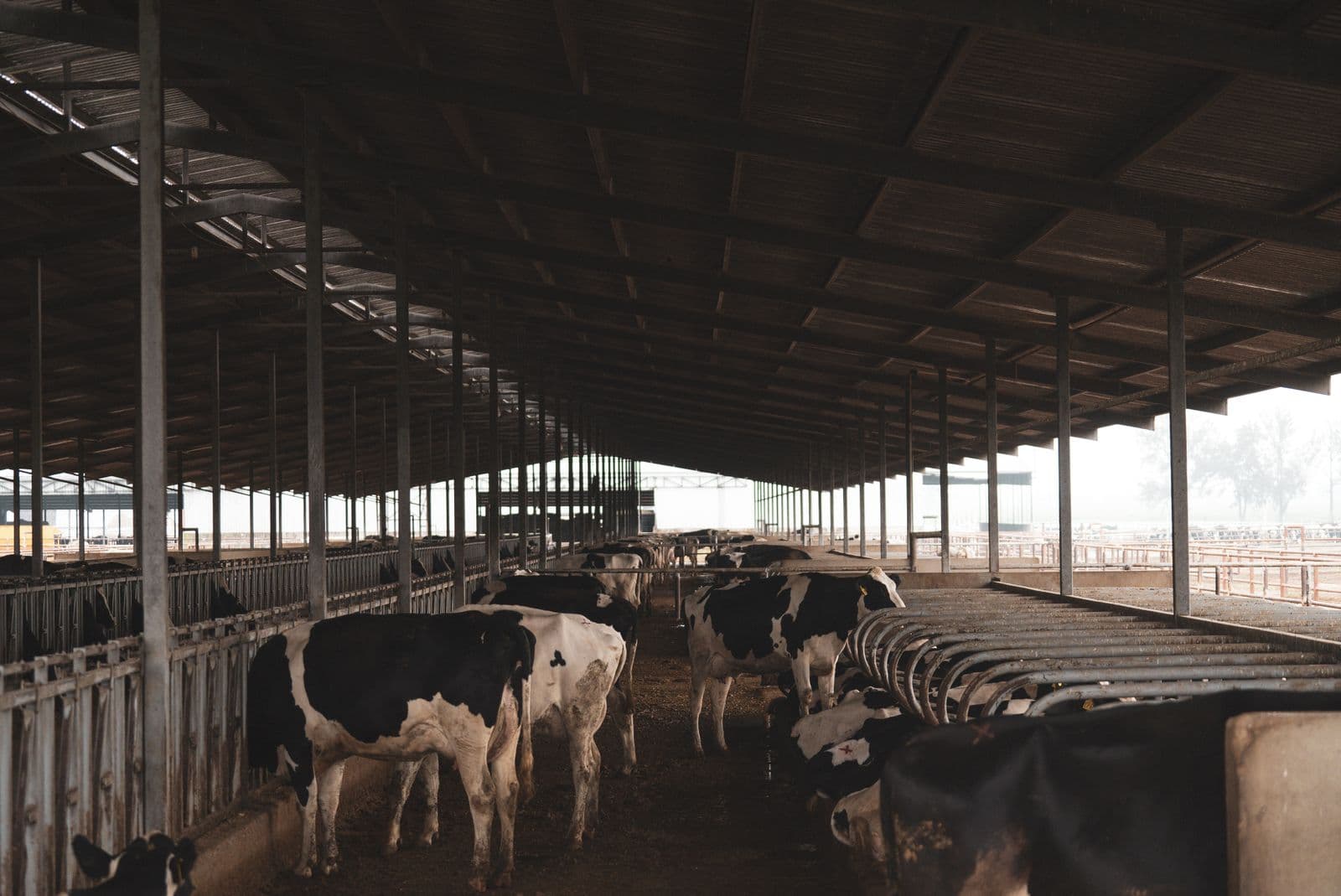
Dairy cattle, sheep, and goats kept in the UAE face a climate their genetics never evolved for. Imported dairy breeds such as Holstein-Friesian start losing milk yield once the temperature-humidity index climbs past a comfortable range, and that threshold is crossed on most days between May and September across Ras Al Khaimah, Sharjah, and the inland emirates. Unlike free-ranging desert livestock, high-producing dairy cows and improved sheep and goat breeds cannot simply tolerate 45°C barn temperatures without a steep production cost — reduced milk output, slower weight gain, lower conception rates, and higher mortality risk during heat waves.
This is where evaporative cooling pads, the same cellulose media technology used across poultry houses in the Gulf, are increasingly installed in livestock barns. Mazraty, based in Ras Al Khaimah with over 20 years supplying UAE farms, stocks the cooling pads, exhaust fans, and cooling paper (10cm and 15cm thickness) used in these installations, adaptable to livestock barn dimensions and stocking arrangements. For a site assessment and quotation, contact our team on WhatsApp at +971 50 535 3412.
How Cooling Pads Work in a Livestock Barn
The principle is identical to poultry house cooling: water is distributed across the top of a cellulose pad wall, and exhaust fans on the opposite side of the barn draw outside air through the wet pad. As air passes through, water evaporates and absorbs heat from the airstream, so air entering the barn is several degrees cooler and slightly more humid. In the UAE's generally dry climate outside the peak humidity weeks, this system typically delivers a 6 to 10°C drop in barn temperature, which is often enough to keep cattle comfortably below the heat-stress threshold even at peak midday temperatures.
Sizing by the Head, Not by the Bird
Air Exchange for Dairy Cattle
Livestock barn ventilation is sized per head rather than per bird, and the numbers are dramatically larger because of body mass and metabolic heat output. Hot-weather guidelines call for roughly 1,000 to 1,500 cubic feet per minute of fresh air per cow — approximately 28 to 42 cubic metres per minute per head — with air velocity across the animal maintained between 1.5 and 2.5 metres per second, rising above 3 metres per second on the hottest days. A 100-head dairy barn therefore needs a fresh air volume in the range of 2,800 to 4,200 cubic metres per minute during summer, roughly ten times what a poultry house of comparable floor area would require, because a dairy cow generates far more metabolic heat than a single bird.
Sheep and Goat Barns
Sheep and goats tolerate heat somewhat better than high-yield dairy cattle, but imported or improved breeds kept at commercial density still benefit from cooling, particularly around lambing and kidding season when heat-stressed does and ewes show reduced milk let-down. Sizing for small ruminants is typically calculated at 40 to 60 percent of the cattle figures per unit of body weight, and barns are often designed with a partial cooling zone — covering the resting and feeding area rather than the entire structure — to control installation cost.
Choosing Pad Thickness: 10cm vs 15cm
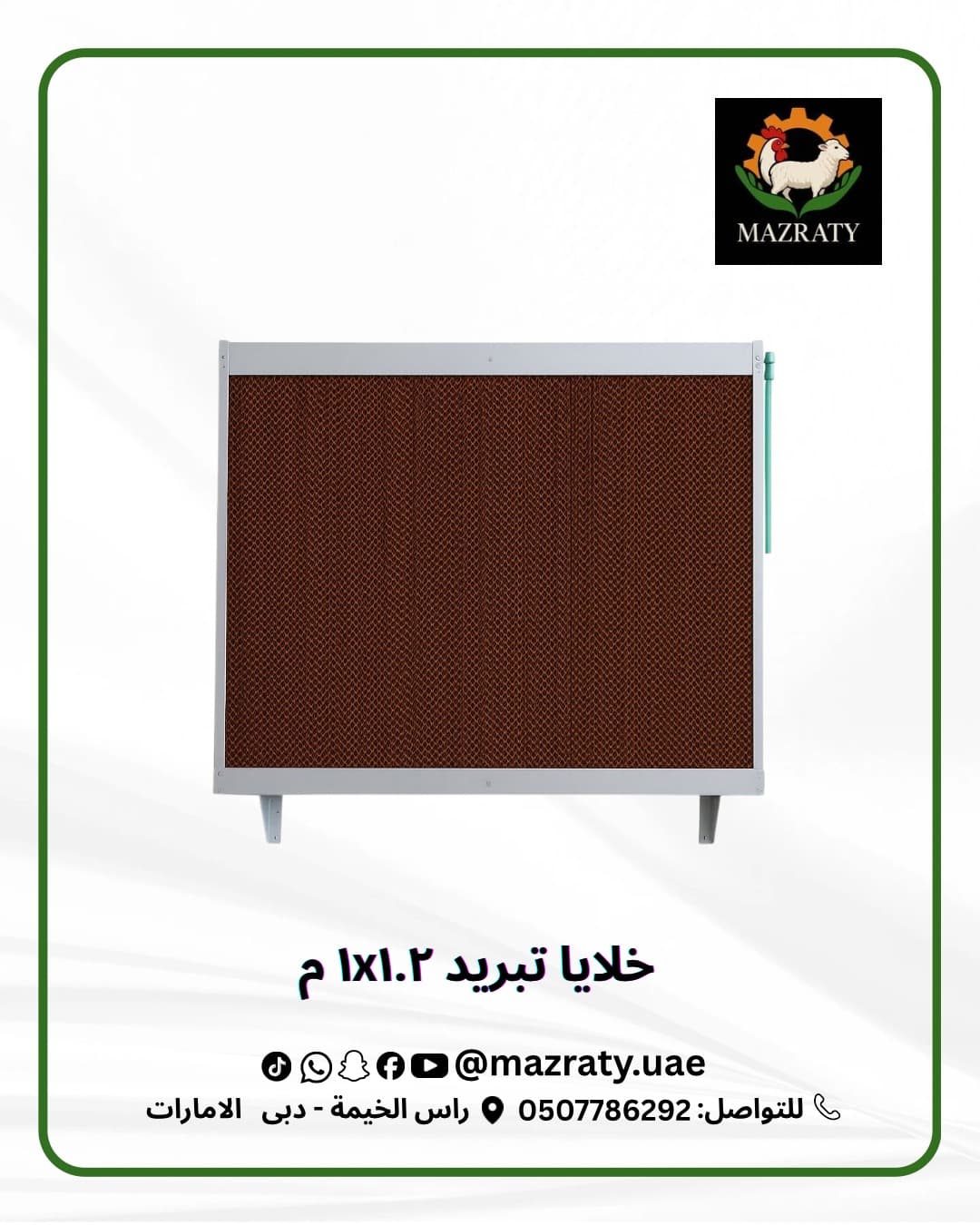
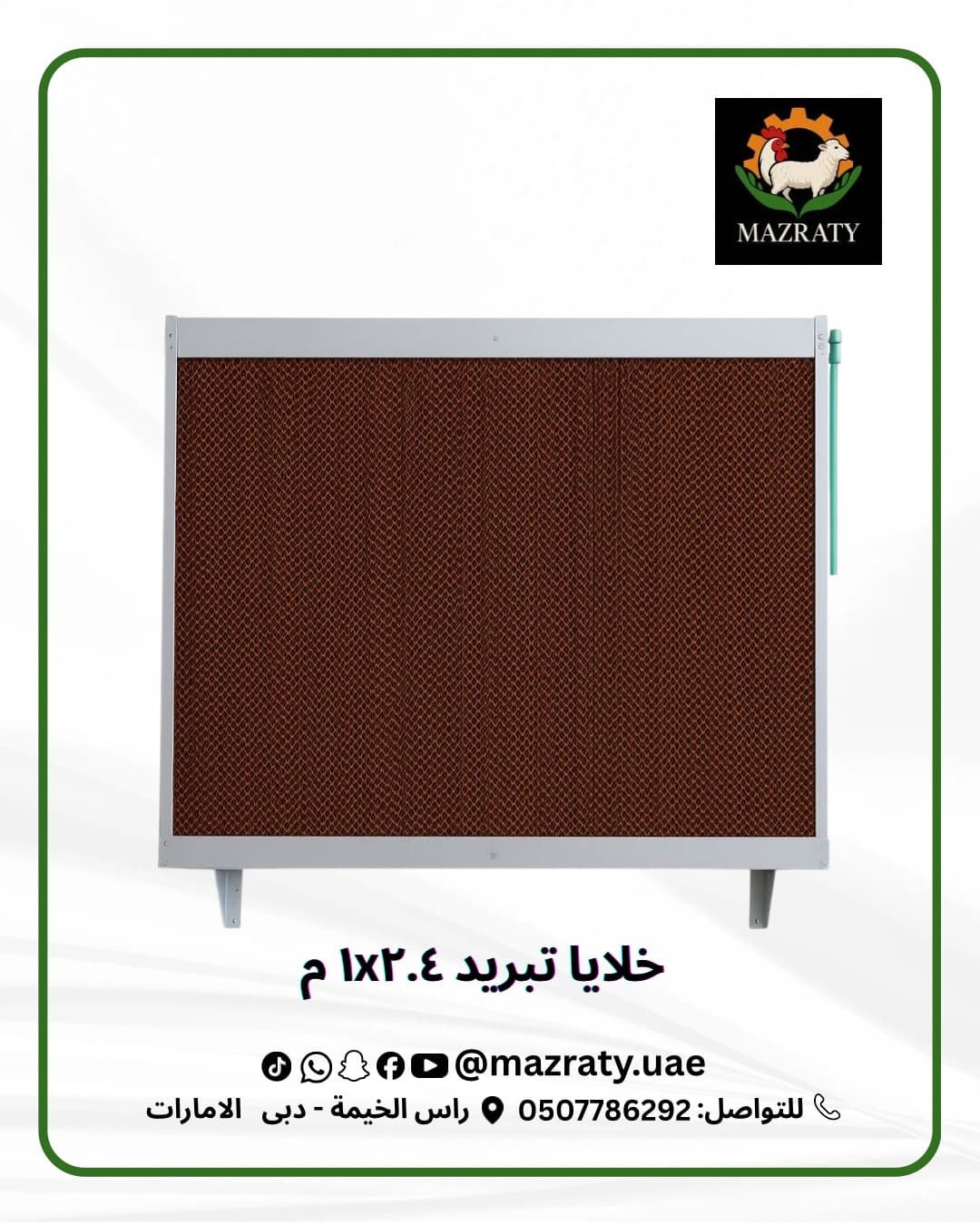
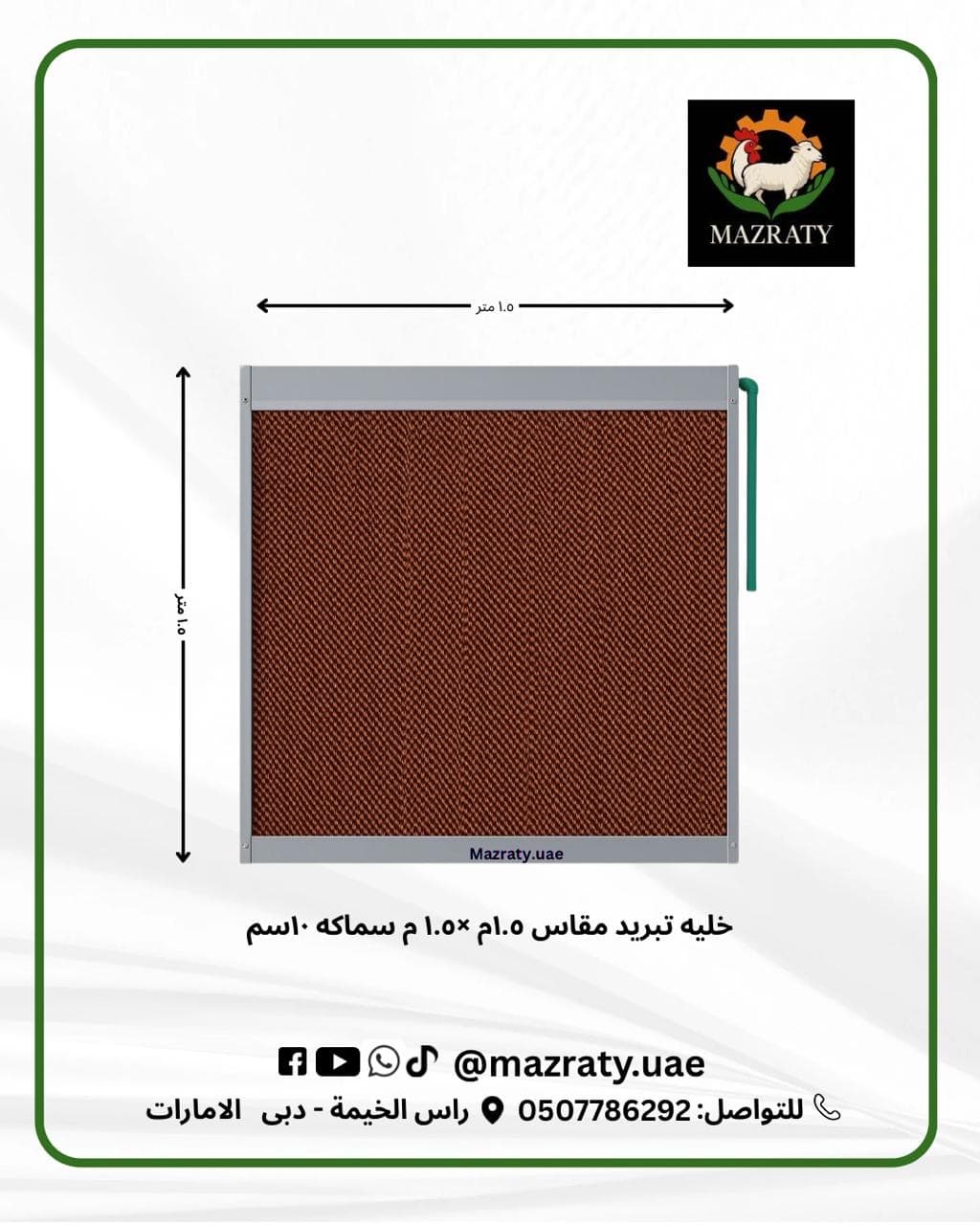
Mazraty supplies cooling paper in both 10cm and 15cm thickness, cut to standard 60cm x 200cm sheets. The 10cm option suits most UAE livestock barns and delivers strong cooling efficiency at a lower air-pressure requirement from the fans. The 15cm option is worth the extra cost for barns in the hottest inland locations (Al Ain, inland Ras Al Khaimah, Fujairah's interior) or for high-value dairy operations where every additional degree of cooling protects milk revenue. Both thicknesses are cut and framed to the exact wall opening dimensions of your barn.
Example: Sizing a 100-Head Dairy Barn
Take a barn housing 100 lactating cows, requiring roughly 3,500 cubic metres per minute of fresh air in summer. At a design air velocity of 2 metres per second through the pad face, the required pad area works out to approximately 29 square metres of pad wall. Fan selection follows the same logic used in poultry houses: divide the total air volume by the rated capacity of a single 140cm exhaust fan (roughly 40,000 to 50,000 cubic metres per hour, or 660 to 830 cubic metres per minute), which points to 5 to 6 fans for this barn. Mazraty's technical team performs these calculations on-site free of charge, accounting for your barn's exact roof height, orientation, and stocking plan.
Installation Steps
- Site the pad wall: Install on the wall facing the prevailing wind, with the fan wall directly opposite for a clean tunnel airflow path.
- Frame and seal: Mount pads in corrosion-resistant aluminium frames and seal every other opening in the barn so air is forced through the pads rather than leaking around them.
- Water distribution: Install a header pipe with evenly spaced drip points across the top of the pad wall, feeding from a pump and reservoir sized for continuous recirculation.
- Collection sump: Build a collection channel beneath the pads to recover and recirculate water, reducing consumption in a region where water cost matters.
- Fan installation: Mount the calculated number of exhaust fans on the opposite wall, wired with a thermostat-controlled staged sequence so fans engage progressively as temperature rises.
- Commissioning: Run the system for 48 hours before introducing animals, checking for even water distribution and verifying the achieved temperature drop with a thermometer at animal height.
Maintenance Schedule
- Daily: Confirm even water flow across the pad face and check that all fans are operating.
- Weekly: Clean the collection sump of manure dust and organic debris, which accumulates faster in livestock barns than in poultry houses.
- Monthly: Flush pads with clean water to remove mineral scale, a particular concern given the UAE's hard groundwater.
- Seasonally: Before summer, inspect all pads for damage and replace any that have lost structural integrity or developed persistent algae growth.
Cost Estimates in AED
A complete cooling pad and fan system for a 100-head dairy barn, including pads, frames, pumps, water distribution, and 5 to 6 exhaust fans, typically costs between AED 18,000 and AED 32,000 for materials, depending on pad thickness and fan specification, with installation quoted separately based on barn complexity and distance from Ras Al Khaimah. Smaller sheep and goat barns with partial cooling zones can start from AED 6,000 to AED 10,000. Contact Mazraty on WhatsApp for a free site visit and itemised quotation.
Reviewed planning sources
These references support operating and welfare principles. Final design and health programs remain site-, strain-, authority- and veterinarian-specific.
Frequently Asked Questions
Is livestock barn cooling the same equipment as poultry house cooling?
The core components — cellulose pads, aluminium frames, and exhaust fans — are the same equipment Mazraty supplies for poultry houses. What differs is the sizing calculation, which is based on per-head body mass and metabolic heat output for cattle, sheep, or goats rather than per-bird figures.
Do sheep and goats really need cooling pads in the UAE?
Local hardy breeds tolerate heat well, but imported dairy goats and commercial sheep operations at higher stocking density see measurable benefits, especially protecting milk yield and reproductive performance during the hottest months.
How much does cooling improve milk yield?
Published dairy research on Gulf-region heat abatement systems has recorded roughly 8 litres per cow per day of recovered milk yield when combined fan and evaporative cooling is used correctly during heat stress periods, though results vary with breed, baseline yield, and how consistently the system is run.
Can an existing open-sided barn be retrofitted?
Yes. Most UAE livestock barns are open-sided sheds, and Mazraty's team can design a partial enclosure — cladding one wall for the pad and another for the fans — without fully closing the structure, preserving natural ventilation during cooler months.
Why Mazraty for Your Livestock Barn
With more than 20 years supplying farm equipment across the UAE, Mazraty extends its poultry cooling expertise to livestock operations, supplying pads, frames, pumps, and fans sized correctly for cattle, sheep, and goat barns. We visit your site, calculate the exact system your barn needs, and handle supply, installation, and after-sales support across all seven emirates. Contact Mazraty today on WhatsApp at +971 50 535 3412 for a free consultation and quotation.