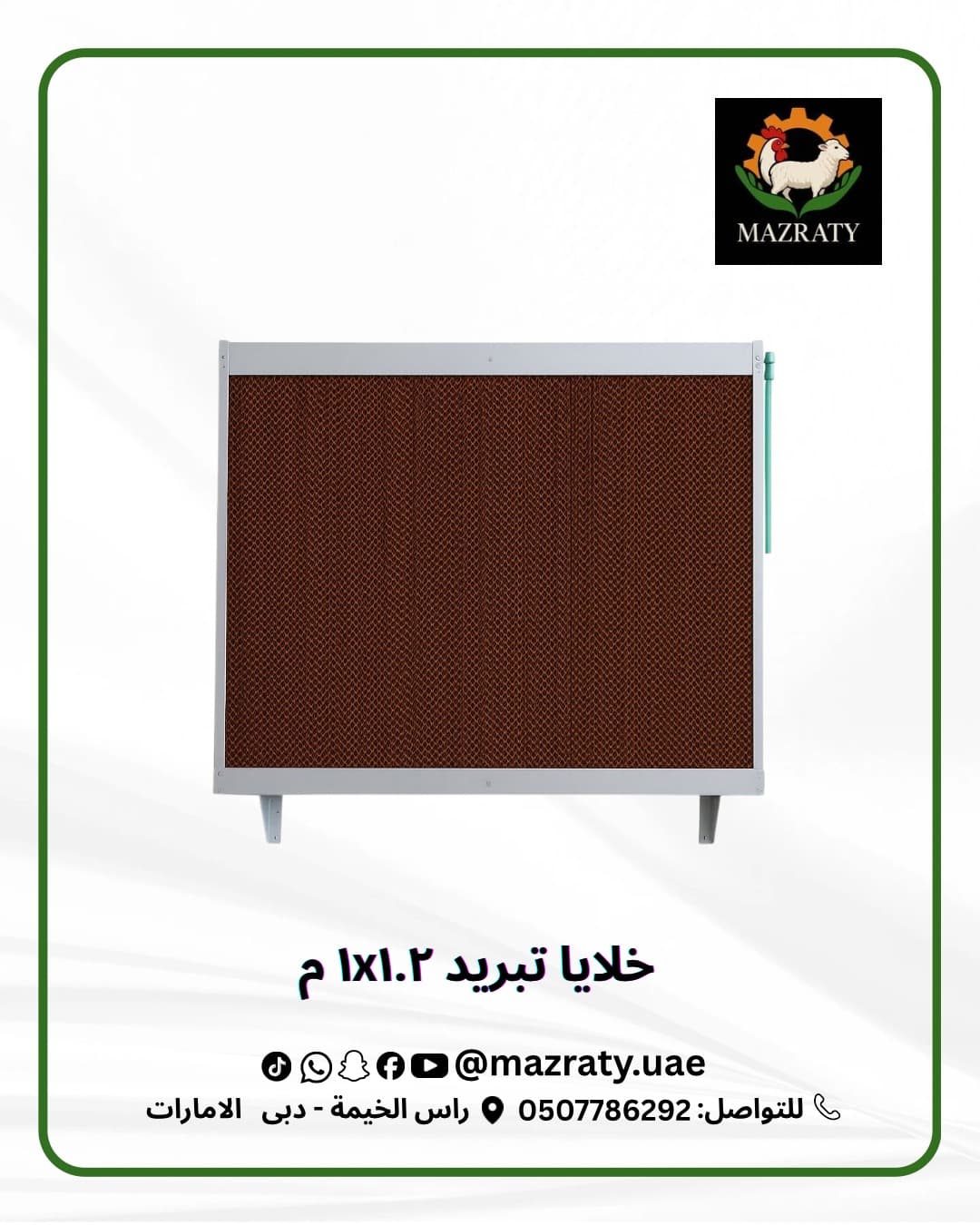
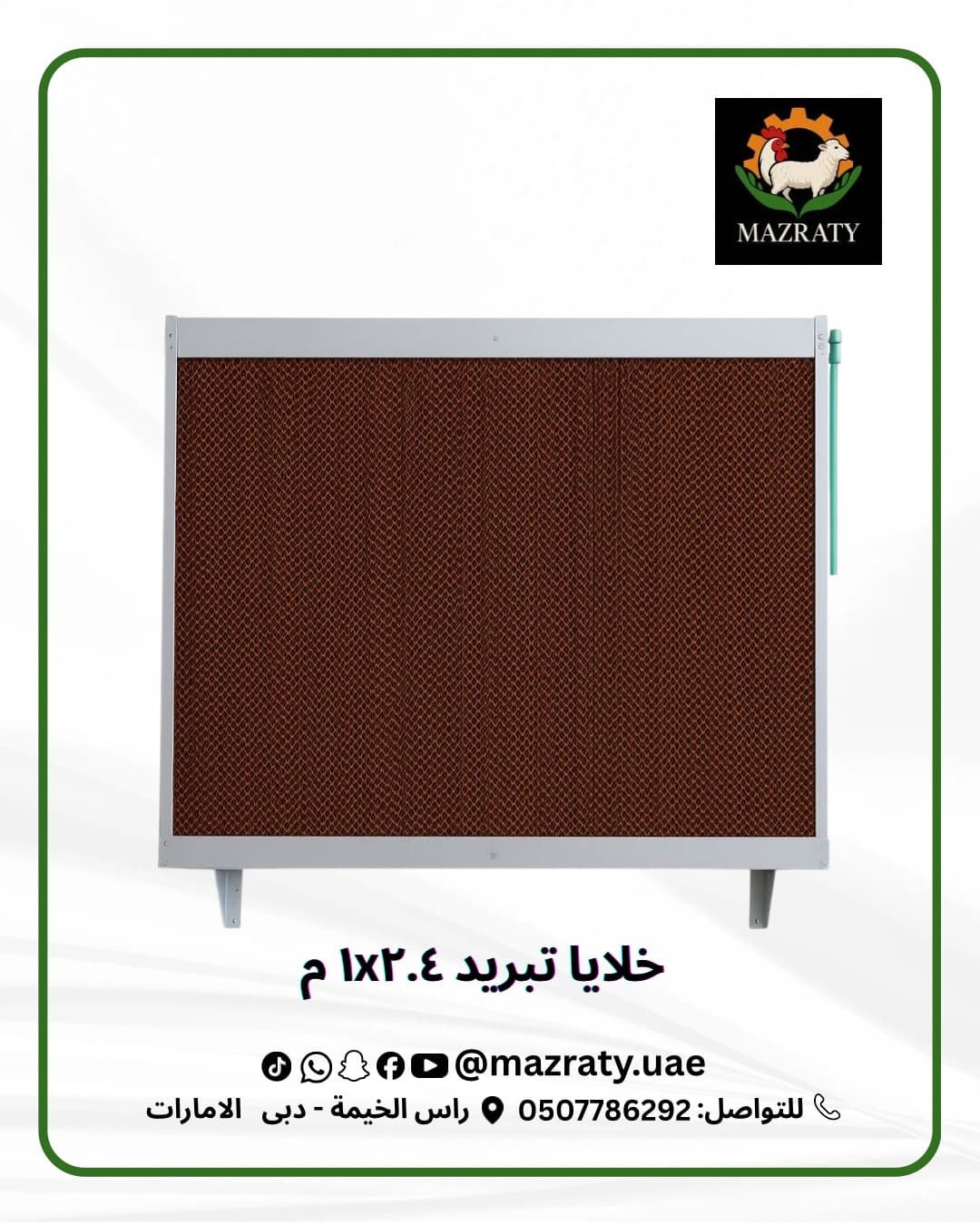
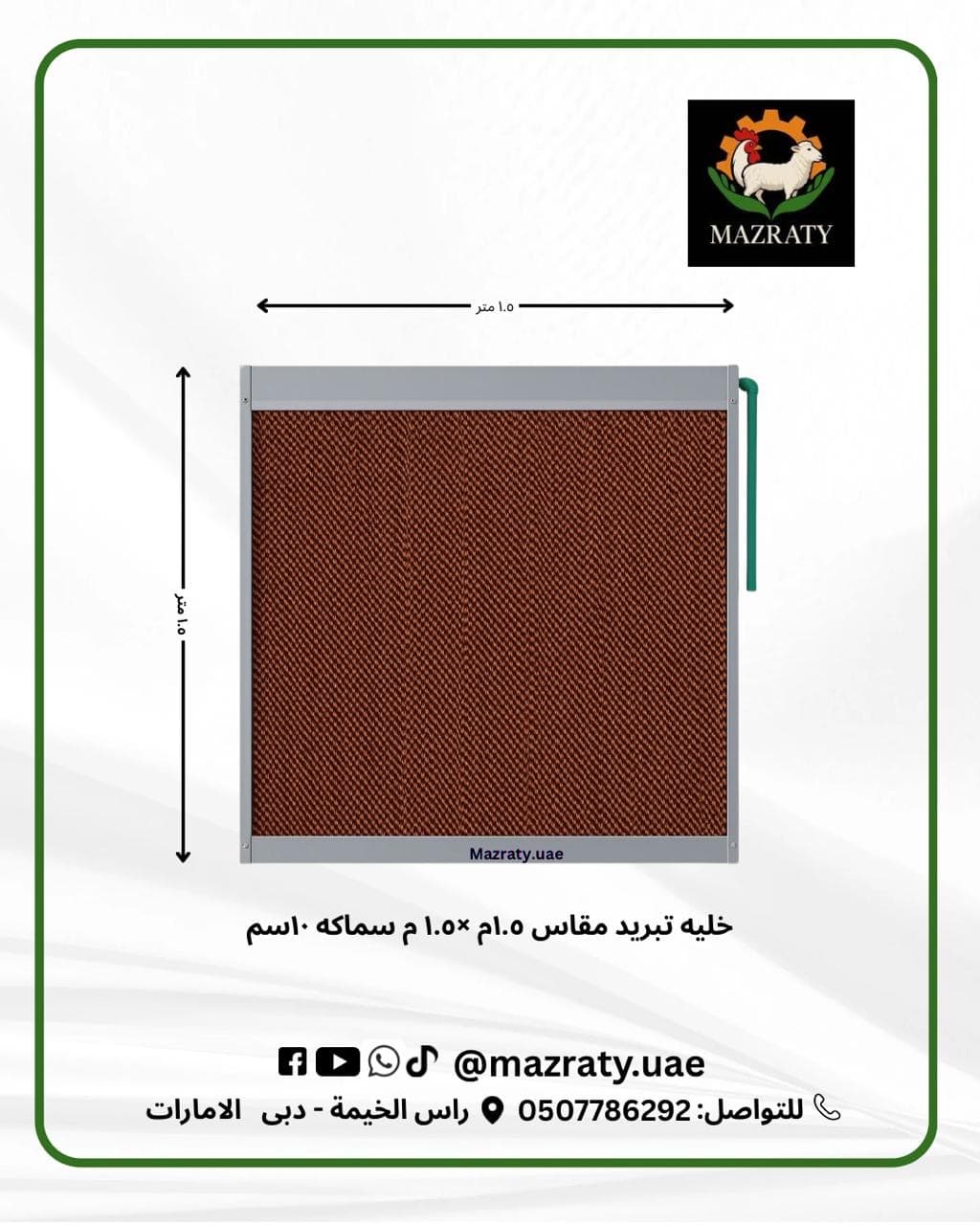
Compare plastic and cellulose cooling pads by airflow, face area, water distribution, water quality, cleaning and installation access.
This guide addresses all of those technical variables in one place: how to choose the right media for Gulf water quality, how to calculate the correct pad face area using the airspeed method, how to size your pump accurately, why drift eliminators matter, and how to build a descaling routine that extends pad life in UAE conditions.
This complete setup — cooling pads paired with exhaust fans — is also known as a poultry house cooling system or a farm cooling pad system, and the goal is always the same: cool the entire house, not just the air at the inlet.
If you would like professional installation support rather than doing it yourself, contact the Mazraty team on WhatsApp at +971505353412. Free delivery is available across all seven Emirates.
Step 1: Choosing Your Cooling Media — Cellulose vs. Plastic
Two media types dominate the UAE market, each with distinct characteristics that matter greatly given local water quality and climate.
Cellulose (Treated Paper) Pads
Manufactured from kraft paper impregnated with anti-rot and anti-microbial compounds and formed into a honeycomb geometry, cellulose pads offer the following advantages:
- Evaporative efficiency up to 92% under ideal conditions — the highest available in this category
- Significantly larger water-contact surface area per unit volume compared to plastic alternatives
- Lighter weight, making field installation and replacement straightforward
- Lower initial cost: typical UAE market pricing ranges from AED 180 to AED 320 per square metre
- Best suited to farms with access to treated, low-TDS, or desalinated water supplies
The principal weakness of cellulose in the Gulf context is its sensitivity to hard water. Where total dissolved solids (TDS) exceed approximately 1,200 ppm, calcium and magnesium salts accumulate rapidly in the flute channels. Within one to two seasons of use with untreated groundwater, the pads can become so encrusted that airflow is seriously impeded — often without the farm manager noticing until bird performance deteriorates sharply.
Plastic (PVC or HDPE) Pads
Manufactured from rigid PVC or high-density polyethylene, plastic pads offer a different value proposition:
- Service life exceeding eight years in Gulf conditions, compared to three to five years for cellulose
- Full compatibility with dilute acid descaling treatments without structural damage
- Slightly lower peak efficiency (85–88%), but that efficiency is far more stable across a full season
- The correct choice for farms using municipal or brackish groundwater
- Pricing in the UAE market ranges from AED 220 to AED 450 per square metre
Practical recommendation for Ras Al Khaimah and the Eastern Region: if your source water hardness exceeds 800 ppm calcium carbonate, select plastic media. If you have access to treated or desalinated water, cellulose will give you higher performance at lower upfront cost.
Step 2: Understanding Flute Angles — 5090 vs. 7090
The numbers 5090 and 7090 refer to the pad thickness and the angle of the internal flute channels, and they have a direct bearing on both thermal performance and system power consumption.
5090 Configuration
Flutes oriented at 90 degrees, pad thickness 50 mm. Characteristics:
- Maximum air-to-water contact surface — highest evaporative efficiency per unit face area
- Higher resistance to airflow (greater static pressure drop), requiring more powerful fans
- Best suited to high-density poultry houses (more than 18 birds per square metre) where cooling capacity is the overriding priority
- Preferred in UAE conditions where dry-bulb temperatures consistently exceed 42°C
7090 Configuration
Flutes oriented at 90 degrees, pad thickness 100 mm (also marketed as 7090 or 100 mm pads). Characteristics:
- Lower airflow resistance — reduced fan energy consumption for a given airspeed
- Better self-draining characteristics and reduced drift carry-over
- Suitable for houses where the distance between the pad face and exhaust fans exceeds 15 metres
- Commonly used in cattle, camel, and equestrian facilities where ceiling heights are greater
For UAE poultry houses longer than 50 metres, combining both configurations — a 5090 layer on the air-inlet face backed by a 7090 layer — achieves an optimal balance between cooling efficiency and manageable static pressure.
Step 3: Sizing the Pad Face Area — The Airspeed Formula
Correct sizing is the single most important technical decision in the entire installation. The design methodology is built around one critical metric: the velocity of air as it passes through the pad face.
The Target Airspeed Range
The internationally accepted design standard for evaporative cooling pads specifies that air velocity at the pad face must fall between 1.5 and 2.0 metres per second.
Below 1.5 m/s, the consequences are:
- Air moves too slowly and becomes fully saturated before reaching the far end of the house
- Uneven temperature distribution from inlet to exhaust — birds near the far end experience inadequate cooling
- Stagnant zones that accelerate pathogen growth
Above 2.0 m/s, the consequences are:
- Water droplets are carried into the house as drift (Drift Carry-Over), wetting the litter and driving up internal humidity
- Reduced contact time between air and water, cutting evaporative efficiency
- Accelerated mechanical erosion of the pad media
Calculation Walkthrough
Step 1 — Calculate the required airflow rate (CMM, cubic metres per minute).
Formula: CMM = House Volume (m3) x Air Changes per Minute
For UAE poultry farms: 1.5 air changes per minute for layer houses; 2.0 changes per minute for broiler houses.
Example: House 80 m long, 12 m wide, average height 2.8 m. Volume = 2,688 m3. For broilers: 2,688 x 2 = 5,376 m3/min.
Step 2 — Convert to cubic metres per second (CMS).
5,376 divided by 60 = 89.6 m3/s.
Step 3 — Calculate the required pad face area.
Face Area = CMS divided by Target Airspeed (m/s)
At a target airspeed of 1.8 m/s: Face Area = 89.6 divided by 1.8 = 49.8 square metres (approximately 50 m2).
Step 4 — Determine pad dimensions.
If choosing pads with a height of 1.8 m: Required length = 50 divided by 1.8 = 27.8 metres. This total length is distributed across the inlet wall, or split across two side walls depending on house orientation and prevailing wind direction.
Need a free sizing calculation for your specific farm? Send your house dimensions to Mazraty on WhatsApp at +971505353412 and our technical team will respond with a tailored design.
Step 4: Pump Sizing and Distribution System Design
The pump is the circulatory system of your cooling installation. Undersizing it produces dry patches on the pad face; oversizing wastes energy and creates excessive drift.
Required Water Flow Rate
For full and even wetting of the pad face:
- Cellulose pads: 3.5 to 5 litres per minute per square metre of face area
- Plastic pads: 4 to 6 litres per minute per square metre
Using our worked example (50 m2 face area, cellulose pads at 4.5 L/min/m2): Required pump flow = 50 x 4.5 = 225 litres per minute minimum.
Head Pressure Requirements
The pump must deliver a minimum of 0.5 bar (50 kPa) dynamic pressure at the furthest distribution point. To calculate total dynamic head, sum:
- The vertical rise from the pump reservoir to the top of the distribution header
- Friction losses in the pipework (calculated using pipe diameter, length, and number of fittings)
- Any filter pressure drop (typically 0.1–0.3 bar for a clean cartridge)
Use a minimum 50 mm diameter PVC main header and 25 mm distribution sub-headers to keep velocity losses manageable.
Pump Type Selection
- Multi-stage centrifugal pumps: Best choice for medium and large farms (more than 200 m2 of pad area)
- Submersible pumps: Practical for smaller installations; eliminate air-locking problems
- Dosing pumps: Added alongside the main pump to inject scale inhibitors continuously
Avoid piston pumps in this application. In the Gulf's dusty, high-temperature environment their maintenance requirements and seal failure rates are disproportionate to the benefit.
Step 5: The Drift Eliminator — Why It Cannot Be Skipped
The drift eliminator is the most frequently omitted component in local UAE installations, and its absence is responsible for a surprisingly large share of the common problems farmers report: wet litter, respiratory issues, and mineral deposits on equipment.
How It Works
A drift eliminator is a panel of complex-geometry plastic installed immediately downstream of the cooling pad (in the direction of airflow). As moisture-laden air passes through, it is forced through a series of sharp directional changes. The inertia of the water droplets causes them to collide with the eliminator's surfaces, coalesce, and drain back to the sump rather than travelling into the house.
Why It Matters in the UAE Specifically
- Municipal and well water in the Emirates carries elevated concentrations of chlorine, calcium, and magnesium — droplets entering the house irritate birds' and workers' respiratory tracts
- Wet litter creates ideal conditions for coccidiosis and fungal diseases; a single season of Drift Carry-Over can significantly increase disease pressure
- Excess internal humidity partially negates the benefit of evaporative cooling — the cooling system ends up working against itself
- Calcium-laden aerosols deposit a white mineral film on drinkers, feeders, and lighting fixtures within weeks
The engineering standard: drift carry-over must not exceed 0.005% of the airflow volume. Well-designed eliminators achieve 0.001% or better. Install one — it pays for itself in the first season.
Step 6: Managing UAE Hard Water — Descaling Protocols
This is the single factor that most determines whether a cooling system in the Emirates lasts two seasons or ten.
Understanding the Problem
Groundwater in Ras Al Khaimah, Fujairah, and Ajman can carry calcium carbonate hardness of 1,800 to 2,500 ppm. During evaporation, dissolved salts remain on the pad surface and crystallise progressively. Left untreated, this scaling process can completely block airflow within 6 to 18 months of operation.
Prevention: Scale Inhibitor Dosing
- Add SHMP (Sodium Hexametaphosphate) continuously at 5–10 ppm in the recirculating sump water
- Alternatively, use commercially available cooling-tower scale inhibitors (available in Dubai's and Abu Dhabi's agricultural supply markets)
- Maintain recirculating water pH between 7.5 and 8.5 using cautious additions of dilute sulphuric acid or hydrochloric acid — always adjust slowly with frequent pH checks
Periodic Cleaning Protocol
- Every 30 days during summer operation: remove the pads and soak them in a 5% citric acid solution for 2 to 4 hours, then rinse thoroughly with clean water
- Do not use hydrochloric acid directly on cellulose pads — it causes permanent structural degradation
- Plastic pads can tolerate 10% HCl solution followed by complete rinsing
- Use a soft brush or low-pressure water jet only — never exceed 40 bar pressure on cellulose media
Bleed-off Management
- Drain and replace 10–15% of sump volume daily during peak operation to prevent salt concentration from multiplying
- On larger farms, install an automatic TDS controller that opens a blowdown valve whenever recirculating water exceeds 1,500 ppm
Mazraty supplies the full range of scale inhibitors, pH test kits, and dosing systems for UAE farm conditions. Contact us on WhatsApp at +971505353412 to order or request advice.
Step 7: Installation Procedure — Step by Step
Preparation Phase
- Measure the designated inlet wall precisely and mark the positions of all supporting frames
- Confirm the wall surface is flat and free from cracks that would allow insect ingress
- Plan the positions of the overhead distribution headers so each falls directly above the pad face
- Size the sump tank at a minimum of 8 litres per square metre of pad face area
Installing the Support Frame
- Install aluminium or hot-dip galvanised steel channel to form a rectangular frame matching the pad dimensions
- Tilt the frame 3 to 5 degrees outward from the building wall to drain excess water away from the house rather than into it
- Leave a drainage channel at the base that returns water by gravity to the sump
- Fix a 1 mm mesh insect screen on the external face to prevent birds and insects from entering behind the pads
Installing the Water Distribution System
- Use 50 mm PVC for the main header, 25 mm for sub-headers running along the top of each pad section
- Drill 3 mm holes every 15 to 20 cm along the sub-headers, angled 45 degrees downward toward the pad face; alternatively use agricultural drip emitters rated at 3–4 litres per hour per point
- Pressure-test the entire distribution system with water before installing the pads — the full face must wet uniformly without pooling
Fitting the Pads and Completing the System
- Insert pad blocks into the frame with the flute channels oriented vertically — this is the correct installation orientation for all standard pads
- Install the drift eliminator immediately behind the pads (downstream) with a 5 to 10 cm air gap between them
- Seal all edges between frame and pad perimeter with foam strip or neutral-cure silicone to prevent air bypass
- Connect the base drainage channel back to the sump, fitting a 100-mesh inline strainer to catch debris before it reaches the pump
- Install a float valve in the sump to maintain a constant water level automatically
Step 8: Replacement Schedule and Service Life
Profitable farms operate on planned replacement cycles rather than waiting for performance to collapse visibly.
Signs That Immediate Replacement Is Required
- Measured cooling efficiency has fallen more than 20% compared to the first season
- Visible cracking or structural failure of the pad body
- Bowing or distortion of cellulose pads under accumulated scale weight
- Persistent musty odour even after cleaning — indicates microbial colonisation of the pad core
- More than 30% of the visible face area is visibly blocked
Recommended Schedules for UAE Conditions
- Cellulose pads: Full replacement every 3 to 4 years; annual deep-clean and distribution system inspection
- Plastic pads: Full replacement every 7 to 9 years; seasonal maintenance each spring before the cooling season begins
- Pump: Full inspection at the end of each summer season; bearing replacement every 3 years
- Distribution headers and emitters: Monthly inspection and cleaning during peak season (April to October)
Mazraty stocks replacement cellulose and plastic pads, pumps, drift eliminators, and all associated hardware. We carry full inventory for same-day or next-day delivery anywhere in the UAE. Call or WhatsApp us at +971505353412 to check availability.
Reviewed planning sources
These references support operating and welfare principles. Final design and health programs remain site-, strain-, authority- and veterinarian-specific.
Frequently Asked Questions
How many square metres of cooling pad does a 10,000-bird broiler house need?
For a standard UAE broiler house measuring 80 x 12 x 2.8 metres, the calculation yields approximately 50 to 55 square metres of pad face area at a target airspeed of 1.8 m/s. The exact figure depends on your fan capacity and house tightness. Contact Mazraty on WhatsApp at +971505353412 for a free custom calculation.
Can I use groundwater directly in my cooling system without treatment?
You can, but it requires protective measures: install a sand filter or 50-micron cartridge filter, continuously dose scale inhibitor, and implement a daily bleed-off programme. If hardness exceeds 1,500 ppm, select plastic rather than cellulose pads and consider adding a small water softener unit upstream of the sump.
What is the difference between 1.0-metre and 1.8-metre pad height?
Taller pads deliver the required face area with fewer individual blocks, fewer joints, and less frame work. The 1.8 m height is the most widely used in UAE poultry farms because it suits the typical interior wall height of 2.2 to 2.5 metres while leaving clearance for the distribution header above and drainage channel below.
Do I need a drift eliminator if my fans are far from the pads?
Yes. Distance does not remove the problem — water droplets travel with the airstream across the full length of the house. In the UAE specifically, those droplets carry dissolved minerals that crystallise on drinkers, feeders, and the birds themselves. A properly rated drift eliminator is a low-cost component that prevents a disproportionate amount of downstream damage.
What does a complete cooling pad installation cost for a farm in Ras Al Khaimah?
For a 1,000-square-metre broiler house, a professional supply-and-install package — including pads, pump, distribution headers, drift eliminator, sump, and electrical connections — typically falls between AED 18,000 and AED 35,000 depending on media type and system specification. For a detailed quotation specific to your farm, contact Mazraty on WhatsApp at +971505353412. We have been installing farm equipment across the UAE for more than 20 years and offer free delivery on all orders.