A complete technical guide to designing an 8-stage feed production line in the UAE — from raw material receiving to bagging. Contact Mazraty: +971 50 535 3412
Complete Feed Production Line: The 8-Stage Equipment Sequence
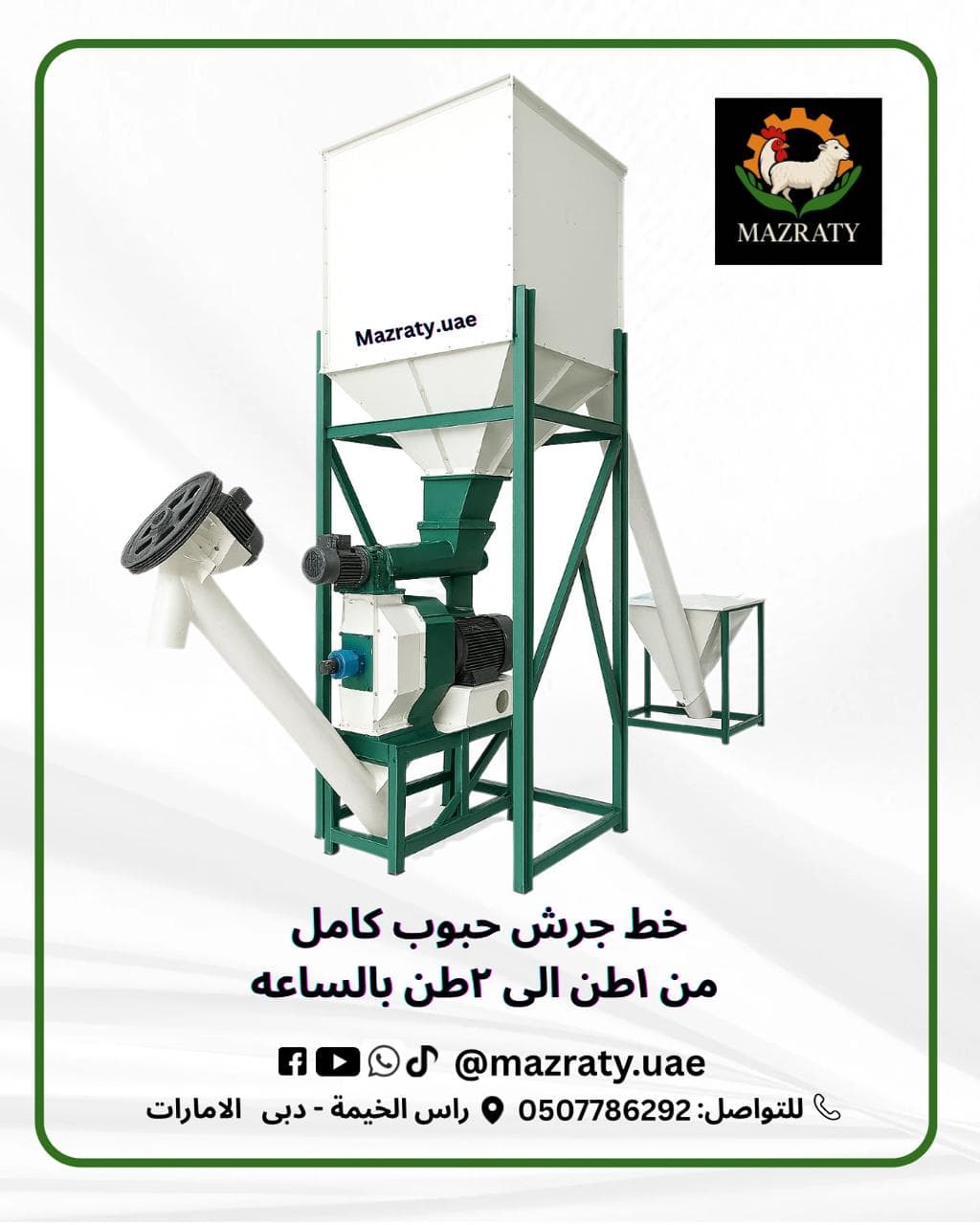
Designing a feed production line is one of the most consequential decisions any farm or agri-industrial project in the UAE will make. A truly integrated line is not simply a collection of machines placed side by side — it is a coordinated system where raw materials flow seamlessly from one stage to the next without bottlenecks, downtime, or waste. At Mazraty in Ras Al Khaimah, we work daily with farm owners and production projects across all seven Emirates, and we understand clearly that the difference between a successful feed mill and one plagued by repeated shutdowns lies in the precision of the equipment sequence design from day one.
In this technical guide, we take you through a detailed tour of the eight stages of a complete feed production line, explaining how to size each machine to match your required capacity, what conveyor types to use between stages, and what PLC control options are available for your operation.
Why Success Starts with Design, Not Purchasing
A common and costly mistake is to buy individual machines and then attempt to assemble them into a line later. The result is almost always a struggling line where certain stages become choke points while others run at less than half capacity. Correct design means first establishing your total required throughput — whether one tonne per hour or five — and then specifying each machine based on that number, with a safety margin of at least 15% above target capacity to avoid running equipment at maximum load continuously.
In the UAE climate, where temperatures exceed 45 degrees Celsius in summer, this margin becomes even more critical, as motor efficiency drops and blockage risks increase in certain stages. For a free technical consultation on designing the right production line for your project, contact the Mazraty team on WhatsApp now: +971 50 535 3412.
Stage 1: Raw Material Receiving and Storage
Equipment Requirements and Design Approach
The feed production journey begins at the raw material receiving point, whether that is maize grain, soybean meal, wheat bran, or other supplementary ingredients. This stage requires:
- Receiving Hopper: Designed to accommodate a full truck load — typically 10 to 20 tonnes — with a primary screening grid to block large objects. Sizing depends on your delivery frequency.
- Screw Conveyor or Bucket Elevator: For transferring material from the hopper to storage silos. Transfer rate must exceed the truck unloading rate to prevent backlog.
- Receiving Scales: Essential for documenting quantities accurately and calculating raw material costs per batch.
Technical note: In the UAE, galvanized steel silos are strongly preferred over mild steel to resist coastal humidity, particularly in areas like Ajman, Ras Al Khaimah, and Umm Al Quwain.
Stage 2: Raw Material Cleaning and Impurity Removal
Screening and Magnetic Separation Equipment
No raw material should advance to actual production without passing through a cleaning stage. Impurities — small stones, dust, and metallic particles — damage machinery in downstream stages and may pose health risks to animals. Equipment for this stage includes:
- Vibrating Screen/Cleaner: Separates impurities by particle size. Chosen based on required flow rate — for instance, a 5-tonne-per-hour screen for a 3-tonne-per-hour line provides an adequate buffer.
- Magnetic Separator: Removes any ferrous objects that pass through the screen. Installed in the conveyor path immediately after the screen.
- Destoner: Particularly important for grains sourced from Gulf farms, where dust and gravel contamination rates are higher than in temperate climates.
All equipment in this stage should be connected by enclosed conveyors to prevent dust dispersion — an environmental requirement in most UAE industrial zones.
Stage 3: Grinding and Milling
Choosing the Right Mill for Your Line Capacity
Grinding is the beating heart of any feed production line. Particle size after milling determines the animal's digestion efficiency and the quality of pellets produced by the press downstream. Two main options exist:
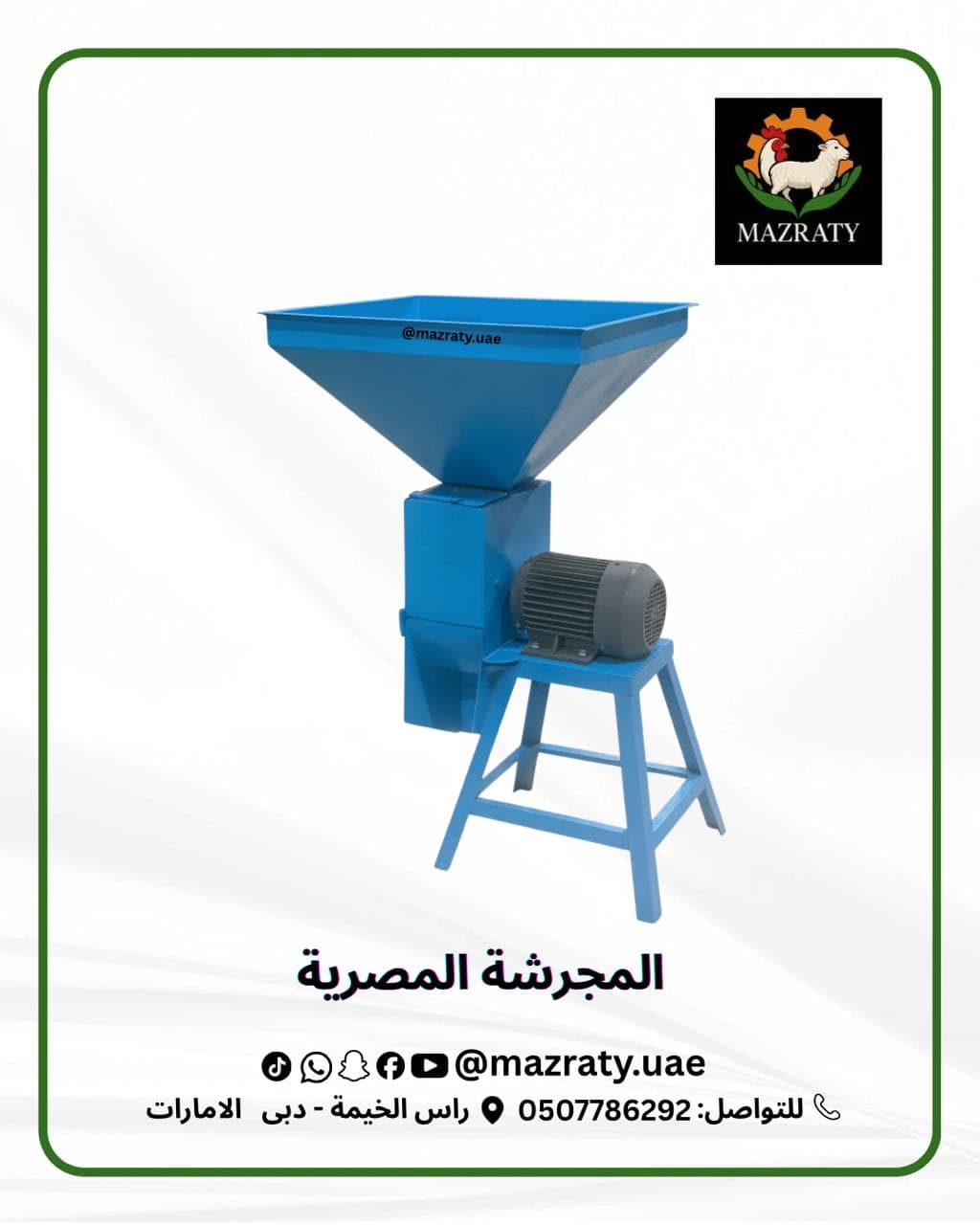
- Hammer Mill: The most common in feed lines. Offers flexibility in particle size adjustment by changing screens. Suitable for grains and mixed feeds. Motor power ranges from 11 kilowatts for small lines to 110 kilowatts for large ones.
- Roller Mill: Used when more uniform, lower-heat grinding is required — particularly for heat-sensitive nutritional supplements.
A key design rule of thumb: the mill's capacity should be 20% above the line's total throughput, since grinding is typically the primary bottleneck. A dust collector or cyclone must be installed directly above the mill — this is a legal requirement in most UAE industrial areas. Looking for a feed mill that fits your line? Contact Mazraty on WhatsApp: +971 50 535 3412 and our technical team will guide you to the best option.
Stage 4: Batching and Mixing
Dosing Scales and Feed Mixers
Precise mixing transforms milled grain into a nutritionally balanced feed. This stage has two components:
A) Batching and Weighing System
- Batching Scales: Measure each ingredient precisely before it enters the mixer. In advanced lines, these are controlled by PLC software to ensure recipe accuracy across every batch.
- Individual Ingredient Bins: Each raw material (maize, soybean, fishmeal, vitamins, minerals) is stored in a separate bin above the mixer to facilitate accurate dosing.
B) The Mixer
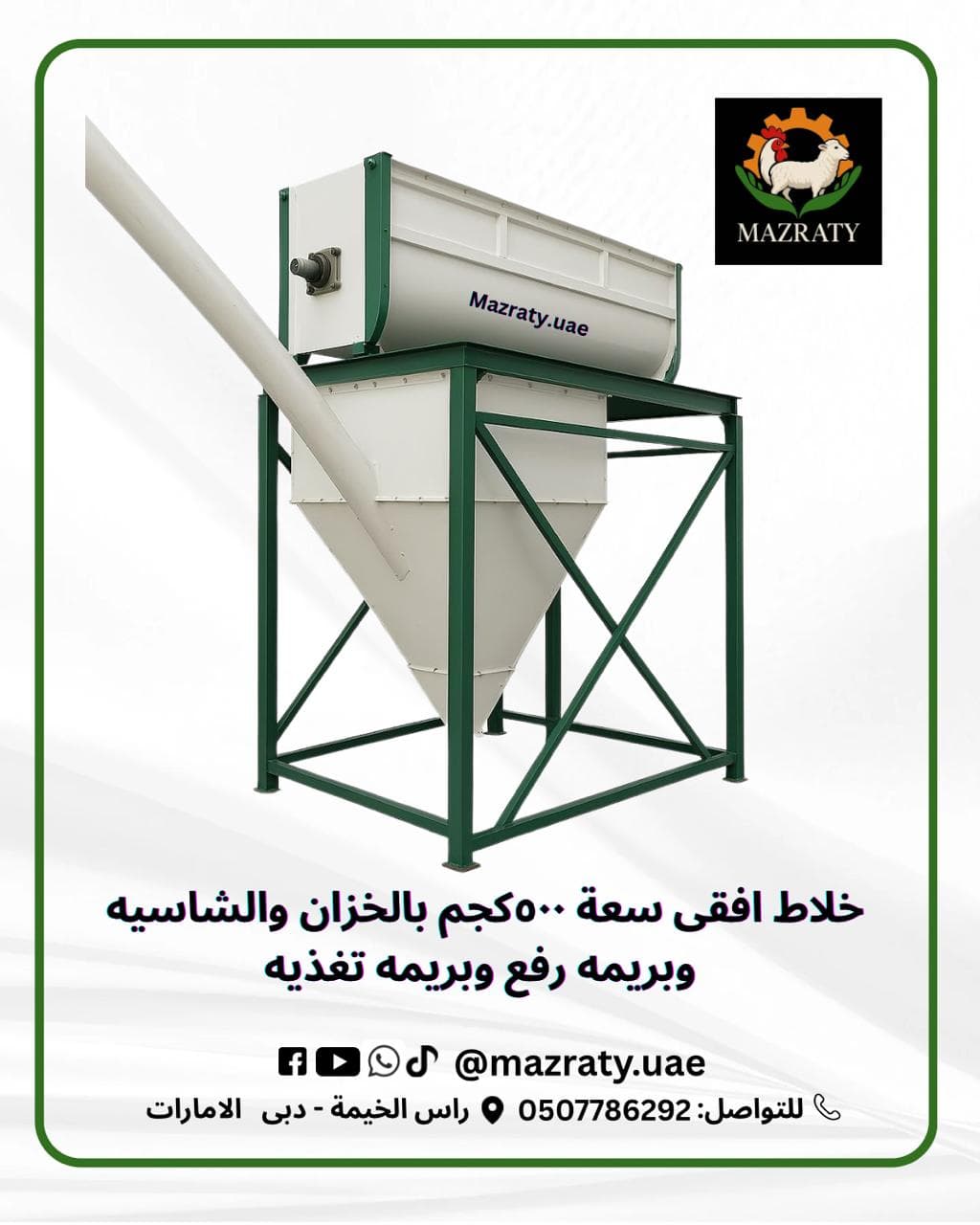
- Horizontal Ribbon Mixer: Best suited for medium-capacity feed lines. Achieves homogeneous mixing in 3 to 5 minutes. Batch capacities range from 500 kilograms to 5 tonnes.
- Paddle Mixer: Faster cycle and gentler on fragile ingredients like mineral premixes.
Important note: Both under-mixing and over-mixing degrade feed quality. Always follow the mixer manufacturer's recommended mixing time, and verify homogeneity through periodic laboratory testing.
Stage 5: Pelleting and Compression
The Pellet Press: Heart of the Production Line
The pelleting stage is the most complex and expensive in the line, and it gives feed its final form as cylindrical pellets. Equipment includes:
- Conditioner or Pre-conditioner: Steam and moisture are added to the mixed meal before it enters the press to soften the material and activate natural starch as a binding agent. Optimal temperature is between 75 and 85 degrees Celsius.
- Ring Die Pellet Press: The standard for professional feed lines. Forces material through holes in a rotating die with various diameters — 2mm for poultry, 4 to 6mm for cattle and sheep, 8 to 10mm for large fish. Motor power ranges from 22 to 315 kilowatts depending on capacity.
- Flat Die Press: Simpler and less expensive, suitable for small lines below 1 tonne per hour.
In the UAE, high ambient temperatures reduce post-press cooling efficiency. It is therefore recommended to invest in a pre-conditioner with a water-cooling unit to ensure consistent pellet quality during summer months.
Stage 6: Cooling
Why Cooling Is Critical in the Gulf Climate
Pellets exiting the press are hot (70 to 90 degrees Celsius), moist, and soft. Packaging them directly would cause clumping, spoilage, and nutritional degradation. The cooling stage is a necessity, not a luxury — and its importance is amplified in the UAE where summer heat and coastal humidity are extreme.
- Counter-flow Cooler: The preferred option for medium and large lines. Passes cool air counter to the direction of pellet flow, achieving more uniform cooling. Cooling time of 10 to 15 minutes reduces pellet temperature to within 5 degrees of ambient temperature.
- Rotary Cooler: Lower cost and simpler, suitable for small lines, but requires more floor space.
The conveyor between the press and the cooler must have a fast discharge rate to prevent hot pellets from accumulating and sticking together. For a specialized recommendation on cooling equipment for your emirate's climate, contact Mazraty on WhatsApp: +971 50 535 3412.
Stage 7: Crumbling
When Is This Stage Needed?
Not every production line requires a crumbling stage, but it is essential when producing feed for young poultry (chicks under three weeks old) or small fish that cannot swallow a full-size pellet. The crumbler breaks the cooled pellet into pieces of a controlled size without fully re-milling it.
- Two-Roll Crumbler: The most common type. The gap between the two rolls is adjustable to control crumble particle size.
- Rotary Sieve or Grader: Added directly after the crumbler to separate fine crumble from coarse particles, returning oversized pieces for a second pass through the crumbler.
Pneumatic or bucket conveying between the cooler, crumbler, and sieve minimizes manual handling of the product and maintains hygiene throughout.
Stage 8: Weighing, Bagging, and Packaging
The Automated Bagging Line
The final stage determines how feed reaches the end user. Packaging choices depend on production volume and target market:
- Weighing Bagger: Fills bags to a precise specified weight (25kg or 50kg). Modern lines achieve 600 to 1,200 bags per hour.
- Bag Sewing Machine: Closes bags with durable thread. In more advanced lines this is replaced by a heat-sealing unit for plastic bags.
- Feed Conveyor to Bagger: Flow rate must be adjustable to avoid overfeeding the bagging machine.
- Date Coder or Printer: A legal requirement in the UAE for printing production date, expiry date, and nutritional information on every bag.
Conveyors Between Stages: The Lifeblood of the Line
Conveyors are not secondary components — they determine the overall efficiency of the entire line. Types used in feed production:
- Belt Conveyor: For long horizontal distances with dry materials. Easy to maintain but requires significant floor space.
- Screw Conveyor: Excellent for short distances and powdered materials. Encloses the material and prevents dust emission.
- Bucket Elevator: For vertical lifting between stages — the optimal choice between milling, mixing, and pressing stages.
- Pneumatic Conveyor: For transporting fine or sensitive feeds such as premix supplements. Highest cost but cleanest operation.
Golden rule: No stage should ever be starved by a slow conveyor. Every conveyor's capacity should exceed the output of the preceding stage by at least 15 to 20 percent.
PLC Control Systems: Automation Intelligence for Your Line
From Manual Control to Full Automation
Programmable Logic Controllers have transformed feed mills from labour-intensive operations into highly efficient facilities run by a small skilled team. Control levels:
- Basic Manual Control: Suitable for small lines below 1 tonne per hour. Each machine is started and stopped individually from a distribution panel.
- Semi-Automatic Control: Relay-based logic with push-button sequencing. Enables automatic start and stop sequences but dosing remains manual.
- PLC with HMI Touchscreen: Best for medium lines (1 to 5 tonnes per hour). The entire line is programmed via a touchscreen interface, recipes are stored and recalled with a single touch, and faults appear immediately with error codes.
- SCADA with Advanced PLC: For large lines above 5 tonnes per hour. Enables remote monitoring via phone or computer, real-time production tracking, and energy consumption monitoring for each machine.
In the UAE, where labour costs are high, investing in a PLC with HMI typically pays back its cost within two years through savings in wages, reduction in human error, and minimised downtime.
Capacity Matching Across Stages: The Critical Equation
A practical example for a 3-tonne-per-hour line:
- Receiving hopper: 15 tonnes (fits one full truck)
- Cleaning screen: 4 tonnes per hour
- Hammer mill: 4 tonnes per hour
- Mixer: 2,000kg per batch x 2 batches per hour = 4 tonnes per hour
- Pellet press: 3.5 tonnes per hour
- Cooler: 4 tonnes per hour
- Bagging machine: 4 tonnes per hour
Notice that every stage exceeds the line's total throughput by a margin. This allows the line to run continuously without choking even at maximum production. Need help calculating the correct specifications for your production line? The Mazraty team is available now on WhatsApp: +971 50 535 3412.
UAE-Specific Design Considerations
A successful design in the UAE goes beyond international standards and accounts for local conditions:
- Heat Protection: Insulate storage silos to prevent raw material overheating in summer, and use IP55-rated motors as a minimum standard.
- Coastal Humidity Protection: Anti-corrosion coatings on all steel structures, especially in coastal areas like Ras Al Khaimah and Fujairah.
- Air Filtration: Dust and air filters require more frequent cleaning due to seasonal sandstorms.
- Electrical Supply: Large lines require three-phase industrial power. Confirm meter capacity and electrical connection permits with DEWA, SEWA, or FEWA before purchasing equipment.
Reviewed planning sources
These references support operating and welfare principles. Final design and health programs remain site-, strain-, authority- and veterinarian-specific.
Frequently Asked Questions About Feed Production Lines in the UAE
1. What is the difference between an integrated feed line and a standalone machine?
A standalone machine such as a hammer mill or pellet press performs one function and requires manual preparation before and after. An integrated production line connects all stages with automated conveyors and programmed control, reducing labour, increasing efficiency, and improving final product quality.
2. How long does it take from raw material input to finished bagged feed?
On a well-designed 3-tonne-per-hour line running at full efficiency, the entire process from cleaning through milling, mixing, pressing, cooling, and bagging takes between 25 and 40 minutes.
3. Do I need a special industrial licence to operate a feed production line in the UAE?
Yes. An industrial licence from the relevant emirate's Department of Economic Development is required. Some emirates may also require an environmental impact assessment for lines exceeding 5 tonnes per hour. We recommend consulting the relevant licensing authority before committing to investment.
4. What is the expected operational lifespan of feed line equipment?
With regular maintenance following manufacturer recommendations, hammer mills and mixers typically operate for 15 to 20 years. The pellet press die requires replacement every 600 to 1,200 operating hours depending on the hardness of materials being processed.
5. Can the line be expanded in the future without replacing the basic infrastructure?
Yes, if the line was designed from the outset with surplus capacity in silos and conveyors. The most difficult component to upgrade is the pellet press, as it is the most expensive and complex machine. The optimal strategy is to purchase a press with higher capacity than your current needs and operate it at partial load initially.
6. Does Mazraty provide design and installation services for feed production lines?
Yes. Mazraty offers feed line design consultations, equipment supply, installation, and ongoing maintenance services. Free delivery is available across all UAE Emirates. Contact us now on WhatsApp: +971 50 535 3412
Conclusion: The Right Investment Starts with the Right Design
A complete feed production line is not just equipment — it is an integrated system that demands clear vision from the very first stage. Every design decision — from screen size to cooler type to control level — affects efficiency, quality, and operational costs for years ahead. In the UAE, with its climatic challenges and regulatory requirements, relying on local expertise is not optional; it is essential.
Mazraty, with over 20 years of experience equipping farms and agricultural projects across the UAE and the wider Gulf region, is ready to accompany you from project concept to the first bag of feed that leaves your line. Contact us today on WhatsApp: +971 50 535 3412 — free delivery across all UAE.