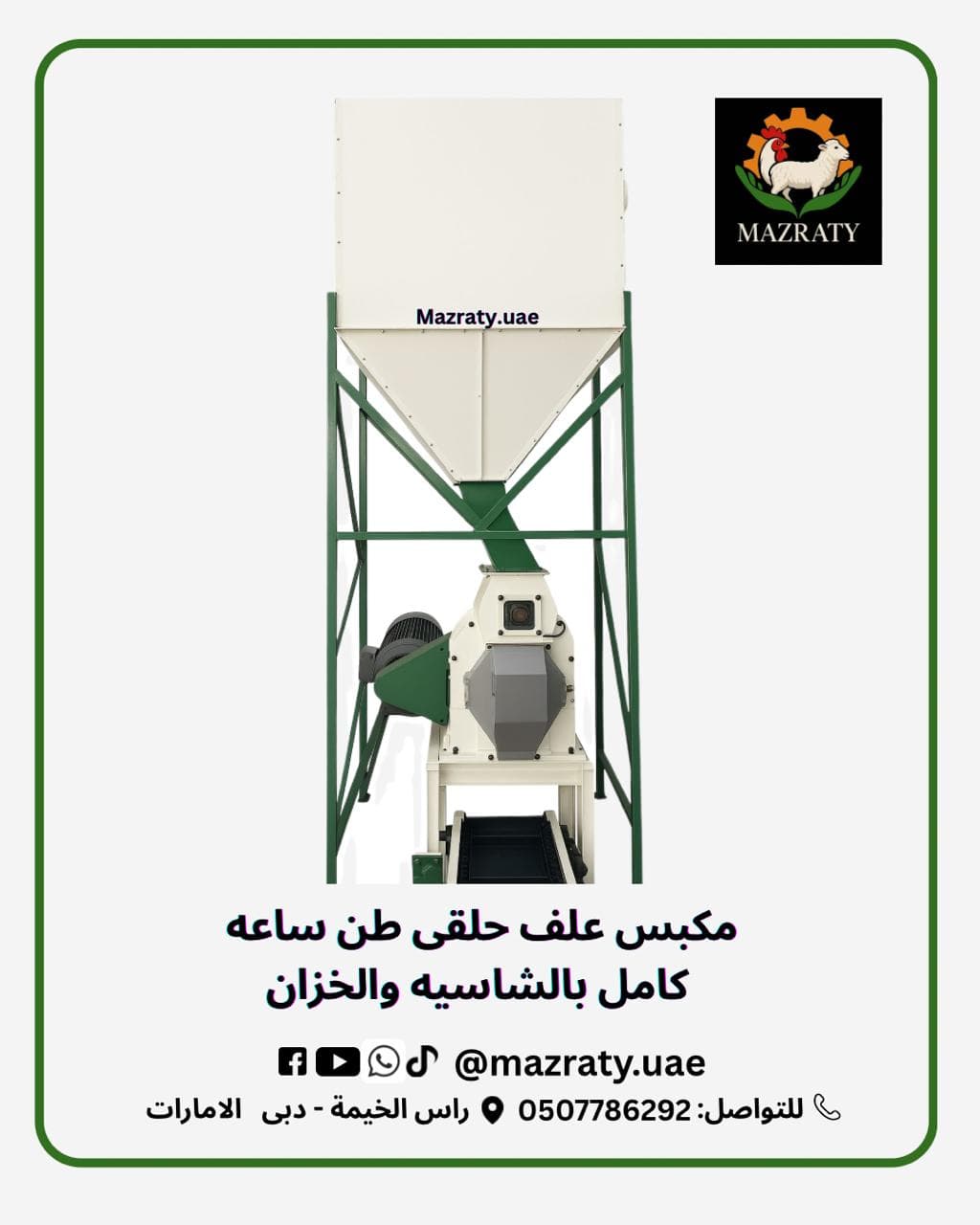
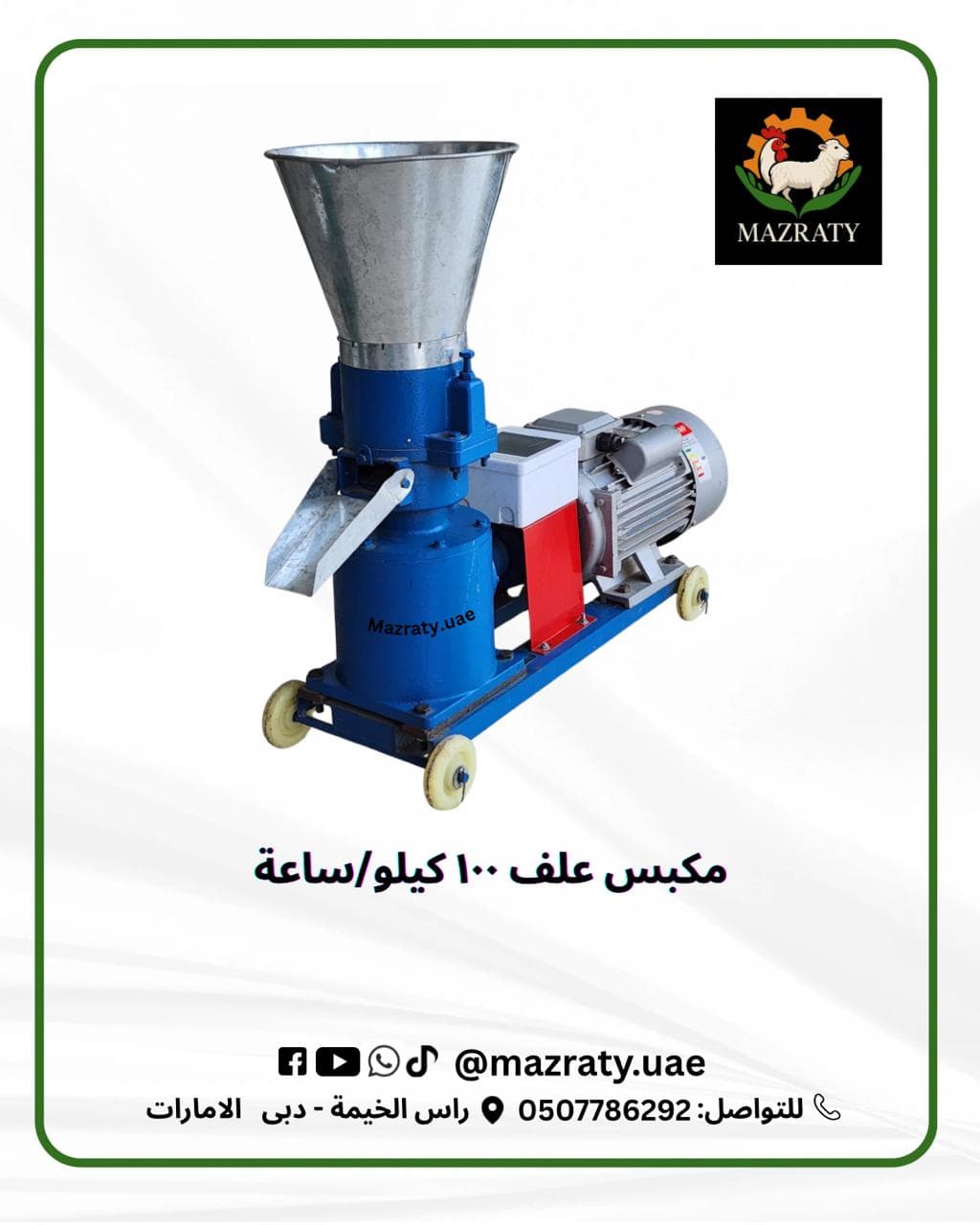
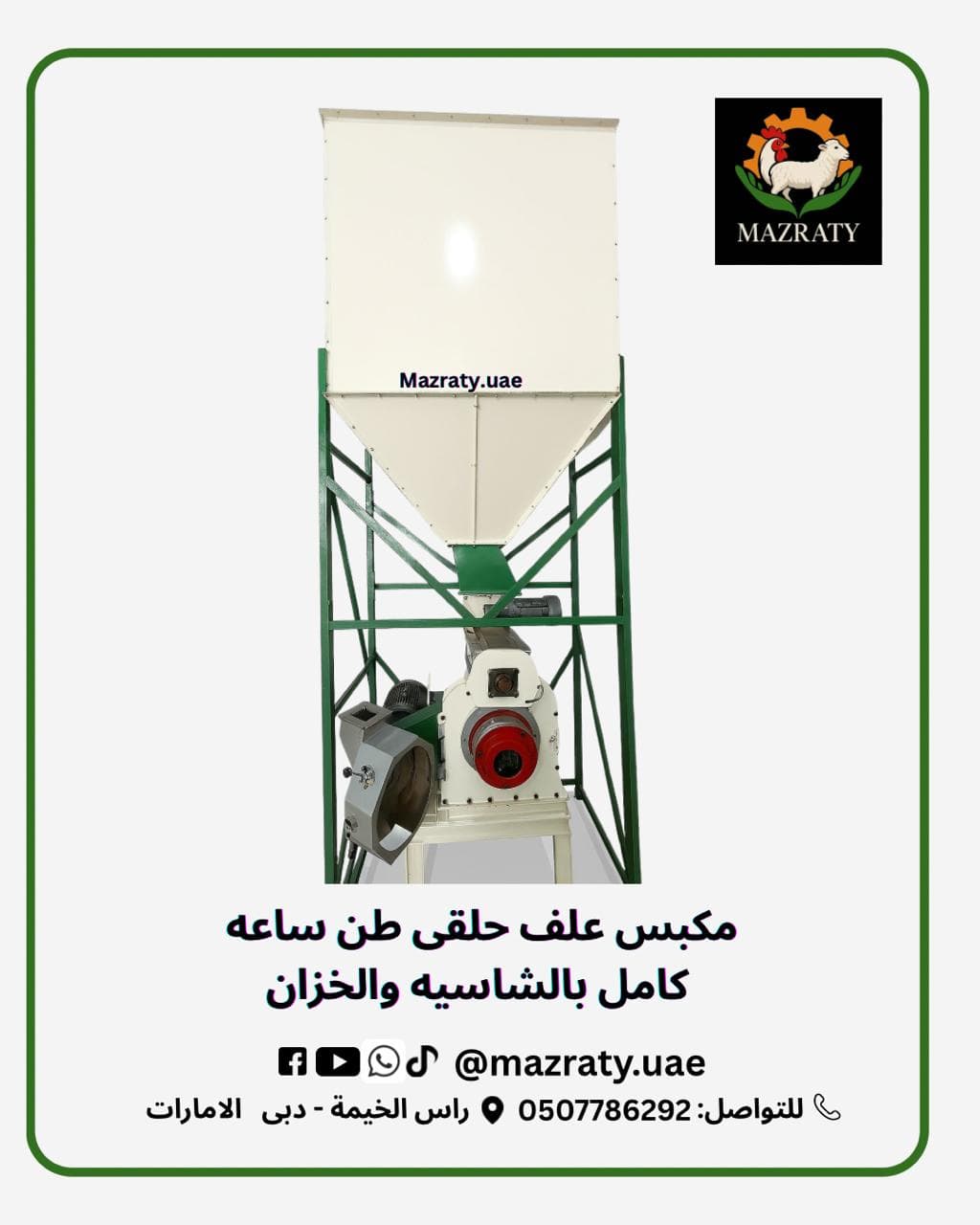
Complete guide to industrial ring die pellet mills in UAE — 1-10T/h capacity, PDI standards, 5-10% FCR improvement and ROI. Contact Mazraty for expert support.
At Mazraty, based in Ras Al Khaimah with over 20 years of experience supplying, installing, and maintaining farm equipment across the UAE, we help farm owners make this decision with full technical transparency. Contact us now on WhatsApp +971 50 535 3412 for a free consultation and a tailored quotation for your commercial pellet mill requirements.
Ring Die vs Flat Die: Understanding the Fundamental Differences
Both ring die and flat die pellet mills compress feed ingredients into cylindrical pellets, but the similarities largely end there. Understanding why ring die technology dominates commercial feed production worldwide helps explain why the investment premium is fully justified for any operation above a certain scale.
Mechanical Principle
In a flat die mill, one or more rollers press against a horizontal perforated disc. The feed mixture is forced through the die holes from above. This design works adequately for small batches but has inherent limitations: uneven pressure distribution across the die surface, heat build-up from friction, and significant mechanical stress at higher throughput rates.
The ring die design inverts this relationship. A cylindrical die ring rotates around a horizontal axis while fixed rollers inside the ring press the feed mixture outward through the die holes. The physics of this arrangement allow for much more even pressure distribution, better heat management, and far higher sustained throughput without proportional increases in mechanical wear.
Pellet Quality: The PDI Difference
Pellet Durability Index (PDI) measures the percentage of pellets that retain their shape after simulated mechanical stress representing the rigours of transport, storage, and feeding systems. Industry minimum standards call for 95% PDI, but premium ring die installations routinely achieve 97-99%.
- Flat die mills typically deliver PDI in the range of 85-92% — suitable for on-farm use with minimal handling
- Ring die mills deliver PDI of 95-99% — the standard for commercial feed manufacturing and sale
Every percentage point below the 95% threshold represents feed that crumbles into dust and fines before reaching the feeding trough. Poultry selectively refuse these fines, creating waste that costs money without delivering any nutritional return.
Production Capacity
The scale gap between the two technologies is significant:
- Flat die mills: 50 - 500 kg per hour
- Small ring die mills: 1 - 2 tonnes per hour
- Mid-range ring die mills: 3 - 6 tonnes per hour
- Large ring die mills: 7 - 10 tonnes per hour and above
The Steam Conditioner: The Heart of Quality Pelleting
Ask any experienced feed mill operator what single component most affects pellet quality, and the answer is almost always the steam conditioner. This unit, positioned between the mixer and the pellet mill, introduces controlled steam into the feed mixture before it enters the die — and its impact on both product quality and equipment longevity is substantial.
How Steam Conditioning Works
Steam at temperatures between 70 and 90 degrees Celsius is injected into the conditioning chamber, where it mixes with the feed for 20 to 30 seconds before the mixture enters the die. This brief but critical exposure achieves three important effects:
- Starch gelatinisation: Heat and moisture activate the starch molecules in cereal grains, converting them from granular form into a natural binder that holds the pellet together from the inside. This reduces or eliminates the need for synthetic binders and directly improves PDI.
- Reduced die friction: A properly conditioned, slightly moist mixture flows through the die channels with significantly less resistance than dry material. This reduces energy consumption per tonne of output and dramatically extends die service life — by 20 to 40% in typical applications.
- Improved digestibility: Moderate heat denatures the trypsin inhibitors naturally present in soybean meal, which would otherwise reduce protein absorption in poultry. Research consistently shows 3-5% improvement in protein utilisation from properly conditioned feed versus unconditioned.
The key is precise temperature control. Excessive heat above 90-95 degrees damages heat-sensitive vitamins, particularly Vitamins A, D, E, and K. Quality conditioning systems include temperature sensors and steam flow controls to keep the mixture within the optimal window. Speak with Mazraty's technical team on +971 50 535 3412 to discuss steam conditioner specifications for your feed formulations.
Die Specifications: Choosing the Right Hole Size and L/D Ratio
The die is the most critical consumable in any pellet mill operation. Selecting the wrong die specification means producing pellets that are either too fragile (causing waste) or too hard for the target animal to eat comfortably. Two parameters define die specification:
Hole Diameter
Hole diameter selection is driven by the animal species and life stage:
- 1.5 - 2 mm: Day-old chicks in starter phase, quail chicks, small ornamental birds
- 2.5 - 3 mm: Broiler grower phase (weeks 2-4), layer pullets, growing quail
- 3 - 4 mm: Finishing broilers, laying hens, ducks, small turkeys
- 4 - 6 mm: Rabbits, sheep, goats, pigeons
- 6 - 10 mm: Cattle, horses, camels, large livestock
The L/D Ratio (Effective Length to Diameter)
This ratio, calculated by dividing the effective channel length in the die by the hole diameter, determines the compression pressure applied to the feed mixture. Higher L/D means greater compression and harder, denser pellets:
- L/D 8-10: Soft pellets for young chicks, shrimp feed, warm-water fish
- L/D 10-12: General poultry standard — by far the most common specification for UAE farms
- L/D 12-15: High-density pellets for ruminants, large livestock, and high-fibre formulations
An L/D ratio that is too high for the formulation will cause the die to choke — material builds up faster than it can exit, forcing a machine stop and die cleaning. An L/D ratio that is too low produces pellets that break apart immediately. Neither the feed miller nor the farmer can afford frequent die chokes or crumbling pellets in a commercial operation.
Die Material Selection for UAE Conditions
Standard carbon steel dies will corrode rapidly in UAE coastal environments where salt-laden air attacks metal surfaces. Specify dies manufactured from stainless steel grade X46Cr13 or through-hardened D2 tool steel. The higher initial cost is repaid many times over through extended service life.
Understanding PDI and Why It Matters Financially
Pellet Durability Index is not just a technical specification to impress quality auditors — it has a direct and calculable impact on feed cost per kilogram of meat or eggs produced.
The Real Cost of Low PDI
Consider a broiler farm in Ras Al Khaimah running 50,000 birds per cycle with a monthly feed consumption of 100 tonnes. At a delivered feed cost of AED 2,000 per tonne:
- At PDI 88% (flat die quality): approximately 12% of feed becomes fines. Of that, poultry refuse and waste roughly half — effective waste rate of 6% of total feed cost.
- Monthly waste: 6% × AED 200,000 = AED 12,000
- Annual waste: AED 144,000 in feed that was purchased, processed, and never converted to animal product
At PDI 97% (ring die standard), fines generation drops to under 3%, and birds consume the vast majority of fine particles that do form. Effective waste falls below 1.5% — a saving of over AED 100,000 per year on this farm size alone, purely from pellet durability improvement.
FCR Improvement and ROI Calculation
Feed Conversion Ratio (FCR) — the kilograms of feed required to produce one kilogram of live weight gain — is the single most important productivity metric in poultry farming. Industry average FCR for modern broiler breeds is 1.7 to 1.9 kg feed per kg liveweight under good management conditions.
How Ring Die Pelleting Improves FCR
Multiple controlled studies and commercial farm comparisons confirm that switching from mash or low-quality pelleted feed to high-PDI ring die pellets improves FCR by 5 to 10%. The mechanisms are well understood:
- Uniform pellet size prevents selective feeding — birds cannot sort out preferred ingredients and avoid others, ensuring balanced nutrient intake per mouthful
- Steam gelatinisation increases starch digestibility from approximately 75-80% in raw grain to 88-93% in conditioned pellets
- Protease inhibitor denaturation increases protein absorption efficiency, reducing the quantity of protein required to achieve target growth rates
- Lower dust levels in feed reduce respiratory irritation, improving overall flock health and feed intake capacity
ROI Calculation for a UAE Commercial Farm
Using conservative UAE market figures for a farm investing in a 2-tonne per hour ring die installation:
- Monthly feed consumption: 120 tonnes
- Feed cost: AED 240,000 per month
- FCR improvement of 7%: saving AED 16,800 per month
- Annual saving: AED 201,600
- Complete ring die installation (mill + conditioner + cooler + installation): AED 130,000 - 180,000
- Simple payback period: 8 to 11 months
This calculation excludes additional savings from feed waste reduction (PDI improvement), reduced purchasing price volatility by producing your own feed, and the premium achievable if selling surplus pelleted feed to neighbouring farms. Contact Mazraty on WhatsApp +971 50 535 3412 for a personalised ROI analysis based on your farm's actual feed volumes and current costs.
Selecting the Right Capacity: 1T/h to 10T/h
One of the most common mistakes in feed mill investment is oversizing the equipment. A mill operating at 30-40% of rated capacity runs inefficiently, consumes more energy per tonne of output, and accelerates mechanical wear on dies and rollers. Equally, undersizing means unplanned second shifts or unsatisfied internal demand.
Capacity Guidelines by Farm Size
- 1-2 tonnes per hour: Poultry farms of 10,000-30,000 birds, or mixed livestock farms. Also suitable as a starting point for operations planning to scale feed production over time.
- 3-5 tonnes per hour: Poultry operations from 30,000 to 100,000 birds, farms supplying feed to neighbouring operations, or small commercial feed companies. The most common range among UAE commercial farms.
- 6-10 tonnes per hour: Standalone commercial feed factories, large integrated poultry companies, and agricultural industrial complexes.
Actual vs Rated Capacity
Always calculate operational capacity at 70-80% of the manufacturer's rated figure. Factors that reduce effective output include high-moisture raw materials, formulations with high fat content, small die hole sizes (below 3 mm), and high ambient temperatures affecting the cooling section. A mill rated at 3 tonnes per hour may deliver 2.1-2.4 tonnes per hour on your specific formulation under UAE summer conditions.
UAE-Specific Considerations for Pellet Mill Operation
The UAE environment imposes specific demands on pellet mill systems that go beyond standard installation guidelines designed for temperate climates.
Cooling System Requirements
Pellets exit the die at 70-90 degrees Celsius. Before storage or bagging, they must be cooled to no more than ambient temperature plus 5 degrees Celsius — otherwise moisture condenses on pellet surfaces during storage, promoting mould growth. In July and August when ambient temperatures exceed 45 degrees Celsius in some UAE inland locations, this means cooling to 50 degrees — still hot enough to accelerate spoilage. A properly sized counter-flow cooler with adequate airflow is non-negotiable, not an optional add-on.
Dust and Corrosion Management
Fine desert dust penetrates equipment enclosures and contaminates lubricating grease in bearings, dramatically accelerating wear. The coastal salinity in Ras Al Khaimah and the northern emirates attacks exposed metal surfaces. Recommended responses:
- Increase bearing inspection and regreasing frequency to every 500 operating hours instead of the standard 1,000 hours for temperate climates
- Specify sealed bearings with IP65 or higher rating on all critical rotating components
- Apply corrosion-inhibiting coating to all external steel surfaces annually before summer humidity peaks
- Install dust collection upstream of the conditioner to reduce abrasive load on die surfaces
Storage Best Practices for UAE Summer
Finished pellets in polypropylene bags stored in non-air-conditioned warehouses should not remain in storage for more than 7 days during summer months. For larger volumes, invest in ventilated steel silos or insulated storage structures. The cost of a spoiled batch far exceeds the infrastructure investment.
Operating Costs: What to Expect in Year One
Comprehensive investment planning must account for ongoing operational costs, not just capital expenditure:
- Die replacement: Typical service life of 1,000 to 2,500 operating hours depending on formulation abrasiveness. Replacement cost AED 3,000 to 8,000 depending on die size.
- Roller replacement: Service life 2,000 to 4,000 hours. Replacement cost AED 1,500 to 4,000 per roller set.
- Electricity: A 2-tonne per hour mill motor consumes approximately 45-55 kW. At UAE industrial electricity rates of approximately AED 0.23 per kWh, a standard 8-hour shift costs around AED 90-100 in electricity for the main drive alone.
- Preventive maintenance parts budget: Allocate 5-8% of the initial equipment cost annually for bearings, seals, cooling fans, and minor hardware.
- Raw material quality testing: Moisture, protein, and fat content testing for incoming materials. Budget AED 1,500-3,000 per month for a basic in-house testing kit or third-party laboratory service.
Mazraty: Your Partner for Industrial Pellet Mill Supply and Installation in the UAE
For over 20 years, Mazraty has provided UAE farms with reliable agricultural equipment backed by genuine technical expertise and after-sales support. Our approach to pellet mill projects goes well beyond equipment delivery:
- Technical consultation: we assess your feed formulations, production volumes, and existing infrastructure before recommending any equipment
- Complete line supply: mill, steam conditioner, cooler, crumbler, and screening equipment sourced and matched to work together
- Professional installation with performance verification and PDI testing before project handover
- Local spare parts inventory for high-wear items — no waiting weeks for international shipping during critical production periods
- Technician training for your team on correct die management, lubrication schedules, and troubleshooting
- Free delivery across all UAE emirates
Whether you are building a new feed production facility from the ground up or upgrading an existing flat die operation to ring die technology, our team brings the practical knowledge to ensure your investment delivers the promised returns. Call or WhatsApp +971 50 535 3412 now to schedule a free site visit and receive a detailed feasibility study for your feed production project.
Reviewed planning sources
These references support operating and welfare principles. Final design and health programs remain site-, strain-, authority- and veterinarian-specific.
Frequently Asked Questions: Industrial Ring Die Pellet Mills in the UAE
Is the price premium for a ring die mill justified compared to a flat die mill?
For any production volume above approximately 500 kg per day, yes. The combination of higher PDI (meaning less feed waste), lower energy cost per tonne, longer die service life in continuous operation, and the significant FCR improvement typically delivers full payback within 8-14 months on the price difference. For smaller operations producing primarily for on-farm use with minimal handling, a flat die may still be appropriate. Mazraty can help you calculate the break-even point for your specific situation — contact us on +971 50 535 3412.
Do I need a steam conditioner with my ring die mill?
For any commercial production above 1 tonne per hour: yes, a steam conditioner is essential. Without it, you will experience frequent die chokes, higher energy consumption, shorter die life, and PDI values in the 90-93% range at best. The conditioner typically costs 15-25% of the mill price and delivers returns many times that in extended die life alone, before accounting for the feed quality improvement.
How do I select the right die hole diameter for poultry feed?
For starter chicks in the first 10 days: 1.5-2 mm. For broiler grower phase from day 10 to day 28: 2.5-3 mm. For finishing broilers and laying hens: 3-4 mm. If you raise multiple species or age groups, purchasing interchangeable dies for the same mill body allows you to produce the appropriate pellet size for each batch. Mazraty maintains stock of common die specifications for fast delivery.
What is the expected cost of a complete 2-tonne per hour ring die installation in the UAE?
A complete line including the ring die mill, steam conditioner, counter-flow cooler, electrical control panel, and professional installation typically falls between AED 130,000 and AED 190,000 depending on specification and brand. The mill unit itself ranges from AED 75,000 to AED 130,000. Contact Mazraty via WhatsApp +971 50 535 3412 for a precise quotation based on your required specifications and site conditions.
Are spare parts and dies readily available in the UAE, or do they need to be imported?
Mazraty maintains local inventory of high-wear items including dies, rollers, and bearings for the brands we distribute. This means minimal downtime when replacement is needed — no waiting for international freight. For specialised or uncommon spare parts, we coordinate with manufacturers for expedited shipping. We strongly recommend that clients keep one spare die set on hand at all times as operational insurance, particularly during peak production cycles.