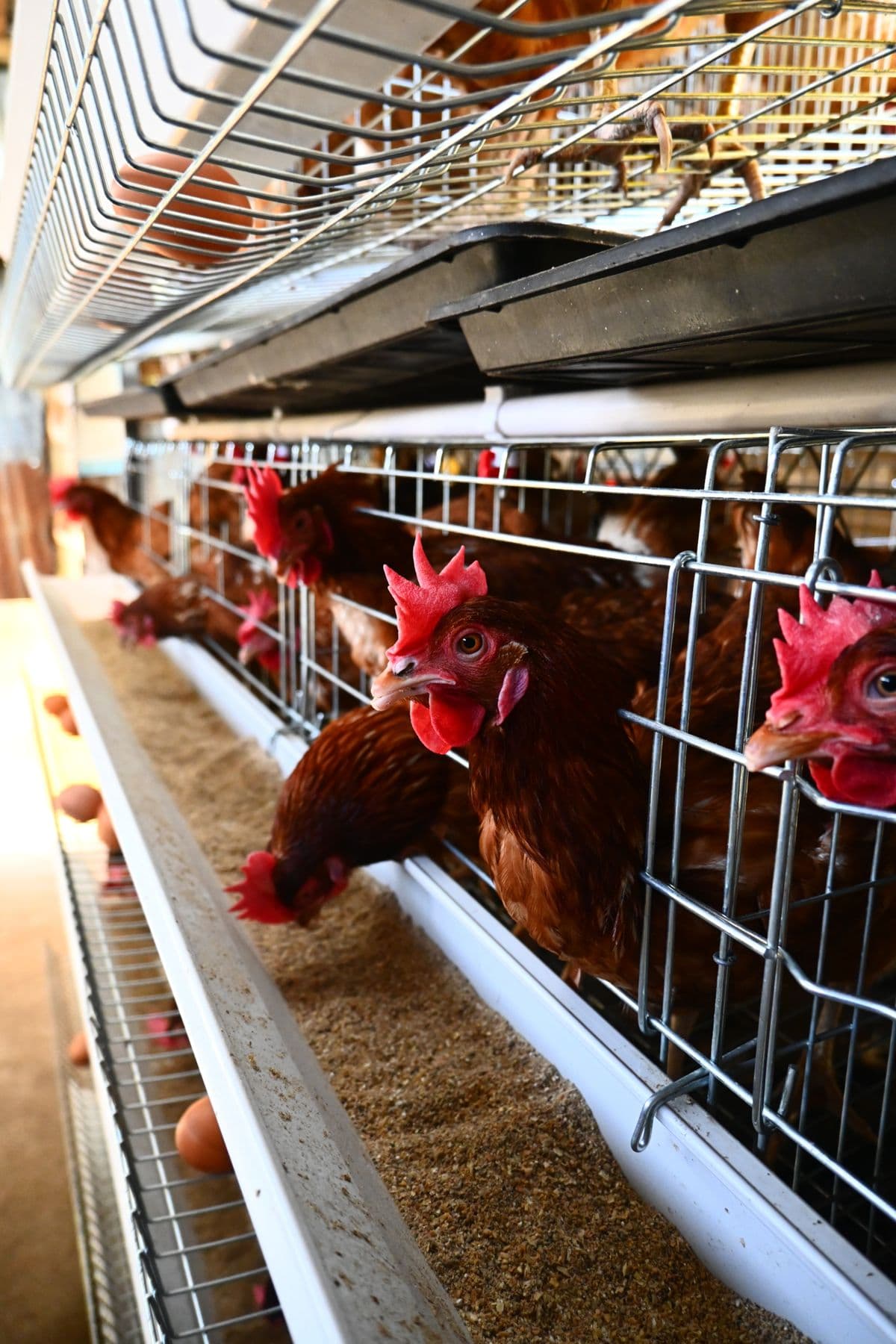
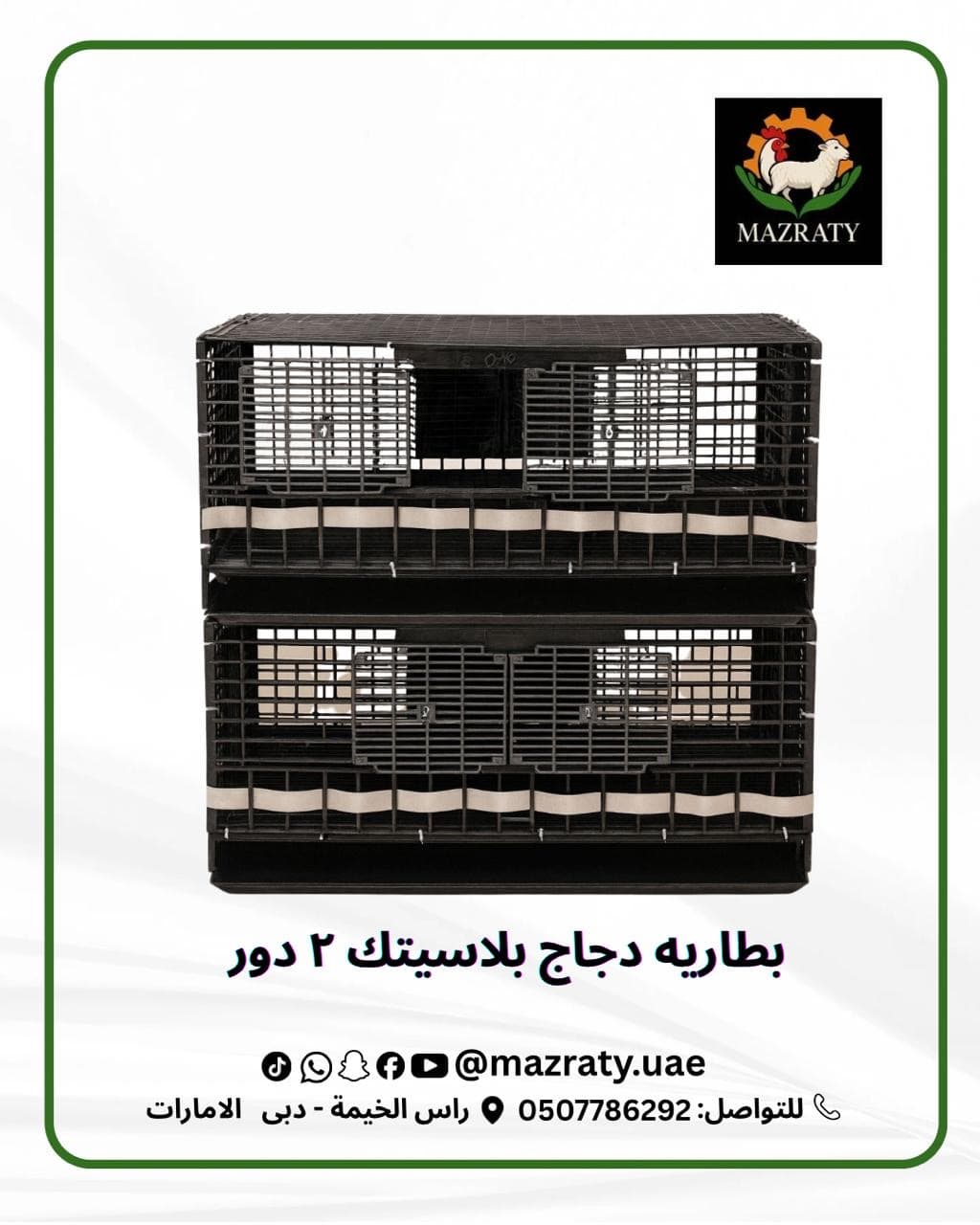
Running a commercial layer operation in the UAE demands infrastructure built for the region's heat, humidity, and 12-month production calendar. Battery cage systems — whether H-frame or A-frame — remain the backbone of profitable egg production from Ras Al Khaimah to Al Ain, delivering hen-housed production rates of 85–90% when correctly specified and maintained. This guide cuts through the noise: you will find a head-to-head comparison of H-frame and A-frame architecture, stocking density regulations, the real difference between automatic and semi-automatic egg collection belts, manure management options, feeding and drinking system choices, UAE-optimised lighting programs, and fully worked ROI models for 5,000-bird and 20,000-bird operations. Whether you are building your first shed or scaling an existing flock, the specifications here will help you avoid the most costly mistakes UAE integrators see every season. Mazraty supplies and installs complete turnkey layer battery systems across the Emirates — contact us on WhatsApp +971 50 535 3412.
H-Frame vs A-Frame: Architecture, Capital Cost, and Manure Management
The single most consequential decision in a layer house design is the cage architecture. Both H-frame and A-frame systems are available through Mazraty, and both are in active use across Ras Al Khaimah, Sharjah, and Abu Dhabi. Understanding the differences before you pour the slab will save you significant capital and operational cost.
A-Frame Cage Architecture
An A-frame system stacks cage tiers in a pyramid configuration — typically two rows angled outward from a central spine — so that manure from upper tiers falls clear of lower tiers onto a sloped sheet or directly to the floor. The visual cross-section resembles the letter A.
- Pros: Lower upfront equipment cost; simpler installation requiring less precise levelling; manure drops freely without belt infrastructure, reducing mechanical failure points; easier visual inspection of birds in lower tiers.
- Cons: Significantly lower bird density per shed footprint (typically 30–40% fewer birds than an equivalent H-frame installation); manure accumulates on the floor beneath the cages and requires regular manual or scraper removal; ammonia levels can build faster in poorly ventilated sheds.
- Capital cost benchmark (UAE 2024–2025): An A-frame system for 5,000 birds costs approximately AED 55,000–75,000 in cage equipment before installation, ventilation, and feeding lines.
- Best fit: Smaller operations (under 8,000 birds), producers prioritising low maintenance complexity, and farms where shed height is limited to under 3.5 metres.
H-Frame Cage Architecture
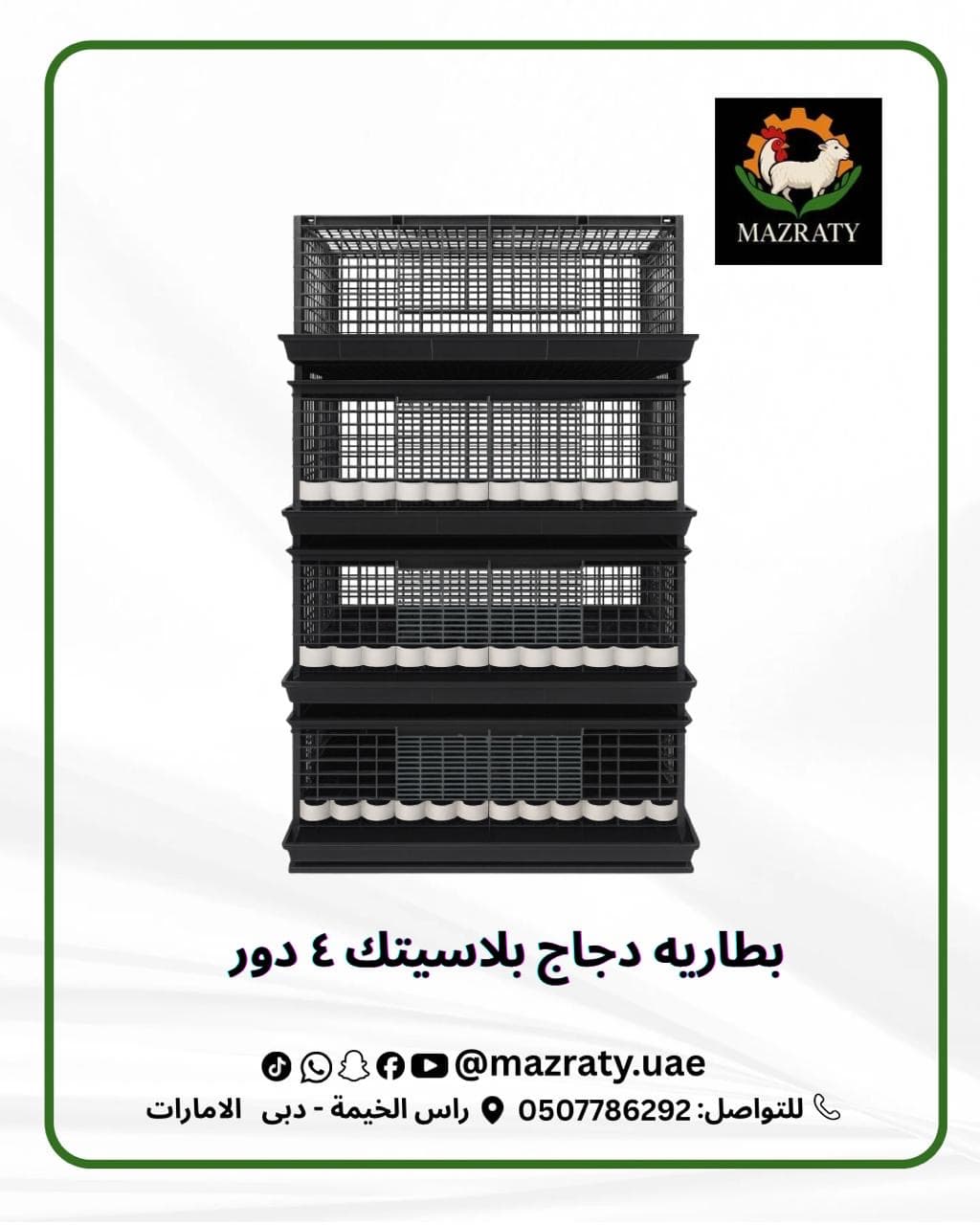
An H-frame system stacks cages vertically in straight columns, with each tier directly above the one below. The cross-section resembles the letter H. Because tiers are stacked vertically, manure from upper tiers would fall onto lower-tier birds without an active removal system, making manure belts a functional requirement rather than an optional upgrade.
- Pros: Maximum bird density per square metre — a 5-tier H-frame installation can accommodate 30–40% more birds than an A-frame in the same shed footprint; uniform bird access to feed and water across all tiers; easier integration of fully automatic egg collection belts; better ammonia management when manure belts are running continuously.
- Cons: Higher capital cost due to mandatory manure belt infrastructure; requires more precise shed height (minimum 4.2 metres for 4-tier, 5.0 metres for 5-tier); belt motors and scraper systems require scheduled maintenance; tier lighting must be engineered carefully to ensure uniform light delivery to all levels.
- Capital cost benchmark (UAE 2024–2025): An H-frame system for 5,000 birds costs approximately AED 85,000–120,000 in cage and belt equipment before installation, ventilation, and feeding lines.
- Best fit: Commercial operations above 8,000 birds, integrators planning future expansion, farms with adequate shed height, and operations targeting the highest possible production per square metre of cooled shed space.
| Parameter | A-Frame | H-Frame |
|---|
| Typical tiers | 2–3 | 3, 4, or 5 |
| Bird density advantage | Baseline | +30–40% |
| Manure system | Floor drop / scraper | Manure belt (mandatory) |
| Minimum shed height | 3.0 m | 4.2 m (4-tier) |
| Equipment cost per bird | Lower | Higher by 25–35% |
| Ammonia risk | Higher without ventilation | Lower with continuous belt |
Stocking Density: Regulatory Standards and UAE Practice
Stocking density is the number that determines whether your cage system is a profitable asset or a welfare and productivity liability. The EU Laying Hens Directive establishes the widely referenced benchmark of 550 cm² of usable cage area per bird as an absolute minimum, with most modern welfare-aware specifications targeting 600–750 cm². In the UAE, the relevant standard is Federal Law No. 19 of 2009 on the use of animals and its executive regulations, which mirror international OIE guidance.
In practical UAE commercial terms, most integrators run 4 to 5 birds per standard cage cell (cage cell dimensions typically 40 cm wide × 50 cm deep, giving 2,000 cm² total, or 400–500 cm² per bird at 4–5 birds). Forward-thinking operations that export or supply premium hotel accounts are moving toward 600 cm² per bird to meet buyer specifications.
Overstocking — cramming 6 birds into a 4-bird cell — produces short-term density savings but measurable production penalties: feed conversion ratios deteriorate from a target of 2.0–2.2 kg feed per kg egg mass to 2.4–2.6; mortality in the flock's second half rises; and feather pecking escalates ammonia exposure. The economics consistently favour correct density.
Mazraty engineers cage layouts to achieve the target density for your specific breed and production system. We supply cage cells in standard widths of 35 cm, 40 cm, and 45 cm to accommodate different flock configurations.
Egg Collection Systems: Automatic vs Semi-Automatic Belts
How eggs travel from the cage to the grading room directly affects breakage rates, labour costs, and the overall hygiene of your operation. Mazraty supplies both automatic and semi-automatic egg collection systems, and the choice has meaningful financial implications.
Automatic Egg Collection Belts
A fully automatic system uses a continuous belt running the length of each cage row. Eggs roll from the sloped cage floor onto the belt, which carries them to a transverse cross-conveyor at the end of the house. The cross-conveyor feeds an elevator that lifts eggs to the grading and packing room. The system runs on a programmable timer — typically three to four collection cycles per day — and requires one operator to monitor the grading room rather than walk the house.
- Breakage rate: Well-maintained automatic systems achieve 0.8–1.2% breakage, compared with 2.0–3.5% in manual collection.
- Labour saving: A 20,000-bird house with automatic collection requires 1–2 collection staff versus 4–6 for manual collection on the same flock.
- Capital addition: Expect to add AED 35,000–55,000 over a semi-automatic system for a 20,000-bird installation.
- UAE consideration: Automatic belts reduce the frequency of human entry into the house, which is significant in UAE summers when workers in a 32 °C controlled-environment house still face physiological heat stress after extended exposure.
Semi-Automatic (Gravity Roll) Egg Collection
A semi-automatic system uses the cage floor slope to roll eggs to the front of the cage, where they rest against a stop wire. Workers walk the row with collection trays, manually lifting eggs from the stop wire. Belts are used only on the transverse conveyor to move collected trays to the packing room.
- Lower capital cost: Saves AED 35,000–55,000 on a 20,000-bird installation.
- Higher labour requirement: Two to three collection rounds per day require dedicated staff time in the house.
- Appropriate for: Operations under 10,000 birds where labour costs are managed and capital efficiency is the priority.
Manure Belt vs Scraper Systems
Managing manure is the hidden cost driver in layer operations. In the UAE's heat, manure left under cages for extended periods generates ammonia rapidly — levels above 25 ppm measurably suppress production and immunity in laying hens. Mazraty installs two proven systems.
Manure belts (standard in H-frame systems) run beneath each tier, carrying fresh droppings to the end of the house for collection. Running belts twice daily keeps under-cage ammonia below 10 ppm, dramatically improving bird respiratory health and production consistency. Belt-collected manure is also drier (55–65% moisture) than floor-scraped manure (70–80% moisture), making it more valuable as a fertiliser sold to UAE date farms and vegetable growers.
Scraper systems (common in A-frame installations and pit-style floor designs) use a mechanical blade to push manure from under the cage rows into a collection channel. They are mechanically simpler than belts but less effective at controlling ammonia in the first 12 hours after defecation. In UAE summer conditions, scraper-cleaned houses need two scraping cycles daily minimum.
Feeding Systems: Trough vs Chain Feeder
Feed accounts for 65–70% of total egg production cost in the UAE, making feeding system efficiency a primary financial lever. Mazraty supplies both trough-based and chain-feeder systems calibrated for layer operations.
Chain feeders run a continuous loop of feed chain along the trough, distributing feed uniformly at programmable intervals. The advantage is consistent feed access across all birds in a row, reducing the dominant-bird feeding advantage seen in static troughs. UAE operators using chain feeders on H-frame systems report feed conversion ratios of 2.0–2.15 kg feed per kg egg mass — the top of the efficiency range.
Trough feeders with auger distribution are lower capital cost and equally effective at the row level, provided the auger delivers feed at a rate that fills the trough before dominant birds have eaten significantly more than subordinate birds. For most UAE layer breeds (Hy-Line Brown, Lohmann Brown, ISA Brown), a 15-second fill time per row is adequate.
Feed trough depth matters: minimum 6 cm depth prevents bill-raking waste, which can add 3–5 g per bird per day in unnecessary feed loss — at AED 1.20/kg feed, that is AED 21,600–36,000 per year in waste on a 20,000-bird flock.
Drinker Systems: Nipple vs Cup Drinkers
Water is the most underrated input in layer nutrition. Hens consuming inadequate water volumes reduce egg production within 24 hours. In the UAE, where water lines can reach 40–45 °C in uninsulated pipework during summer, drinker system design is critical.
Nipple drinkers are the standard in modern Mazraty-supplied systems. 360° nipples with drip cups provide water on demand with minimal spillage. The target flow rate for layers is 60–90 ml/minute at 15–25 kPa pressure. One nipple per 6–8 birds is the recommended ratio; at higher density per nipple, water consumption falls below the 200–250 ml/bird/day required for peak production in UAE temperatures.
Cup drinkers provide open water surface access, which some operators prefer for older flocks or breeds showing nipple-access difficulty. They carry a higher cleaning burden — cups must be flushed daily in UAE temperatures to prevent algae and pathogen growth.
Mazraty recommends insulating water supply lines in all UAE installations and installing a water cooler unit upstream of the house on summer installations. Reducing inlet water temperature from 40 °C to 25 °C has been documented to increase water intake by 15–20% and improve production by 2–3 percentage points during peak summer months.
Lighting Programs for UAE Layer Operations
Egg production in laying hens is photo-stimulated — hens require a minimum of 12–14 hours of light to maintain production, with the commercial target of 16 hours of light per 24-hour cycle producing peak production rates. In the UAE, where natural day length ranges from 12.5 hours (December) to 13.5 hours (June), supplemental lighting is required year-round to maintain 16-hour programs.
Mazraty supplies LED lighting systems specifically programmed for layer house use:
- Intensity: 10–20 lux at bird level (measured at the bottom tier in H-frame installations). Higher intensity does not improve production and increases energy cost.
- Spectrum: Red-spectrum LED (620–750 nm) is most effective for stimulating the hypothalamic-pituitary-gonadal axis. Avoid blue-spectrum dominant lights in layer houses.
- Programme: A standard UAE layer programme uses a 16L:8D cycle with a 30-minute twilight dimming period before lights-off to prevent panic-flush (sudden darkness causing birds to flush off perches simultaneously, breaking eggs and causing injury).
- Tier uniformity: In 4-tier and 5-tier H-frame houses, supplemental strip lights at tier 2 and tier 4 level maintain the ±20% light uniformity standard. Without tier-level lighting, bottom-tier birds may receive only 4–6 lux versus 18–20 lux at top tier, producing measurable production differences across the same row.
Cage Dimensions and Tier Configurations
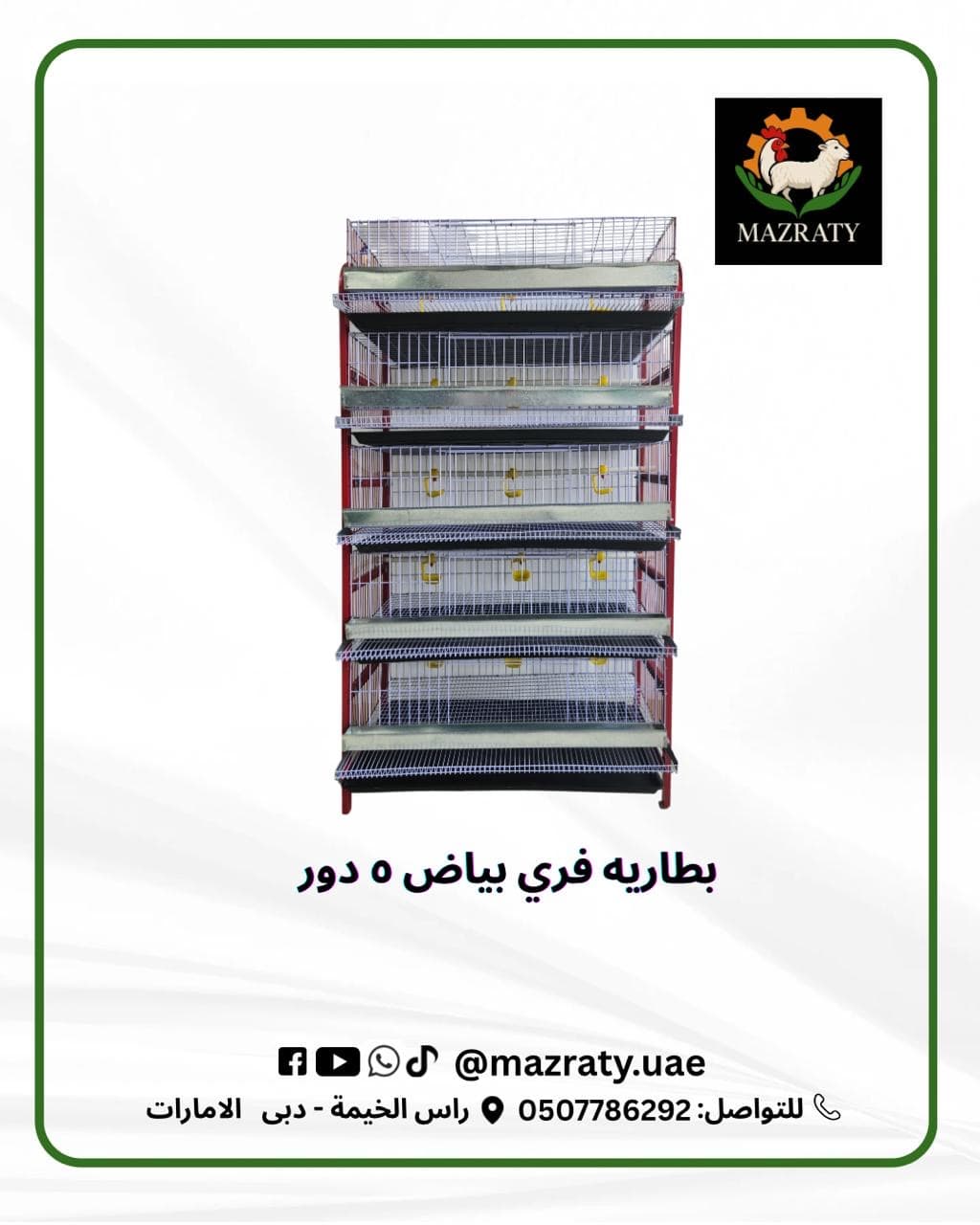
Mazraty supplies H-frame cages in 3-tier, 4-tier, and 5-tier configurations and A-frame cages in 2-tier and 3-tier configurations. The following table summarises key dimensional specifications:
| Configuration | Cage Cell (W×D×H) | Birds/Cell | cm²/Bird | Min Shed Height |
|---|
| H-Frame 3-Tier | 40×50×42 cm | 4 | 500 | 3.5 m |
| H-Frame 4-Tier | 40×50×42 cm | 4–5 | 400–500 | 4.2 m |
| H-Frame 5-Tier | 40×50×42 cm | 4–5 | 400–500 | 5.0 m |
| A-Frame 2-Tier | 40×50×42 cm | 4 | 500 | 2.8 m |
| A-Frame 3-Tier | 40×50×42 cm | 4 | 500 | 3.5 m |
Row length is typically modular in 1.8-metre sections and can be specified to match shed length. A standard UAE layer house of 100 metres × 15 metres running 4-tier H-frame at 5 birds per cell accommodates approximately 22,000–24,000 birds within standard density parameters.
UAE Performance Benchmarks
Understanding what performance is achievable in UAE conditions is essential for realistic financial planning. The following benchmarks are drawn from Mazraty-supplied installations operating under standard UAE conditions (controlled-environment houses, 26–28 °C year-round setpoint, 60–70% relative humidity):
- Hen-housed egg production: 85–90% (850–900 eggs per 1,000 hens per day at peak)
- Peak production age: 26–30 weeks of age (Hy-Line Brown, Lohmann Brown)
- Production cycle duration: 72–80 weeks from first egg
- Feed consumption: 110–120 g/bird/day at peak production
- Water consumption: 220–260 ml/bird/day at 26–28 °C ambient
- Mortality rate: 0.8–1.2% per month in well-managed H-frame systems
- Average egg weight: 60–65 g at peak (Lohmann Brown); 58–63 g (Hy-Line Brown)
- Feed conversion ratio: 2.0–2.2 kg feed per kg egg mass
ROI Calculation: 5,000-Bird vs 20,000-Bird Operations
Return on investment in a UAE layer operation depends on five variables: capital cost, feed cost, egg selling price, mortality rate, and production rate. The following models use current UAE market data.
5,000-Bird H-Frame Operation
- Capital cost (cage system + installation): AED 95,000–130,000
- Pullet cost (point-of-lay, 18 weeks): AED 30–38/bird × 5,000 = AED 150,000–190,000
- Total setup (cages + birds + shed fit-out): AED 400,000–550,000 estimated
- Daily feed cost: 5,000 birds × 115 g × AED 1.20/kg = AED 690/day
- Daily egg revenue: 5,000 birds × 87% production × AED 0.75/egg = AED 3,263/day
- Daily gross margin: AED 3,263 − AED 690 = AED 2,573/day (before labour, utilities, depreciation)
- Annual gross margin: ~AED 939,000
- Simple payback on cage equipment: 4–6 months from first production
20,000-Bird H-Frame Operation
- Capital cost (cage system + installation): AED 320,000–420,000
- Pullet cost: AED 30–38/bird × 20,000 = AED 600,000–760,000
- Total setup: AED 1,600,000–2,100,000 estimated
- Daily feed cost: 20,000 × 115 g × AED 1.20/kg = AED 2,760/day
- Daily egg revenue: 20,000 × 87% × AED 0.75/egg = AED 13,050/day
- Daily gross margin: AED 10,290/day
- Annual gross margin: ~AED 3,756,000
- Economies of scale: Labour, veterinary, and utility costs per bird are 35–45% lower at 20,000 birds than at 5,000 birds, making the 20,000-bird operation disproportionately more profitable per bird.
These figures illustrate why serious UAE egg producers scale to 20,000+ birds as rapidly as capital and shed space allow. The cage equipment payback at 20,000 birds is typically 3–5 months from first egg when using Mazraty's H-frame system with automatic egg collection.
Installation, Commissioning, and After-Sales Support by Mazraty
A battery cage system is only as good as its installation. Mazraty provides end-to-end project management for layer house fit-out in Ras Al Khaimah and across the UAE: site survey and cage layout design, supply of all cage, belt, feeding, and drinking system components, professional installation by our trained technical team, commissioning and operational training for your farm staff, and 12-month warranty on all equipment with ongoing spare parts availability.
We work with farms ranging from 2,000-bird family operations to 100,000-bird commercial integrations, and we have the references to demonstrate consistent performance across both segments. Whether you are evaluating H-frame vs A-frame for the first time or replacing aging equipment in an existing house, our technical team will survey your site and provide a detailed specification with itemised pricing — at no cost and with no obligation.
Ready to build the UAE's most efficient layer operation? Contact Mazraty today on WhatsApp +971 50 535 3412. Our team responds within the business day and can schedule a site visit within 48 hours across the Emirates. Mazraty — the farm equipment partner UAE producers trust.
Reviewed planning sources
These references support operating and welfare principles. Final design and health programs remain site-, strain-, authority- and veterinarian-specific.
Frequently Asked Questions
Should a farm choose an A-frame or H-frame system?
Compare bird count, building height, labour, automation, manure handling and two real layouts before deciding.
Is rated capacity enough for comparison?
No. Review bird space, feed and water access, egg collection, service aisles and welfare requirements.