Water quality is one of the most overlooked factors driving flock and herd performance on UAE farms. With groundwater TDS levels routinely measuring between 2,000 and 8,000 ppm across Ras Al Khaimah, Sharjah, and Abu Dhabi agricultural zones, unfiltered water silently erodes feed conversion ratios, suppresses vaccine efficacy, clogs nipple drinkers, and accelerates respiratory disease pressure in broiler and layer houses. This guide covers the complete water treatment stack — from initial laboratory testing through reverse osmosis sizing, sand and carbon filtration, UV sterilization, and daily chlorine dosing — giving farm managers precise numbers to act on. Every system discussed is available through Mazraty, Ras Al Khaimah's leading farm equipment supplier, with expert advice available on WhatsApp +971 50 535 3412. Protect your animals, protect your margins.
This is not a theoretical problem. Published field data from Gulf poultry operations show a consistent 6–12% depression in broiler daily weight gain when drinking water TDS exceeds 3,000 ppm, and layer farms report a 4–8% reduction in egg production. The economic loss from a 5,000-bird broiler house running on untreated well water at typical UAE market prices (AED 18–22 per kg live weight) easily exceeds AED 15,000 per cycle — far more than the annualised cost of a correctly sized water treatment system.
Mazraty supplies complete water treatment solutions for UAE farms: from basic sediment pre-filters to full reverse osmosis arrays with dosatron medication injection. Everything discussed in this guide is available from our Ras Al Khaimah showroom or delivered farm-ready across the Emirates.
Step 1 — Water Quality Testing: Know Your Baseline
No treatment system can be correctly specified without a laboratory water analysis. A full agricultural water panel for poultry and livestock should include:
- pH — target range 6.0–8.0 for poultry; values above 8.5 indicate carbonate alkalinity and accelerate nipple drinker calcification
- Total Dissolved Solids (TDS) — measured in ppm by conductivity meter; direct correlate of salinity stress
- Total hardness — as CaCO₃ in mg/L; above 250 mg/L causes scale in heat exchangers, nipple valves, and vaccine dilution
- Chloride — values above 250 mg/L suppress feed intake in broilers
- Sodium — above 50 mg/L can interfere with potassium balance
- Sulfate — above 250 mg/L causes diarrhoea in young chicks and calves
- Nitrate — above 25 mg/L (as NO₃-N) causes methaemoglobinaemia in young animals
- Iron and manganese — iron above 0.3 mg/L, manganese above 0.05 mg/L
- Fluoride — chronic exposure above 2 mg/L causes fluorosis in laying hens
- Total coliform and E. coli count — any detectable coliform in drinking water is unacceptable
- Heterotrophic plate count (HPC) — target below 500 CFU/mL at point of use
In the UAE, accredited water testing is available through the Environment Agency Abu Dhabi (EAD), the Ras Al Khaimah Municipality Environmental Health Division, and private laboratories including SGS Gulf and Bureau Veritas. A full agricultural panel costs approximately AED 400–800 and takes 3–5 working days. Repeat testing is recommended every six months and after any change in water source or significant rainfall event that could alter aquifer chemistry.
Once you have your baseline panel, share it with the Mazraty technical team — we will recommend the exact combination of treatment stages your water requires, sized to your daily consumption volume.
Step 2 — Sediment and Multimedia Filtration: Protecting Downstream Equipment
Before any membrane or UV system, suspended solids must be removed. UAE well water frequently carries fine sand, silt, iron floc, and organic debris that will rapidly foul RO membranes and UV quartz sleeves if not pre-treated.
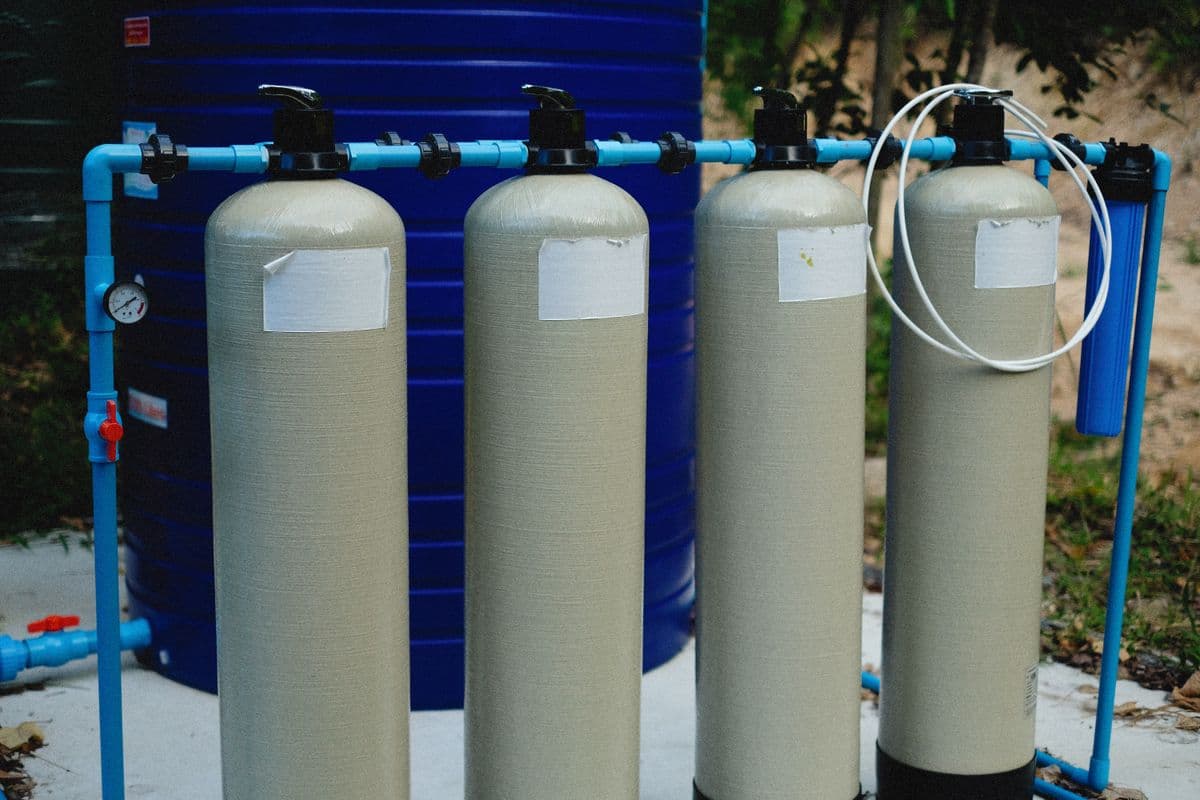
Sand Filtration
A correctly graded silica sand filter with a minimum bed depth of 900 mm, operating at a surface loading rate of 5–8 m/hour, will reduce turbidity from typical UAE well water values of 5–30 NTU down to below 1 NTU. Backwash with clean water at 15–20 m/hour for 10–15 minutes daily. For high-iron well water, a greensand (manganese greensand or Birm) media bed will catalyse iron oxidation and filter the resulting floc simultaneously.
Multimedia Filtration
A three-layer multimedia filter — coarse gravel support, mid-grade sand, fine anthracite — provides better turbidity removal than single-media sand at the same vessel diameter because the graded layers trap particles at different depths. This extends filter run times by 40–60% between backwash cycles, important on farms without automatic controls.
Cartridge Pre-Filters
A final 5-micron and then 1-micron cartridge housing before the RO or UV stage is standard practice. Replace cartridges when differential pressure exceeds 0.5 bar — on UAE well water this may be as often as every 2–4 weeks depending on iron and silt loading.
Mazraty stocks Pentair, Watts, and locally sourced multimedia filter vessels from 10-inch diameter (suitable for farms up to 500 birds or 20 head of cattle) to 48-inch commercial vessels for integrated farm water stations.
Step 3 — Reverse Osmosis: The Core Desalination Stage
For UAE well water with TDS above 1,500 ppm, reverse osmosis (RO) is the only practical technology that simultaneously removes salinity, hardness, nitrate, fluoride, and residual pesticides in a single pass. Understanding RO system sizing is critical to avoid the two most common farm mistakes: undersizing (running out of product water at peak demand) and oversizing (excessive concentrate waste and unnecessary capital cost).
Sizing for Livestock Water Demand
Use the following daily water consumption benchmarks to calculate your minimum RO product flow rate:
| Animal Type | Daily Water Consumption | Heat Stress Multiplier (UAE Summer) |
|---|
| Broiler (35-day cycle) | 180–220 ml/bird/day average | ×1.8 |
| Laying hen | 200–250 ml/bird/day | ×1.6 |
| Turkey (market weight) | 500–700 ml/bird/day | ×1.7 |
| Dairy cow (milk-producing) | 80–120 litres/head/day | ×1.5 |
| Beef cattle (fattening) | 40–70 litres/head/day | ×1.4 |
| Goat / sheep | 3–8 litres/head/day | ×1.5 |
Apply the heat stress multiplier for UAE summer months (May through September). A 10,000-bird broiler farm will require approximately 10,000 × 0.22 × 1.8 = 3,960 litres per day of treated product water in peak summer. At a typical RO system recovery rate of 65–70% (meaning 65–70 litres of product per 100 litres of feed water), the total feed water requirement is approximately 5,700–6,100 litres per day. Size your RO system at 115–120% of peak daily demand to provide a buffer for membrane performance decline as elements age.
Recovery Rates and Concentrate Disposal
UAE brackish water RO systems typically operate at 65–75% recovery on feed water with TDS below 5,000 ppm. Above 5,000 ppm feed TDS, staged RO or batch RO is required to maintain acceptable recovery without membrane scaling. The reject (concentrate) stream from an RO system is a high-TDS brine — at 70% recovery, the concentrate TDS will be approximately 3.3× the feed water TDS. For 4,000 ppm feed water this yields a concentrate of ~13,000 ppm, which cannot be discharged to soil near crops or used for animal watering. Approved disposal methods in the UAE include: connection to a licensed sewer or effluent collection system; evaporation ponds on licenced land; or use for dust suppression on unpaved farm roads away from water bodies. The Ras Al Khaimah Environment Protection Authority (RAKEPA) should be consulted for site-specific guidance.
Membrane Selection and Maintenance
For UAE brackish well water, 4040 or 8040 format thin-film composite (TFC) polyamide membranes rated for feed water up to 10,000 ppm TDS are standard. Flush membranes with low-pressure permeate at system shutdown. Chemical cleaning every 3–6 months with a low-pH citric acid solution (pH 2–3) removes scale; a high-pH sodium hydroxide solution (pH 11–12) removes biological and organic fouling. Membrane lifespan on UAE well water with proper pre-treatment is 3–5 years.
Step 4 — Activated Carbon Filtration: Removing Chlorine and Organic Compounds
If your farm sources any municipal water as a supplement to well water, or if you are chlorinating well water as part of disinfection (see below), activated carbon filtration is essential before that water reaches animals or RO membranes. Free chlorine above 0.1 mg/L rapidly degrades TFC polyamide RO membranes, reducing salt rejection within months. Chlorine also destroys live vaccine cultures when used in drinking water administration.
Granular activated carbon (GAC) beds — typically 8×30 mesh coconut shell or coal-base carbon — remove free chlorine, chloramines, pesticides, herbicides, and taste/odour compounds. An empty bed contact time (EBCT) of at least 10 minutes is required for effective chloramine removal; 5 minutes is adequate for free chlorine alone. Carbon media should be backwashed weekly and replaced every 12–24 months depending on organic load. As a rule of thumb, replace carbon when the carbon filter outlet chlorine reading is consistently above 0.1 mg/L after the bed has been recently regenerated.
Block carbon cartridge filters (10-micron carbon block, then 5-micron carbon block) are suitable as a final polishing stage before a UV sterilizer or vaccine dilution tank on smaller farms.
Step 5 — UV Sterilization: Chemical-Free Pathogen Inactivation
Ultraviolet (UV) sterilization at 254 nm wavelength disrupts the DNA of bacteria, viruses, and protozoa, rendering them unable to reproduce. UV systems produce no disinfection by-products, do not alter water chemistry, and do not interfere with vaccine viruses when water passes through the UV system before reaching the vaccine dosing point.
Dose Calculation
Regulatory guidance for agricultural water disinfection targets a minimum UV dose of 40 mJ/cm² for 4-log (99.99%) inactivation of coliform bacteria and 3-log inactivation of most enteric viruses. To verify that your UV system delivers this dose at your actual flow rate:
- Confirm the system's validated dose at your operating flow rate from the manufacturer's performance data
- Ensure UV transmittance (UVT) of the water is ≥75% at 254 nm — iron, humic acids, and turbidity all reduce UVT and must be removed by pre-filtration before the UV chamber
- For UAE well water with iron above 0.3 mg/L, achieve iron removal first or UV effectiveness is severely compromised
- Replace UV lamps every 9,000–12,000 operating hours (approximately 12–15 months of continuous use) — lamp output degrades even when the lamp remains lit
- Clean quartz sleeves monthly with a 2% citric acid wipe to remove scale deposits that block UV transmission
Mazraty supplies Trojan, Wedeco, and Atlantic UV systems sized from 0.5 m³/hour (small ruminant or hobby farms) to 50 m³/hour (commercial poultry integrations).
Step 6 — Chemical Dosing Systems: Chlorination and pH Adjustment
Even after RO and UV treatment, continuous low-level disinfection residual in the water distribution lines is essential to prevent biofilm regrowth. On large farms with long pipe runs, water temperature in UAE summer can reach 35–40°C inside uninsulated lines, creating ideal conditions for Salmonella, Campylobacter, and Pseudomonas proliferation.
Chlorination
Maintain a free chlorine residual of 0.5–3.0 ppm at the end of the water line (the farthest nipple drinker). This means the chlorine concentration at the header tank or dosing point will need to be higher — typically 3–5 ppm — to compensate for decay along the line. Use sodium hypochlorite solution (5–12% active chlorine) dosed via a peristaltic or diaphragm dosing pump. Chlorine demand of UAE well water varies significantly with organic load and iron content; measure residual at multiple points in the line to establish your farm's specific decay profile.
Important: chlorine reacts with ammonia (from animal waste gassing into the water) to form chloramines, which are less effective disinfectants. Keep water troughs and nipple drinker drip areas clean to reduce ammonia contamination of the water supply.
Acidifier Dosing for pH Control
Target drinking water pH of 6.0–6.8 for poultry. At this pH range, the intestinal environment is less hospitable to enteric pathogens and the bioavailability of many water-soluble vitamins is optimised. UAE water post-RO is often near neutral (pH 6.5–7.5), but hard well water or water from alkaline bore formations can present pH above 8.0. Organic acid blends (citric acid, formic acid, acetic acid — available as proprietary commercial products) dosed via a proportional injector at 0.5–2 mL per litre achieve the target pH range without the safety risks of mineral acids. Verify pH daily with a calibrated pH meter at the drinker end of the line.
Step 7 — Dosatron Proportional Injectors: Medication and Supplement Delivery
Dosatron and similar hydraulically driven proportional injectors allow precise delivery of water-soluble medications, vitamins, electrolytes, organic acids, and probiotics through the drinking water system without electricity. The injector draws a fixed ratio of concentrate per volume of water passing through — common ratios are 1:100, 1:200, and 1:500 — regardless of line pressure fluctuations (operating range typically 0.3–6 bar).
For UAE farms, proportional injectors are particularly valuable for:
- Heat stress electrolyte programmes during summer (sodium bicarbonate, potassium chloride, vitamin C dosing)
- Tylosin, tetracycline, and enrofloxacin antibiotic courses per veterinary prescription
- Live vaccine delivery — critical note: always bypass UV and chlorination systems when delivering live vaccines, and flush lines before and after
- Organic acid acidifier blends for gut health programmes
- Probiotic delivery programmes
Mazraty stocks Dosatron D14MZ2 (1:200 dilution, 14 litres/hour maximum) and D25F2 (1:500 dilution, 25 litres/hour) models, along with compatible bypass manifold kits and mixing tanks.
Step 8 — Water Line Flushing and Biofilm Removal Protocol
Biofilm — a structured community of bacteria encased in an extracellular polysaccharide matrix — forms in nipple drinker lines within days of contamination and provides a persistent reservoir of pathogens that routine chlorination cannot penetrate at safe drinking concentrations. UAE summer temperatures accelerate biofilm development dramatically. A systematic biofilm removal protocol should be conducted at every flock or herd turnover and at minimum every 60 days on continuous production systems.
Hydrogen Peroxide Shock Treatment Protocol
- Remove all animals from the house or isolate water supply from drinkers
- Flush lines at maximum flow for 10 minutes to remove gross deposits
- Fill lines with a 3–5% hydrogen peroxide solution (food-grade 35% H₂O₂ diluted to 3–5% working strength — caution: handle 35% concentrate with full PPE including face shield and chemical-resistant gloves)
- Allow 30–60 minutes contact time with all nipple valves open to fill the full dead volume
- Flush completely with clean water until peroxide test strips read negative
- For persistent biofilm, a secondary treatment with a proprietary quaternary ammonium compound (QAC) cleaner, followed by a second water rinse, can be used between flocks (not while animals are present)
After biofilm treatment, re-establish chlorine residual immediately and verify pH is within target range before returning water to animals.
Hard Water Impacts: Nipple Drinker Clogging and Vaccine Failure
Hard water with calcium carbonate hardness above 300 mg/L as CaCO₃ will deposit scale on nipple valve seats, stainless steel filter screens, and heat exchanger coils within weeks in UAE temperature conditions. A blocked nipple drinker delivering 50% of rated flow means the animals at that station are chronically underwatered — a problem invisible unless staff physically test each nipple with a graduated container every week.
The vaccine efficacy problem is less obvious but equally damaging. Many live viral vaccines (Newcastle disease, Infectious Bronchitis, Gumboro) are highly sensitive to water chemistry. Published data shows that:
- Water pH above 8.0 reduces Newcastle disease LaSota strain viability by >50% within 2 hours
- Chlorine at 1 ppm completely inactivates most live viral vaccines within 30 minutes
- Water hardness above 400 mg/L reduces vaccine virus titre through calcium-protein binding
- Iron above 0.5 mg/L acts as a pro-oxidant that accelerates viral inactivation
The practical solution is to use RO-treated or independently softened water for vaccine dilution, with pH adjusted to 6.5–7.0, free of chlorine and iron, at a temperature below 20°C. Adding skimmed milk powder at 2–3 g per litre of vaccine water as a protein stabiliser is a well-established field practice that doubles vaccine viability duration in the water line.
Mazraty Water System Solutions for UAE Farms
Mazraty is Ras Al Khaimah's leading farm equipment supplier, serving poultry, dairy, and small ruminant producers across the UAE since our establishment. Our water treatment product range covers every stage of the treatment train described in this guide:
- Pre-filtration: multimedia filter vessels, iron removal filter media (greensand, Birm, KDF), sediment cartridge housings in 10-inch and 20-inch formats
- Reverse osmosis systems: 500 LPH to 10,000 LPH brackish water RO systems, pre-assembled on skid frames, with automatic controls, pressure gauges, and TDS monitors
- Activated carbon: GAC vessels and block carbon cartridge housings for chlorine and organic removal
- UV sterilizers: 0.5 to 50 m³/hour validated-dose UV systems with lamp hour counters and sleeve cleaning mechanisms
- Chemical dosing: peristaltic and diaphragm dosing pumps, Dosatron proportional injectors, mixing tanks, and complete chlorination station kits
- Water line accessories: pressure regulators, water meters, solenoid valves, and hydrogen peroxide shock treatment starter kits
- Monitoring equipment: inline TDS monitors, pH probes, ORP (oxidation-reduction potential) controllers for chlorine residual management
Our technical team can review your water laboratory report and recommend a complete treatment system specification within 24 hours. We offer site visit consultations across Ras Al Khaimah, Fujairah, and Sharjah agricultural zones, and our delivery team provides installation support for complete water station setups.
Safe water is not an option — it is the foundation of every productive farm in the UAE. Contact Mazraty today to protect your flock, your herd, and your margins. Reach us on WhatsApp at +971 50 535 3412 or visit our Ras Al Khaimah showroom. Our team is ready to design your farm's complete water treatment solution.
Reviewed planning sources
These references support operating and welfare principles. Final design and health programs remain site-, strain-, authority- and veterinarian-specific.
Frequently Asked Questions
How is a farm water filter selected?
Start with water analysis, peak flow and particle size, then define filtration, sanitation and acceptable pressure loss.
Where should water samples be taken?
Test the source and the end of the furthest drinking line to expose tank, pipe and biofilm problems.