In the UAE summer, poultry drink two to three times more water than in cooler months — yet the very pipes and tanks delivering that water become a hidden danger. Black or dark plastic supply pipes exposed to direct sun in Ras Al Khaimah and across the Emirates routinely reach 50 to 60°C within two hours of the morning flush. Rather than drinking freely, birds reduce voluntary intake to avoid scalding their crops, accelerating the onset of fatal heat stress. The result is a paradox: the hotter the day, the less water birds consume, precisely when they need it most. This guide breaks down the 25°C rule — the science-backed threshold above which voluntary water intake drops sharply — and ranks every practical solution from low-cost pipe shading and insulated foam lagging, through underground burial and morning flushing protocols, all the way to industrial water chiller units. Specific sizing calculations, AED cost ranges, and a real UAE broiler farm case study showing an 8% FCR improvement are included. Mazraty supplies water chillers and insulated water system components across the UAE — WhatsApp +971 50 535 3412.
- 25–34°C water: intake reduction begins, typically 10–20% below optimum. Birds appear to drink but do so in shorter, less frequent sessions.
- 35°C water: intake drops by approximately 50% compared to 18°C baseline. At this level the bird cannot compensate for the water deficit through any behavioral change.
- Above 40°C: water intake may fall to near-zero in sensitive breeds. Chicks are particularly vulnerable — a first drink of 50°C water from a sun-heated header line can cause crop burns and immediate mortality.
The target for UAE summer poultry housing is water delivered at the nipple or cup at 15–20°C. At this range, intake stimulation is maximized, birds cool themselves internally through evaporative heat exchange in the respiratory tract, and the thermal benefit of each litre consumed contributes actively to thermoregulation rather than adding to heat load.
In practice, keeping water at 15–20°C throughout a UAE July afternoon — with ambient temperatures of 42–47°C in Ras Al Khaimah and humidity often exceeding 70% — requires deliberate engineering. It does not happen passively.
The Solar Heat Problem: How Bad Does It Get?
To appreciate the scale of the problem, consider what happens to a standard 1,000-litre polyethylene (PE) header tank mounted on a roof or elevated stand with no shade covering in a UAE summer. At 06:00, the water inside may be 30°C from overnight ambient heating. By 08:30, with direct solar irradiance reaching 600–800 W/m² on a clear summer morning, the tank surface temperature exceeds 60°C. The water temperature inside rises to 45–50°C within two hours. The 32mm black PE supply pipe running along the roof ridge to the shed connection point reaches internal water temperatures of 50–60°C within 20 minutes of the morning sun hitting it.
When the automatic nipple lines open at morning feeding time, the first water entering the drinker lines is not cool residual water from overnight — it is the superheated water sitting in the exposed supply run. In a 1,000 m² broiler shed with a 40-metre supply run, that first flush contains 80–120 litres of near-boiling water delivered directly to nipple drinkers. Chicks and pullets at the near end of the line receive the hottest water first.
The physiological cascade that follows is well-documented:
- Birds refuse nipples or take only micro-sips, reducing cooling intake.
- Panting increases, raising respiratory water loss and accelerating dehydration.
- Feed intake falls (a 1°C rise in core temperature suppresses appetite by 4–5%).
- Heat stress mortality begins in the weakest birds within 2–3 hours if ambient temperature exceeds 38°C.
- FCR (feed conversion ratio) deteriorates for the entire flock even for birds that survive.
Solutions Ranked by Cost and Practicality
1. Shade Covering and Tank Painting (AED 200–800)
The cheapest intervention with the highest immediate impact is simple shading. Paint all exposed polyethylene tanks white using exterior-grade white paint. White surfaces reflect 80–85% of solar radiation versus the 5–10% reflected by black PE — a white 1,000-litre tank exposed to the same UAE summer sun stays 15–20°C cooler than an identical unpainted tank.
Extend shade cloth (80% UV block, green or black) over all exposed supply pipework and over the tank itself if painting is not sufficient. Shade cloth poles can be fabricated from 25mm galvanized pipe for a 10-metre pipe run for under AED 300 in materials. This alone can reduce pipe water temperature from 55°C to 38°C — not ideal, but significantly better than untreated.
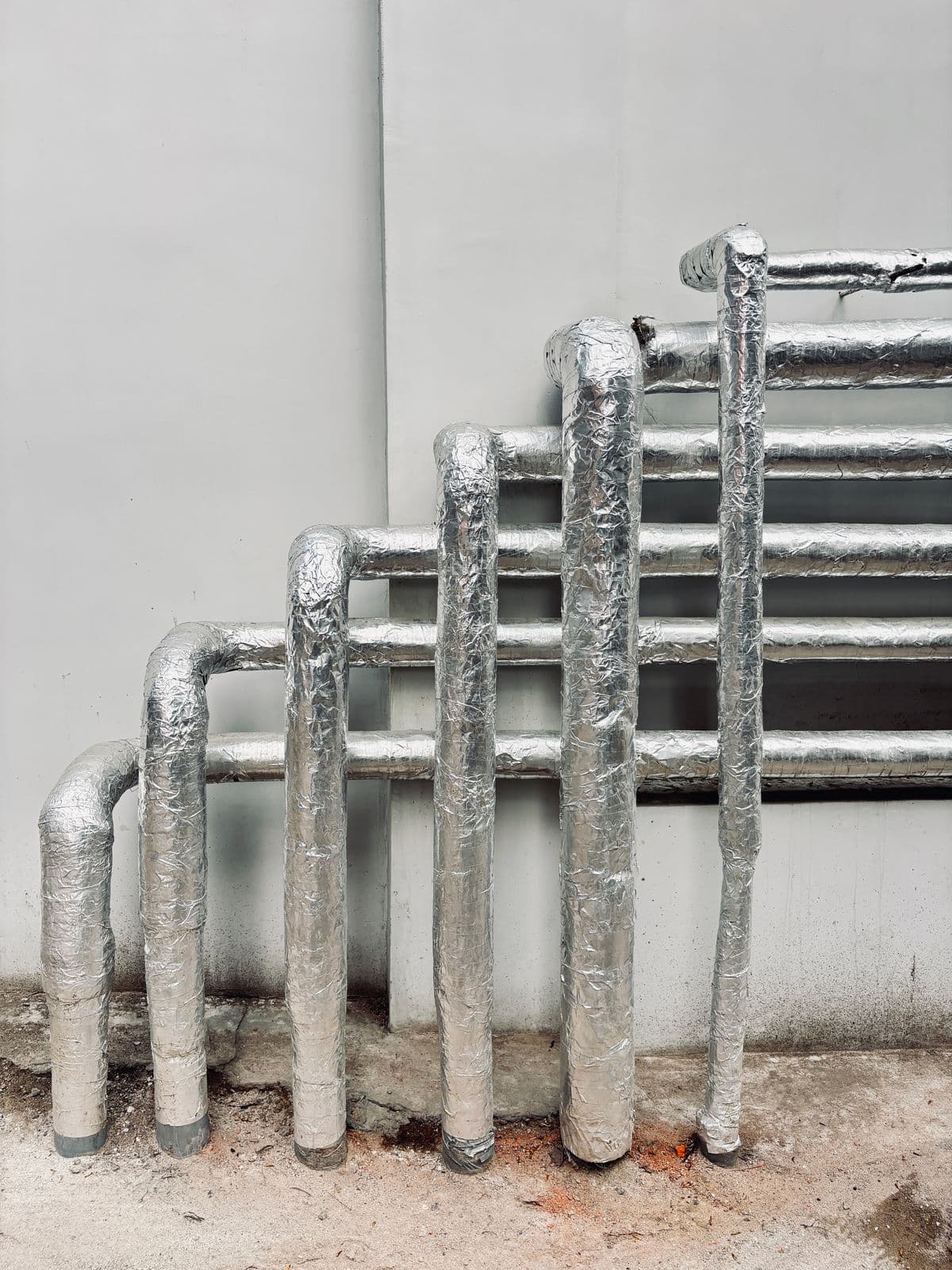
Add insulating foam lagging (closed-cell polyethylene foam, 19mm wall thickness) over the shade-cloth-covered pipes for an additional 8–12°C reduction, bringing a shaded and lagged supply line down to 26–30°C in typical UAE summer conditions. Cost for a 40-metre run: approximately AED 180–260 in foam pipe insulation materials.
2. Underground Pipe Burial (AED 1,500–4,000 per 100 m run)
Burying the water supply pipes eliminates solar exposure entirely. UAE soil temperatures at 60 cm depth remain relatively stable at 28–32°C even in peak summer, compared to surface and near-surface soil temperatures that can exceed 55–65°C. Burial to 60 cm is the minimum effective depth; 90 cm is preferable for new construction where trenching is already planned.
For existing farms retrofitting buried lines, the excavation cost is the main expense. A 100-metre trench at 70 cm depth in packed sandy-loam UAE soil typically costs AED 1,500–2,500 in manual labour, plus AED 400–800 in HDPE pipe and fittings. The pipe installed underground should be HDPE (high-density polyethylene) rated for burial, not standard PVC which becomes brittle in UAE soil conditions over time.
Water arriving via a buried supply line at 30°C rather than 55°C is still warmer than ideal but eliminates the acute crop-burn risk and reduces the load on any chiller unit installed at the header.
3. Insulated Pipe Wrap for Above-Ground Runs (AED 150–400 per 20 m)
Where burial is not practical — for example, the final above-ground run from a buried supply to a shed entry point — self-adhesive closed-cell foam pipe insulation in 19mm wall thickness is the most practical solution. This product is widely available in UAE hardware and irrigation suppliers. Applied over any existing pipe up to 50mm diameter, it reduces peak solar-gain temperature by 8–12°C on a 40–50°C ambient day. It must be covered with UV-resistant tape or aluminum foil tape to prevent the foam itself from degrading in UAE UV conditions; bare foam lasts only one season under direct UAE sun before it crumbles.
4. Morning Flushing Protocol (AED 0 — labour only)
Before birds are allowed access to drinker lines each morning — typically at first light, 05:30–06:00 in UAE summer — flush the first 5 litres of hot water per 20-metre line section through the end drain caps. This removes the water that has been sitting in exposed pipe overnight and through the early-morning solar heating period. On a 500-bird broiler shed with a 40-metre main line and 4 lateral lines, the total flush volume is 8–12 litres — negligible water waste relative to the mortality risk avoided.
This protocol costs nothing beyond worker time (5 minutes per shed) and should be implemented on every UAE poultry farm as a minimum practice regardless of what other cooling measures are in place. Log flush water temperature with a simple thermometer — if the flush water temperature is above 40°C, additional insulation or chilling is required.
5. Industrial Water Chiller Units (AED 3,000–25,000)
For serious UAE broiler or layer operations — farms above 5,000 birds, or any farm where summer mortality and FCR losses exceed AED 15,000 per flock — an industrial refrigeration water chiller is the definitive solution. These units cool the entire farm water supply to 12–18°C before it enters the header system, eliminating the temperature problem at the source.
How they work: A refrigeration circuit (compressor, condenser, expansion valve, evaporator) transfers heat from the farm water supply into refrigerant gas, which is then rejected to the ambient air via a condenser fan unit. Farm water circulates through the evaporator heat exchanger and exits at the setpoint temperature (typically 12–15°C).
Sizing calculation:
| Parameter | Formula / Value |
|---|
| Daily water demand (broilers, UAE summer) | Bird count × 0.35–0.45 L/bird/day |
| Peak hourly demand | Daily demand ÷ 10 (birds drink mainly 06:00–16:00) |
| Temperature drop required | Incoming temp (°C) − target temp (12–15°C) |
| BTU/hour required | L/hour × 4.19 kJ/L·°C × ΔT × 0.948 |
| Chiller tons required | BTU/hour ÷ 12,000 |
Example: A 10,000-bird broiler farm in Ras Al Khaimah consumes approximately 3,800 litres per day in July. Peak hourly demand: 380 L/hour. Incoming water temperature (from shaded header after underground supply): 32°C. Target: 14°C. ΔT = 18°C. BTU/hour = 380 × 4.19 × 18 × 0.948 = 27,190 BTU/hour. Chiller required: approximately 2.3 tons. A 3-ton unit (the next standard size) provides comfortable headroom.
Cost ranges (UAE market, 2024–2025):
- 1-ton chiller: AED 3,000–5,500
- 3-ton chiller: AED 7,000–12,000
- 5-ton chiller: AED 12,000–18,000
- 10-ton chiller: AED 20,000–28,000
ROI calculation: On a 10,000-bird flock with average live weight 2.2 kg and farm-gate price AED 14/kg, a 2% reduction in summer mortality (200 birds) saves AED 6,160 per flock cycle. An FCR improvement of 0.08 points (achievable with 12°C vs 45°C water) saves approximately AED 4,400 in feed cost per cycle. Combined: AED 10,560 per 45-day cycle, or AED 84,480 per year on 8 cycles. A AED 12,000 chiller investment pays back in under 2 months of UAE summer production.
6. Ice Injection — Emergency Protocol (AED 50–150 per event)
When a chiller unit fails during peak summer — which does happen, particularly during power fluctuation events — ice block injection into the header tank is the emergency response. The calculation: 50 kg of ice added to a 1,000-litre tank drops the water temperature by approximately 5°C (accounting for heat gain from the tank walls and ambient air). Ice blocks are available from UAE ice suppliers in 25 kg and 50 kg blocks at AED 15–30 per 50 kg block.
Ice should be added in mesh bags suspended inside the tank rather than dropped loose, to allow easy removal once melted and to prevent tank contamination. This is not a substitute for a functioning chiller — ice melts within 45–90 minutes in a UAE summer ambient environment — but it buys critical time to prevent acute mortality while the chiller is being repaired.
Header Tank Insulation: The Overlooked Factor
The header tank is the single largest thermal mass in the water supply system and deserves specific engineering attention. Standard polyethylene tanks absorb solar radiation and have minimal insulation value. The upgrade options, in order of effectiveness:
- Polystyrene-lined fibreglass tanks: purpose-built insulated tanks with 50mm polystyrene core between fibreglass inner and outer shells. These maintain water temperature within 3–5°C of fill temperature for 4–6 hours in UAE summer ambient. Cost premium over standard PE: 40–60%, but the thermal benefit is substantial. Available in 500L, 1,000L, and 2,000L capacities.
- Relocating tanks indoors: Moving the header tank inside the poultry shed (or into a shaded enclosed store adjacent to the shed) removes it from direct solar exposure entirely. The shed interior, even without evaporative cooling, remains 8–15°C cooler than outdoor ambient due to roof insulation and ventilation air movement.
- Retrofitting insulation boards: Gluing 50mm extruded polystyrene (XPS) insulation boards to existing PE tank exterior surfaces and covering with a UV-reflective foil wrap reduces solar heat gain by 60–70% at a cost of AED 200–400 per tank.
Nipple Drinker Line Flushing and Scale Management
Nipple drinkers in UAE summer conditions face a compounding problem: high water temperature accelerates mineral scale deposition inside the nipple valve mechanism. UAE water has high hardness (150–400 mg/L as CaCO₃ in RAK supply areas), and when warm water sits in a line, evaporation at the nipple tip concentrates minerals and causes the ball valve inside to stick — resulting in either constant drip (wasted water, wet litter) or complete blockage (bird cannot drink).
The summer maintenance protocol for nipple lines:
- Flush all lines 3× per day — morning (before bird access), midday (12:00–13:00), and late afternoon (17:00). Each flush runs water through the drain end of the line for 30 seconds to clear settled sediment and warm water pockets.
- Weekly citric acid flush: Dissolve 50g of food-grade citric acid per 10 litres of water. Run through lines and hold for 30 minutes. Flush clear with clean water. This dissolves calcium carbonate scale that daily flushing does not remove and keeps nipple valves operating correctly.
- Monthly nipple inspection: Manually test 10% of nipples per line section by pressing the actuator pin. Any nipple that does not release water freely within 2 seconds should be replaced. In UAE summer, nipple failure rates of 3–5% per month are normal; maintain a stock of replacement nipples.
Electrolyte Supplementation During Heat Events
Even with optimally cooled water, birds in UAE summer heat (ambient above 38°C) lose electrolytes rapidly through panting. Panting expels CO₂, causing respiratory alkalosis, and simultaneously losses sodium, potassium, and chloride through mucous secretion. Electrolyte supplementation via the drinking water (not feed — feed intake is depressed during heat stress) is the corrective measure.
Recommended electrolyte addition during heat events (ambient above 38°C, lasting more than 4 hours):
- Sodium: 200 mg/L
- Potassium: 400 mg/L
- Bicarbonate (sodium bicarbonate): 300 mg/L
- Vitamin C: 200 mg/L (ascorbic acid — reduces cortisol response to heat stress)
Commercial poultry electrolyte formulations containing these ratios are available through UAE veterinary suppliers. Do not use human electrolyte sachets (incorrect mineral ratios, too high in glucose). Electrolyte water should be prepared fresh daily and not left in lines for more than 24 hours, as sugars in some formulations accelerate bacterial growth in warm water systems.
Water Consumption Monitoring as a Health Diagnostic Tool
Water meters installed on each shed's main supply line provide one of the most valuable early-warning indicators available to UAE poultry farmers. A sudden drop in daily water consumption of more than 15% below the previous 3-day average is a significant event requiring immediate investigation. The diagnostic hierarchy:
- Check water temperature at the nipple — if above 35°C, the drop in consumption is thermal, not pathological. Implement immediate cooling measures (ice injection, line flush) before any other investigation.
- Check nipple line pressure — a pressure drop indicates a supply failure or major nipple blockage.
- Check for wet litter under lines — dripping nipples indicate scale buildup causing valves to stick open, which reads as reduced tank consumption but is actually wasted water.
- If temperature and pressure are normal, consider respiratory disease (Newcastle, IB) which suppresses appetite and thirst simultaneously — contact your veterinarian.
Many UAE farmers attribute sudden consumption drops to disease and begin antibiotic treatment — only to discover the cause was a water temperature of 48°C in the supply line. This wastes treatment cost, contributes to antibiotic resistance, and delays the actual corrective action. Always rule out water temperature as the cause first.
Case Study: Ras Al Khaimah Broiler Farm, July–August
A 20,000-bird broiler farm in the Al Rams area of Ras Al Khaimah upgraded from an unshaded PE tank system with uninsulated above-ground supply pipes to a fully chilled system (3-ton chiller delivering 12°C water to all four sheds) in June of a recent season. The results over the subsequent July–August period, compared to the same months the prior year:
- FCR improvement: 1.92 to 1.77 — an improvement of 0.15 points, exceeding the benchmark 8% improvement predicted by the poultry science literature.
- Heat-stress mortality: Reduced from 3.2% over the two-month period to 0.4% — near-zero, within normal background mortality range.
- Average live weight at 35 days: Increased by 120g per bird due to improved feed intake consistency.
- Chiller investment: AED 22,000 (3-ton unit plus installation and insulated pipe fittings).
- Estimated return per two-month period: AED 38,000 (mortality reduction + FCR savings + weight gain premium).
The farm manager's observation: "The birds were calm. In the old system, you could see them panting and crowding away from the nipples by 10 in the morning. With the chiller, they were still eating and drinking normally at 14:00 in July."
Implementation Priority for UAE Farms
Not every farm needs a chiller on day one. The recommended implementation sequence based on flock size and budget:
| Flock Size | Minimum Intervention | Recommended | Approximate Cost |
|---|
| Under 1,000 birds | White paint + shade + morning flush | Add foam lagging on all supply pipes | AED 300–800 |
| 1,000–5,000 birds | Buried supply + shaded insulated tank | 1-ton chiller at header | AED 2,000–6,000 |
| 5,000–15,000 birds | 3-ton chiller + buried supply lines | Automated flush timers + water meters per shed | AED 10,000–18,000 |
| Above 15,000 birds | 5–10 ton chiller + full insulated ring main | Chilled water + automatic line flush valves + temperature monitoring | AED 20,000–35,000 |
Get the Right Equipment from Mazraty
Mazraty (مزرعتي) is Ras Al Khaimah's leading supplier of farm equipment and poultry systems. We supply industrial water chillers sized for UAE poultry operations, insulated fibreglass header tanks, HDPE burial-grade supply pipe, closed-cell foam pipe insulation with UV-resistant outer wraps, nipple drinker line components, and citric acid scale control products. Our team can help you size a chiller for your specific flock and shed layout, and advise on the most cost-effective combination of interventions for your budget.
Contact us on WhatsApp +971 50 535 3412 for a free consultation on your summer water cooling needs. Keep your birds drinking, keep your birds producing.
Reviewed planning sources
These references support operating and welfare principles. Final design and health programs remain site-, strain-, authority- and veterinarian-specific.
Frequently Asked Questions
Is one water temperature right for every flock?
No. Follow the breed guide and bird age, and measure temperature at the line end rather than only at the tank.
How can drinking water stay cooler?
Shade the tank, insulate exposed lines, prevent stagnation, flush lines and check flow at the furthest point.